


In short ⚡
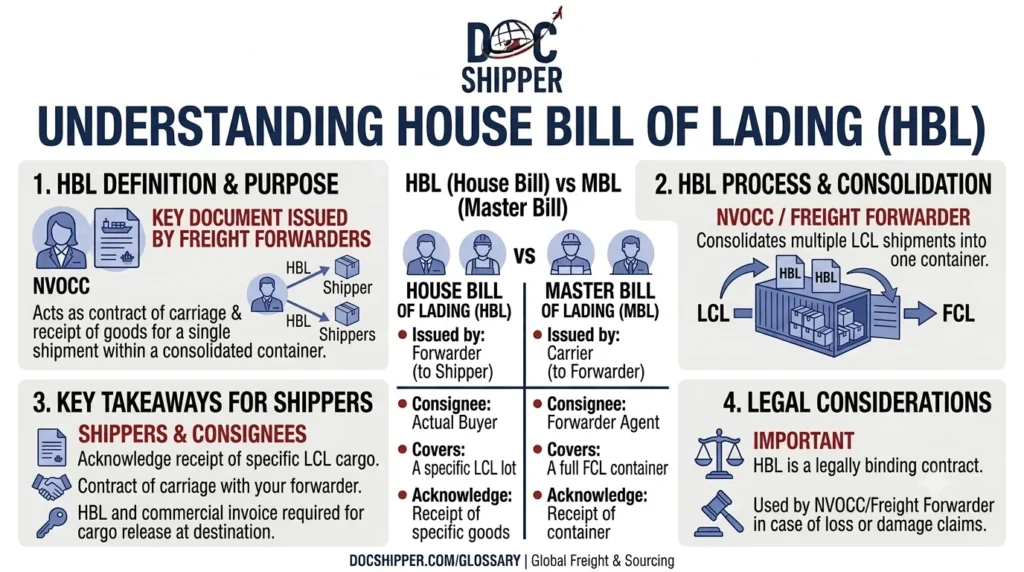
A House Bill of Lading (HBL) is a transport document issued by a freight forwarder to a shipper, confirming receipt of goods for transportation. Unlike the Master Bill of Lading issued by the carrier, the HBL serves as a contract between the forwarder and the cargo owner, enabling consolidated shipments and flexible delivery management in international trade.
Introduction
In international shipping, confusion between the House Bill of Lading and Master Bill of Lading causes frequent customs delays and payment disputes. Shippers working with freight forwarders often receive an HBL without understanding its legal implications or limitations compared to carrier-issued documents.
The House Bill of Lading represents a fundamental instrument in Less than Container Load (LCL) shipments and multimodal transport. It allows freight forwarders to manage multiple small shipments under a single master document, optimizing costs while providing individual tracking and delivery control to each consignee.
Key characteristics of the House Bill of Lading include:
- Contractual relationship: Binds the freight forwarder (not the carrier) to the shipper
- Consolidation function: Enables grouping of multiple shipments under one Master B/L
- Non-negotiable versions: Often issued as straight (consigned) bills for specific receivers
- Limited liability: Subject to forwarder’s standard trading conditions, not carrier liability regimes
- Flexibility advantage: Allows cargo splitting and re-routing without carrier approval
Legal Framework & Operational Expertise
The House Bill of Lading operates within a dual-document system where the freight forwarder acts as both carrier (to the shipper) and shipper (to the ocean carrier). This creates a layered liability structure distinct from direct carrier relationships governed by international conventions like the Hague-Visby Rules or Rotterdam Rules.
Unlike the Master Bill of Lading (MBL) issued by the actual carrier, the HBL does not directly reference the vessel operator. The forwarder assumes responsibility for the entire door-to-door movement, even when subcontracting ocean, air, or inland transport. This arrangement offers commercial advantages but requires careful verification of the forwarder’s financial stability and insurance coverage.
The FIATA Multimodal Transport Bill of Lading (FBL) represents the standardized version used by members of the International Federation of Freight Forwarders Associations. According to FIATA guidelines, this document functions as a negotiable instrument when issued “to order,” enabling banks to finance transactions through letters of credit.
Three critical operational distinctions define HBL usage:
- Title transfer capability: Negotiable HBLs allow ownership transfer through endorsement, while straight HBLs require physical presence of the named consignee
- Release procedures: Cargo delivery requires presentation of the original HBL to the forwarder’s destination agent, not directly to the carrier
- Liability limitations: Forwarders typically incorporate FIATA or national forwarding association conditions limiting per-kilogram compensation below carrier liability caps
At DocShipper, we systematically verify HBL terms against Master B/L conditions to identify liability gaps, particularly regarding delayed delivery claims and cargo damage coverage. Our legal review process ensures clients understand which entity holds ultimate responsibility for each transport segment.
The Incoterms relationship significantly impacts HBL functionality. Under CIF or CFR terms, the seller controls freight arrangements and typically receives the HBL as shipper. Conversely, FOB terms place this control with the buyer, who instructs their forwarder to issue the HBL directly. Misalignment between Incoterms and document flow creates frequent payment disputes in documentary credit transactions.
Practical Examples & Comparative Data
Understanding House Bill of Lading applications requires examining real-world scenarios and quantitative comparisons. The following data-driven examples illustrate when HBLs provide strategic advantages over direct carrier bookings.
Comparative Analysis: HBL vs. MBL Cost Structure
| Shipment Type | Volume (CBM) | Direct MBL Cost | Forwarder HBL Cost | Savings |
|---|---|---|---|---|
| Shanghai-Hamburg LCL | 3.5 CBM | $420 | $280 | 33% reduction |
| Multimodal Asia-US | 8 CBM | $1,150 | $890 | 23% reduction |
| Full Container (FCL) | 28 CBM | $2,800 | $2,950 | 5% premium |
This comparison demonstrates that HBLs deliver maximum value for small-volume shipments (under 10 CBM), where consolidation reduces per-unit costs. Full container loads typically incur premium charges when booked through forwarders rather than directly with carriers.
Use Case: E-commerce Multi-Destination Distribution
A European electronics importer receives 25 pallets from Shenzhen destined for five different warehouses across Germany, France, and Netherlands. The forwarder issues:
- One Master B/L: Covering the entire consolidated shipment from Shenzhen to Rotterdam
- Five House B/Ls: Each specifying final warehouse destinations and individual consignees
This structure enables the forwarder to deconsolidate cargo at Rotterdam’s Container Freight Station without requiring carrier involvement. Each warehouse receives its specific HBL for customs clearance, while the importer pays consolidated ocean freight rates. The arrangement saves approximately $3,200 compared to separate direct shipments, based on 2024 Asia-Europe LCL rates.
Documentary Credit Scenario
A Kenyan coffee exporter ships 12 tons to a US roaster under a Letter of Credit requiring presentation of a “Full Set of Clean Bills of Lading.” The forwarder issues three original HBLs marked “Freight Prepaid” and consigned “To Order of Shipper.”
Key procedural requirements:
- The HBL must reference the Master B/L number for traceability
- All three originals require the forwarder’s authorized signature and company stamp
- The exporter negotiates the HBL set with their bank within the LC’s 21-day presentation period
- The US consignee obtains one endorsed original from their bank to claim cargo from the forwarder’s agent
Banks accept FIATA-member HBLs for approximately 78% of agricultural commodity transactions, according to 2023 ICC Banking Commission data, provided they meet UCP 600 transport document requirements.
Risk Mitigation Example
During the 2021 Suez Canal blockage, a pharmaceutical importer held HBLs for temperature-controlled cargo aboard a delayed vessel. Because the HBL contract was with their forwarder (not the carrier), they successfully negotiated:
- Cargo substitution: Forwarder sourced alternative air freight at partial cost-sharing
- Storage compensation: Forwarder covered extended cold-storage fees during delay
- Delivery guarantee: Forwarder issued a Letter of Indemnity to release cargo without original HBL presentation
This flexibility would have been impossible with a direct carrier MBL, which offers no contractual basis for cargo substitution or expedited release procedures.
Conclusion
The House Bill of Lading serves as the cornerstone of modern freight forwarding operations, enabling cost-effective consolidation and flexible delivery management that direct carrier relationships cannot match. Understanding its legal distinctions from Master Bills prevents costly disputes and clearance delays.
Need expert guidance on HBL documentation or customs compliance? Contact DocShipper today for tailored freight forwarding solutions.
📚 Quiz
Test Your Knowledge: House Bill of Lading
What is the primary contractual relationship established by a House Bill of Lading?
A European importer believes their House Bill of Lading provides the same liability protection as international carrier conventions like the Hague-Visby Rules. Is this assumption correct?
Your company ships 4.5 CBM of electronics from Shanghai to Rotterdam. Based on the cost comparison data, which document type would likely provide better value?
🎯 Your Result
📞 Free Quote in 24hFAQ | House Bill of Lading: Definition, Purpose & Practical Examples
The Master Bill of Lading (MBL) is issued by the ocean carrier to the freight forwarder, covering the entire shipment. The House Bill of Lading (HBL) is issued by the forwarder to the actual shipper or consignee. While the MBL governs the carrier-forwarder relationship, the HBL regulates the forwarder-client contract. In consolidated shipments, one MBL may cover multiple HBLs for different cargo owners traveling in the same container.
Yes, when issued "To Order" or "To Order of Shipper," an HBL functions as a negotiable document of title. This allows transfer of ownership through endorsement, enabling banks to accept it for documentary credit transactions. However, many forwarders issue non-negotiable "straight" HBLs consigned directly to a named party, which cannot be endorsed or traded. Always verify the consignee field to determine negotiability status.
The freight forwarder who issued the HBL bears primary contractual liability to the shipper, regardless of which carrier actually transported the goods. However, most HBLs incorporate standard trading conditions (such as FIATA or BIFA terms) that limit liability to lower amounts than carrier conventions. The forwarder may subsequently pursue claims against the actual carrier under the Master B/L, but this remains separate from their obligations to the shipper.
Standard practice involves issuing three original HBLs, marked as "Original 1 of 3," "Original 2 of 3," and "Original 3 of 3." Presentation of any one original to the destination agent authorizes cargo release, rendering the others void. Some forwarders now offer single-original sets or electronic alternatives to reduce fraud risk. Documentary credit transactions typically require the "full set" of originals for bank negotiation.
Release without original HBL presentation requires a Letter of Indemnity (LOI) or bank guarantee, typically covering 200-300% of cargo value. This practice, while common in time-sensitive situations, exposes the forwarder to significant risk if the original HBL holder later claims the goods. Many forwarders refuse LOI release for high-value shipments or when dealing with unknown parties. Electronic bills of lading systems like Bolero or essDOCS provide secure alternatives to paper document circulation.
A seaway bill (or sea waybill) is a non-negotiable transport document that does not represent title to goods. Unlike an HBL, which requires original presentation for cargo release, a seaway bill allows the named consignee to claim goods by simply proving identity. This eliminates document courier costs and delays but cannot be used for documentary credit transactions or when the shipper needs to retain control over goods until payment. Seaway bills suit shipments between affiliated companies or under open account payment terms.
In multimodal or combined transport, the HBL covers the entire door-to-door movement across different transport modes (sea, air, road, rail). The forwarder assumes responsibility as a carrier for all segments, even when subcontracting actual transport to airlines, shipping lines, or trucking companies. This single-document approach simplifies documentation compared to receiving separate bills for each transport leg. The FIATA Multimodal Transport Bill of Lading (FBL) specifically serves this purpose under standardized international conditions.
Yes, customs authorities worldwide accept HBLs as proof of cargo ownership and transport details for clearance purposes. The HBL must contain complete shipper/consignee information, accurate cargo descriptions, and proper Harmonized System (HS) codes. In some jurisdictions, customs may request the Master B/L number referenced on the HBL to verify container arrival and prevent fraudulent declarations. Electronic HBL copies are increasingly accepted, though original presentation may still be required for high-duty goods or restricted commodities.
Material errors in the HBL (incorrect consignee, wrong cargo description, or inaccurate weight/volume) can cause customs holds, delivery refusal, or documentary credit discrepancies. The issuing forwarder must issue a corrected HBL or amendment letter, often incurring fees of $50-150 per correction. If the error stems from incorrect Master B/L data, the forwarder must request carrier amendment first. Time-sensitive shipments may require express courier of corrected originals to the destination. Prevention through careful verification before HBL issuance remains the most cost-effective approach.
Yes, electronic Bill of Lading surrender increasingly replaces physical document courier, particularly for non-negotiable HBLs. The shipper authorizes surrender via email or through the forwarder's digital platform, allowing instant cargo release at destination without original presentation. This process reduces document transit time from 5-7 days to minutes and eliminates courier costs of $75-150. However, negotiable HBLs used in documentary credits typically still require physical original presentation unless participating in blockchain-based platforms like TradeLens or CargoX that provide legally recognized electronic title transfer.
HBLs do not have statutory expiration dates, but forwarders and destination terminals impose practical time limits. Standard free time for cargo pickup ranges from 5-10 days after arrival notification, after which demurrage and storage charges accrue at rates of $50-200 per day depending on cargo type and location. If cargo remains unclaimed for extended periods (typically 30-90 days), it may be deemed abandoned and subject to auction or disposal according to local regulations. Some jurisdictions allow forwarders to claim liens on cargo for unpaid freight charges.
Cargo insurance under HBL shipments requires careful attention to who holds insurable interest and at which transport stages. The HBL shipper should obtain coverage from origin warehouse to final delivery, as the forwarder's liability insurance typically provides limited coverage (often capped at $2-10 per kilogram). Marine cargo policies must specifically reference "forwarder's liability" coverage to address gaps between HBL and MBL protection. When using Incoterms like CIF where the seller arranges insurance, the policy should name the HBL consignee as loss payee to enable claims filing.
Need Help with
Logistics or Sourcing ?
First, we secure the right products from the right suppliers at the right price by managing the sourcing process from start to finish. Then, we simplify your shipping experience - from pickup to final delivery - ensuring any product, anywhere, is delivered at highly competitive prices.


Fill the Form
Prefer email? Send us your inquiry, and we’ll get back to you as soon as possible.
Contact us




