


In short ⚡
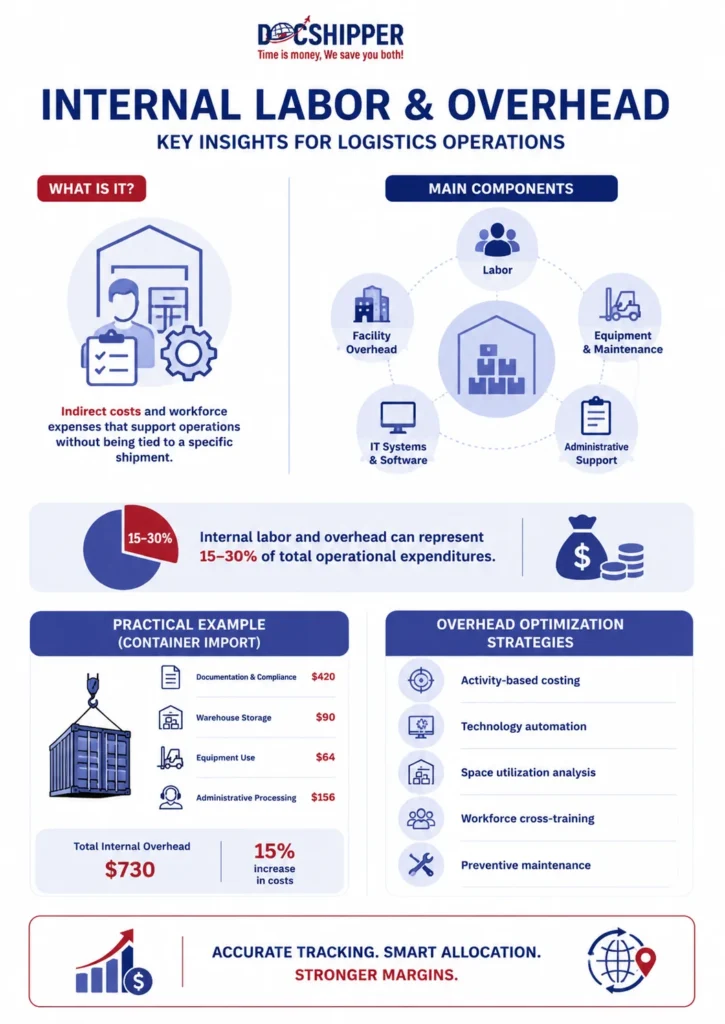
Internal Labor and Overhead refers to the indirect costs and workforce expenses incurred within a company's operations that support production, logistics, or service delivery without being directly attributable to a specific product or shipment. These costs include salaries of administrative staff, facility expenses, equipment depreciation, utilities, and management expenses essential for maintaining operational infrastructure in international trade and logistics.
Introduction
Many importers and exporters struggle to accurately calculate their true landed costs because they overlook internal labor and overhead expenses. These hidden costs can represent 15-30% of total operational expenditures, significantly impacting pricing strategies and profit margins.
In international logistics, understanding internal labor and overhead becomes critical when evaluating supply chain efficiency. Companies that fail to account for these costs often underprice their services or products, leading to unsustainable business models.
Key characteristics of internal labor and overhead in logistics include:
- Indirect allocation: Costs distributed across multiple operations rather than traced to individual shipments
- Fixed and variable components: Mix of constant expenses (rent, salaries) and fluctuating costs (utilities, temporary labor)
- Operational support functions: Warehouse management, customs documentation processing, quality control, and compliance activities
- Infrastructure maintenance: IT systems, material handling equipment, safety programs, and facility upkeep
- Administrative burden: Management oversight, human resources, accounting, legal compliance, and regulatory reporting
In-Depth Analysis & Expertise
Internal labor and overhead encompasses several critical cost categories that logistics operations must monitor systematically. Understanding these components enables accurate cost allocation models and supports strategic decision-making in supply chain management.
The labor component includes direct wages for warehouse staff, supervisors, and administrative personnel who support logistics operations. This extends beyond production workers to encompass documentation specialists, compliance officers, and customer service representatives handling international shipments.
Facility overhead represents space-related expenses such as warehouse rent or mortgage, property taxes, insurance, heating, cooling, and lighting. These costs remain relatively constant regardless of shipment volume, creating challenges for accurate per-unit cost calculations.
Equipment depreciation and maintenance includes forklifts, pallet jacks, conveyor systems, scanning equipment, and warehouse management software. According to U.S. Census Bureau manufacturing data, equipment costs typically represent 8-12% of total overhead in logistics facilities.
Administrative overhead covers management salaries, office supplies, telecommunications, professional services (legal, accounting), and insurance policies. These expenses support the operational infrastructure necessary for compliant international trade activities.
At DocShipper, we systematically track internal labor and overhead allocation to provide transparent pricing for our clients. Our cost accounting systems separate direct shipment costs from support expenses, ensuring accurate quotations for international logistics services.
The allocation methodology determines how these indirect costs are distributed across operations. Common approaches include activity-based costing, direct labor hours, machine hours, or square footage utilization. The chosen method significantly impacts profitability analysis and pricing strategies.
Practical Examples & Data
To illustrate internal labor and overhead impact, consider a mid-sized freight forwarding company processing 500 shipments monthly with the following annual cost structure:
| Cost Category | Annual Amount | Per Shipment | Allocation Method |
|---|---|---|---|
| Warehouse Staff Salaries | $420,000 | $70 | Direct labor hours |
| Facility Rent & Utilities | $180,000 | $30 | Square footage |
| Equipment Depreciation | $96,000 | $16 | Machine hours |
| Administrative Support | $144,000 | $24 | Transaction count |
| IT Systems & Software | $60,000 | $10 | User licenses |
| Total Internal Overhead | $900,000 | $150 | — |
Use Case: Container Import Scenario
A company imports a 40-foot container from Shanghai to Los Angeles. The direct costs (ocean freight, customs duties, port charges) total $4,800. However, internal processing requires:
- 12 hours of documentation and compliance work ($420 in labor overhead)
- 3 days of warehouse storage ($90 in facility overhead)
- 4 hours of material handling equipment use ($64 in equipment overhead)
- Administrative processing and communication ($156 in support overhead)
The total internal overhead allocation adds $730 to the shipment cost—a 15% increase often overlooked in initial cost estimates. This hidden expense directly impacts profit margins and competitive pricing.
Key Overhead Optimization Strategies:
- Activity-based costing implementation: Track actual resource consumption per shipment type
- Technology automation: Reduce manual documentation time by 40-60% through digital platforms
- Space utilization analysis: Optimize warehouse layout to reduce per-square-foot allocation
- Workforce cross-training: Improve labor flexibility and reduce idle time costs
- Preventive maintenance programs: Lower equipment downtime and extend asset lifecycle
Conclusion
Internal labor and overhead represents a significant yet frequently underestimated component of international logistics costs. Accurate tracking and allocation of these expenses is essential for competitive pricing, profitability analysis, and sustainable business growth in global trade operations.
Need assistance optimizing your internal cost structure or accurately calculating landed costs for your shipments? Contact DocShipper for expert guidance on logistics cost management and supply chain optimization.
📚 Quiz
Test Your Knowledge: Internal Labor and Overhead
What is the primary characteristic of internal labor and overhead costs in logistics operations?
A company processes 500 monthly shipments with $900,000 annual internal overhead. What common mistake occurs when pricing services?
Which scenario correctly applies internal overhead allocation principles?
🎯 Your Result
📞 Free Quote in 24hFAQ | Internal Labor and Overhead: Definition, Calculation & Practical Examples
Direct logistics costs are immediately traceable to specific shipments (freight charges, customs duties, insurance), while internal labor and overhead are indirect expenses supporting multiple operations simultaneously. Overhead includes facility rent, administrative salaries, and equipment depreciation that cannot be attributed to a single transaction but are essential for operational capacity. Proper distinction enables accurate cost allocation and pricing strategies.
Industry benchmarks suggest internal labor and overhead typically account for 15-30% of total logistics operational costs, though this varies significantly by business model. Warehouse-intensive operations may experience higher overhead ratios (25-35%), while asset-light freight forwarders might see 10-20%. Companies should establish internal benchmarks based on their specific operational profile and continuously monitor overhead efficiency metrics.
Activity-based costing (ABC) provides the most precise overhead allocation by identifying specific cost drivers for different activities. This method assigns expenses based on actual resource consumption rather than arbitrary percentages. However, ABC requires sophisticated tracking systems and may be cost-prohibitive for smaller operations. Many companies use hybrid approaches combining transaction counts for administrative costs, labor hours for warehouse expenses, and square footage for facility overhead.
Warehouse management systems (WMS), transportation management systems (TMS), and automated documentation platforms can reduce administrative labor requirements by 40-60%. Electronic data interchange (EDI) eliminates manual data entry, while automated customs filing reduces compliance overhead. Cloud-based solutions minimize IT infrastructure costs, and predictive analytics optimize resource allocation. Implementation requires upfront investment but typically achieves ROI within 18-24 months through reduced overhead burden.
Yes, incorporating allocated overhead ensures pricing covers full operational costs and maintains profitability. Transparent quotations should distinguish between direct costs (freight, duties) and handling fees that cover internal expenses. Many logistics providers use standard handling charges or percentage markups that implicitly include overhead allocation. Failing to account for these costs in pricing leads to unsustainable margins and potential business failure.
Overhead rates should be reviewed quarterly and recalculated annually based on actual expense data and volume forecasts. Significant operational changes (facility expansion, equipment purchases, workforce adjustments) warrant immediate recalculation. Seasonal businesses may require multiple rate structures to reflect varying capacity utilization. Regular reviews prevent pricing distortions and ensure cost recovery across all service lines.
Underestimating overhead by just 5% can reduce net profit margins by 15-25% in competitive logistics markets where gross margins typically range from 10-20%. Systematic underestimation leads to chronic underpricing, cash flow challenges, and inability to invest in necessary infrastructure improvements. Companies discovering significant overhead underestimation often face difficult decisions about price increases or cost reduction programs that may impact service quality.
Yes, employee benefits including health insurance, retirement contributions, paid time off, and payroll taxes are integral components of internal labor costs. Total compensation typically exceeds base wages by 25-40% depending on benefit packages and regional requirements. Accurate overhead calculation must include these "burden rates" to reflect true labor expenses. Many companies use a loaded labor rate that combines wages, benefits, and associated payroll costs.
Fixed overhead components (rent, management salaries, base IT costs) decrease on a per-unit basis as shipment volume increases, creating economies of scale. A facility with $200,000 annual fixed overhead processing 1,000 shipments allocates $200 per shipment, while 2,000 shipments reduce this to $100 each. However, variable overhead (utilities, temporary labor, maintenance) increases with volume, limiting scale benefits. Growth strategies must balance volume increases against infrastructure expansion requirements.
Comprehensive overhead analysis is critical when evaluating outsourcing versus in-house logistics operations. Companies must compare third-party provider rates against total internal costs including allocated overhead, not just direct labor expenses. Outsourcing eliminates fixed facility overhead but introduces management and coordination costs. Accurate overhead calculation often reveals that apparent in-house savings disappear when full cost allocation is applied, justifying strategic outsourcing decisions.
Customs compliance generates significant indirect costs including specialized staff training, software licensing for classification databases, document retention systems, and periodic audit preparation. Companies filing thousands of entries annually may dedicate full-time staff to compliance, creating substantial labor overhead. Regulatory changes require ongoing training investments. Proper classification research, origin determination, and valuation documentation consume resources that must be allocated across all import/export activities.
Sophisticated overhead management enables precise service line profitability analysis, revealing which customers, routes, or product categories generate positive margins. Companies with accurate allocation systems can strategically price services, focusing on high-margin opportunities while adjusting or eliminating unprofitable activities. Transparent overhead tracking also supports continuous improvement initiatives by identifying cost reduction opportunities competitors may overlook, creating sustainable competitive advantages through operational efficiency.
Need Help with
Logistics or Sourcing ?
First, we secure the right products from the right suppliers at the right price by managing the sourcing process from start to finish. Then, we simplify your shipping experience - from pickup to final delivery - ensuring any product, anywhere, is delivered at highly competitive prices.


Fill the Form
Prefer email? Send us your inquiry, and we’ll get back to you as soon as possible.
Contact us




