


In short ⚡
Fixed overhead refers to indirect business costs that remain constant regardless of production volume or operational activity levels. These expenses include rent, insurance, salaries of administrative staff, and depreciation—costs that must be paid whether a company ships one container or one thousand.
Introduction
Many logistics companies struggle to accurately allocate costs when calculating shipment profitability. The confusion often stems from mixing fixed and variable expenses, leading to mispriced quotes and squeezed margins.
In international freight forwardingS, understanding fixed overhead is crucial for financial planning and competitive pricing. These costs form the foundation of your operational budget and directly impact break-even calculations.
Key characteristics of fixed overhead in logistics include:
- Time-based consistency: Costs remain stable across monthly or annual periods
- Independence from volume: Expenses persist even during low-activity periods
- Predictability: Facilitates long-term budgeting and financial forecasting
- Allocation complexity: Requires systematic distribution across services or products
- Strategic importance: Influences pricing strategies and profitability analysis
Understanding Fixed Overhead in Logistics Operations
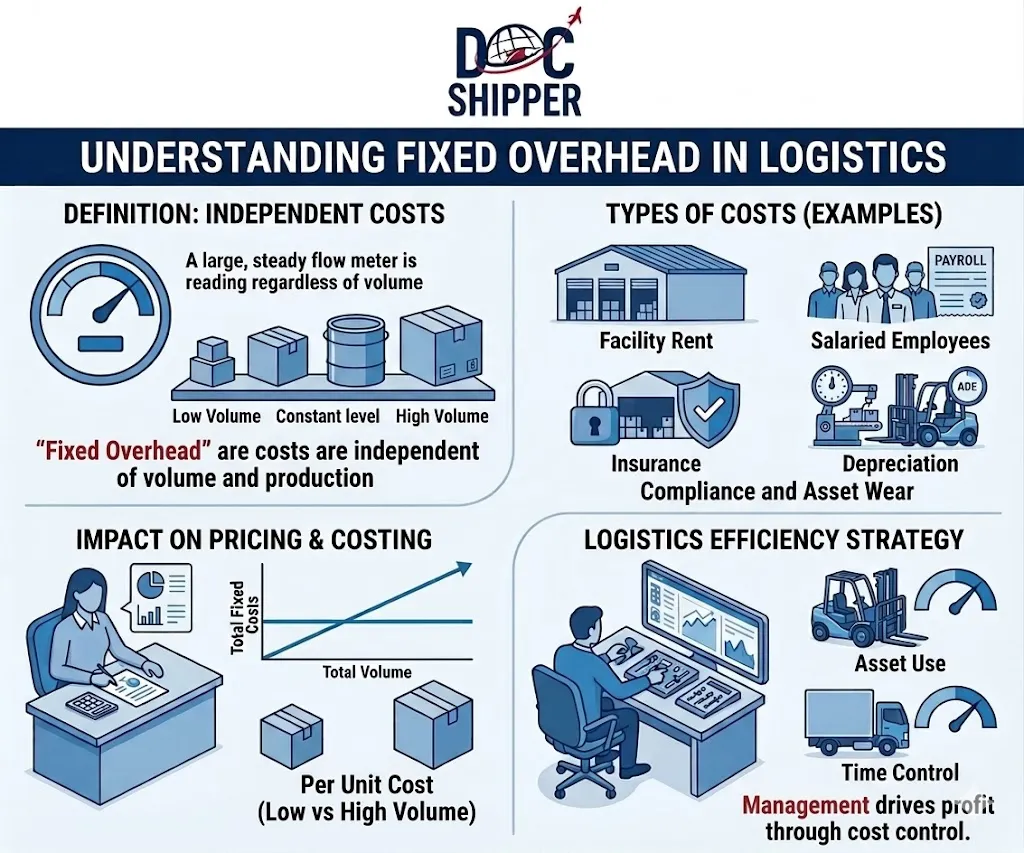
Fixed overhead encompasses all indirect operational costs that do not fluctuate with shipment volumes. Unlike variable costs such as fuel surcharges or handling fees, these expenses create a baseline financial commitment for freight forwarders.
The primary components include facility rent or lease payments for warehouses and office spaces. Whether your warehouse handles 100 or 1,000 pallets monthly, rent remains constant. Similarly, insurance premiums for liability coverage, property protection, and professional indemnity maintain fixed rates regardless of operational intensity.
Administrative salaries represent another significant category. Management teams, accounting staff, and compliance officers receive consistent compensation independent of shipment counts. This contrasts with warehouse labor, which often scales with volume.
Equipment depreciation and amortization create non-cash fixed costs. Forklifts, scanning systems, and software licenses lose value systematically over time, regardless of utilization rates. These accounting entries impact profitability calculations even without immediate cash outflows.
According to International Chamber of Commerce guidelines, proper overhead allocation ensures transparent cost structures in international trade. At DocShipper, we systematically review fixed cost structures during our financial consultations to help clients optimize their pricing models and identify potential savings opportunities.
The relevant range concept introduces an important nuance. Fixed costs remain stable only within specific activity boundaries. Doubling shipment volumes might necessitate additional warehouse space, transforming what was fixed into a stepped cost. Understanding these thresholds prevents budget surprises during growth phases.
Calculation Methods & Real-World Scenarios
Calculating fixed overhead rates enables accurate cost allocation across services. The standard formula divides total fixed costs by a relevant activity measure, creating a per-unit allocation rate.
Use Case: Small Freight Forwarder
A forwarder handles 500 shipments monthly with annual fixed overhead of $240,000. Breaking down the components:
- Warehouse rent: $60,000 annually
- Office lease: $36,000 annually
- Administrative salaries: $120,000 annually
- Insurance premiums: $18,000 annually
- Software licenses: $6,000 annually
Monthly fixed overhead: $240,000 ÷ 12 = $20,000
Per-shipment allocation: $20,000 ÷ 500 = $40 per shipment
This $40 must be recovered in pricing to cover indirect costs before achieving profitability. If the forwarder increases volume to 750 shipments without adding fixed costs, the allocation drops to $26.67 per shipment, improving competitive positioning.
| Activity Level | Monthly Shipments | Fixed Overhead per Unit | Impact on Pricing |
|---|---|---|---|
| Low Volume | 300 | $66.67 | Higher base cost |
| Standard Volume | 500 | $40.00 | Balanced pricing |
| High Volume | 750 | $26.67 | Competitive advantage |
| Maximum Capacity | 1,000 | $20.00 | Optimal efficiency |
The table demonstrates economies of scale in action. Spreading fixed costs across more units reduces per-shipment burden, explaining why high-volume forwarders often offer more competitive rates.
Break-Even Analysis Application: If variable costs per shipment equal $60 and the selling price is $120, the contribution margin is $60. With monthly fixed overhead of $20,000, the break-even point is 334 shipments ($20,000 ÷ $60). Any volume beyond this threshold generates profit.
Industry data shows that freight forwarders typically allocate 25-35% of total costs to fixed overhead, with the remainder being variable. At DocShipper, we help clients optimize this ratio through strategic warehouse selection and technology investments that maximize capacity utilization without proportionally increasing fixed commitments.
Conclusion
Fixed overhead management separates profitable freight forwarders from struggling competitors. Understanding these costs enables strategic pricing, accurate financial forecasting, and informed capacity decisions that drive sustainable growth.
Need expert guidance on optimizing your cost structure? Contact DocShipper for a comprehensive operational analysis.
📚 Quiz
Test Your Knowledge: Fixed Overhead
Which statement correctly defines fixed overhead in logistics operations?
A freight forwarder has $240,000 annual fixed overhead and processes 500 shipments monthly. What happens to per-shipment overhead allocation if volume increases to 750 shipments without adding new fixed costs?
Which scenario represents a correct application of fixed overhead concepts in freight forwarding?
🎯 Your Result
📞 Free Personalized QuoteFAQ | Fixed Overhead: Definition, Calculation & Practical Examples
Fixed overhead remains constant regardless of shipment volumes—such as warehouse rent or administrative salaries. Variable costs fluctuate with activity levels, including fuel surcharges, handling fees, and temporary labor. This distinction is critical for accurate break-even analysis and pricing strategies in freight forwarding operations.
Companies typically use activity-based allocation, dividing total fixed costs by a relevant measure like shipment count, weight handled, or cubic meters processed. The resulting rate is then applied to each transaction. For example, $20,000 monthly overhead divided by 500 shipments equals $40 allocated per shipment.
Yes, through renegotiating leases, consolidating facilities, automating administrative tasks, or switching to pay-per-use software models. However, reductions often require strategic initiatives rather than operational adjustments. Careful analysis prevents cutting essential infrastructure that supports service quality and compliance requirements.
Fixed overhead determines the minimum revenue needed for profitability. The break-even formula divides total fixed costs by contribution margin per unit. Higher fixed costs increase the break-even threshold, requiring more shipments to become profitable. This relationship drives forwarders to maximize capacity utilization.
High fixed overhead relative to volume forces higher prices to maintain margins. Companies with optimized fixed cost structures can offer lower rates while preserving profitability. Volume growth without proportional fixed cost increases creates competitive advantages through better per-unit economics and pricing flexibility.
Yes, depreciation represents the systematic allocation of asset costs over their useful lives. Though non-cash, it reflects real economic consumption of equipment value and should be included in comprehensive cost analyses. Ignoring depreciation leads to underestimating true operational costs and can result in unprofitable pricing decisions.
Stepped fixed costs remain constant within specific activity ranges but jump to new levels when thresholds are crossed. For example, warehouse rent stays fixed until capacity is reached, then increases when additional space is leased. Recognizing these steps prevents budget surprises during growth phases and informs strategic capacity planning.
Best practice involves quarterly reviews with annual comprehensive assessments. Significant volume changes, facility additions, or major equipment purchases warrant immediate recalculation. Regular updates ensure pricing accuracy, prevent margin erosion, and provide early warning of profitability challenges requiring operational adjustments.
Industry benchmarks suggest 25-35% for established freight forwarders, with the remainder being variable costs. Startups often show higher ratios due to underutilized capacity. Ratios significantly above 40% may indicate inefficient operations or excessive infrastructure investment relative to revenue generation capabilities.
Cloud-based software subscriptions and pay-per-use platforms offer variable alternatives to traditional fixed IT infrastructure. Similarly, temporary warehouse space or third-party logistics partnerships can replace permanent facilities. These models provide flexibility but may increase per-unit costs, requiring careful cost-benefit analysis before implementation.
Customs brokers face fixed costs including compliance software licenses, bonding requirements, and specialized staff salaries. These expenses must be recovered regardless of transaction volumes. Efficient overhead management allows competitive customs clearance pricing while maintaining regulatory compliance and service quality standards.
When evaluating whether to perform services in-house or outsource, fixed overhead commitments are critical. Outsourcing converts fixed costs to variable, providing flexibility but potentially higher per-transaction expenses. The decision depends on volume projections, available capital, and strategic priorities regarding control versus cost optimization.
Need Help with
Logistics or Sourcing ?
First, we secure the right products from the right suppliers at the right price by managing the sourcing process from start to finish. Then, we simplify your shipping experience - from pickup to final delivery - ensuring any product, anywhere, is delivered at highly competitive prices.


Fill the Form
Prefer email? Send us your inquiry, and we’ll get back to you as soon as possible.
Contact us




