


In short ⚡
Indirect costs are business expenses that cannot be directly attributed to a specific product, shipment, or service. Unlike direct costs (materials, freight), they support overall operations—overhead, utilities, administrative salaries, rent—and must be allocated across activities using cost drivers or allocation keys.
Introduction
Many importers struggle to calculate the true landed cost of their shipments because they overlook indirect expenses. A container might cost $3,000 in freight, but what about warehouse rent, compliance staff, or software subscriptions? These indirect costs inflate total expenses by 15–30% yet remain invisible in per-shipment calculations.
In international trade, understanding indirect costs is critical for accurate pricing, profitability analysis, and customs valuation. While direct costs (ocean freight, customs duties) are easy to track, indirect expenses require systematic allocation to avoid distorted margins and compliance errors.
Key characteristics of indirect costs:
- Shared nature: Benefit multiple shipments, products, or departments simultaneously
- Fixed or semi-variable: Do not fluctuate proportionally with shipment volume
- Allocation necessity: Require cost drivers (square footage, labor hours, shipment count) for distribution
- Impact on customs valuation: Some indirect costs must be added to transaction value under WCO rules
- Profitability distortion risk: Poor allocation leads to mispriced products or underestimated landed costs
Understanding Indirect Costs in Logistics
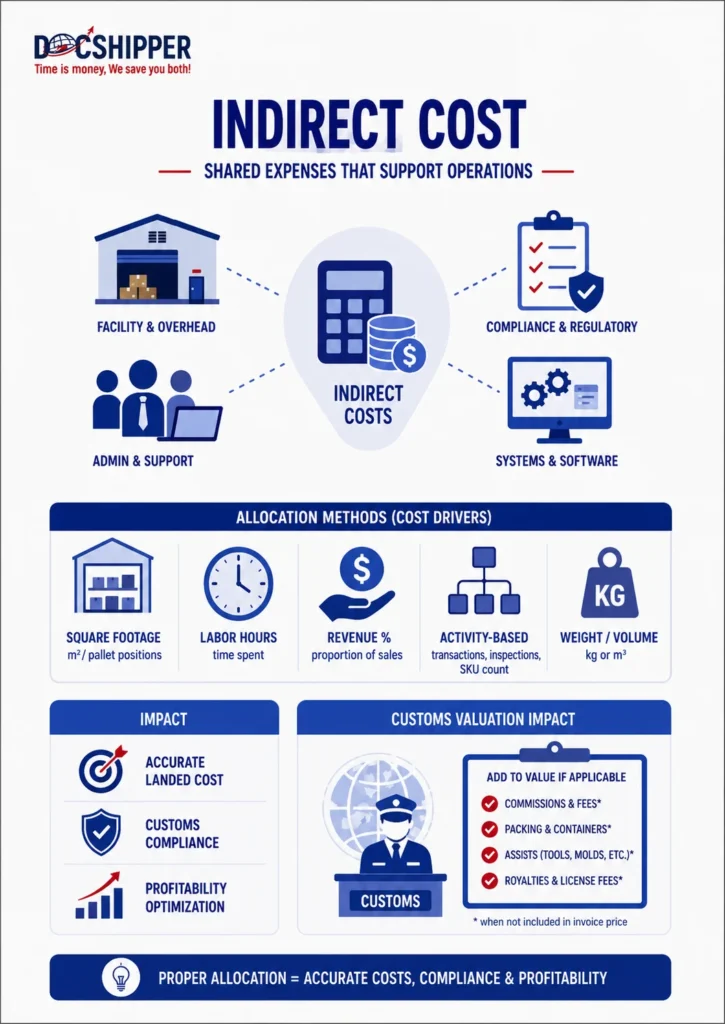
Indirect costs fall into three main categories in supply chain operations. Overhead expenses include facility rent, utilities, insurance, and equipment depreciation. A warehouse housing 50 clients’ inventory must allocate these costs proportionally—often by pallet positions or square meters occupied.
Administrative and support costs encompass salaries for non-operational staff (compliance officers, IT support, accounting), software licenses (TMS, WMS), and office supplies. These expenses support all shipments but cannot be traced to a single transaction. For example, a customs broker’s salary serves hundreds of clients monthly.
Regulatory and compliance costs are particularly relevant in international trade. Maintaining WCO Authorized Economic Operator (AEO) status requires audits, training, and system upgrades—costs spread across annual import volumes. Similarly, product testing for regulatory compliance (FDA, CE marking) benefits entire product lines, not individual shipments.
Under customs valuation rules, certain indirect costs must be added to the transaction value if incurred by the buyer but not included in the invoice price. These include:
- Commissions and brokerage fees (except buying commissions)
- Costs of containers and packing treated as reusable for customs purposes
- Assists: molds, tools, engineering work provided by the buyer
- Royalties and license fees related to the imported goods
At DocShipper, we systematically review indirect cost allocation during landed cost calculations to ensure clients maintain customs compliance while optimizing their cost structures. Misclassifying an assist as overhead, for instance, can trigger valuation adjustments and penalties during audits.
Common allocation methods include activity-based costing (ABC), which assigns costs based on actual resource consumption, and traditional volume-based allocation, using simple metrics like weight, revenue, or shipment count. ABC provides accuracy but requires detailed tracking, while volume-based methods trade precision for simplicity.
Allocation Methods & Real-World Examples
Consider an importer handling electronics and textiles through the same logistics provider. The warehouse costs $50,000 monthly for 10,000 square meters. Electronics occupy 3,000 m² (high-value, low-volume), textiles use 7,000 m² (low-value, high-volume). Using square footage allocation, electronics absorb $15,000 (30%) and textiles $35,000 (70%) in rent—fair for space usage but ignoring handling complexity.
| Allocation Method | Cost Driver | Best For | Limitations |
|---|---|---|---|
| Square Footage | m² or pallet positions | Warehouse rent, utilities | Ignores handling intensity |
| Labor Hours | Direct labor time per shipment | Supervision, admin support | Requires detailed time tracking |
| Revenue % | Proportion of total sales | Corporate overhead, marketing | Penalizes high-margin products |
| Activity-Based | Transactions, inspections, SKU count | Complex operations with diverse activities | High implementation cost |
| Weight/Volume | Kilograms or cubic meters | Freight-related overhead | Inaccurate for value-based services |
Case Study: A customs broker handles 500 shipments monthly with $80,000 in fixed costs (salaries, software, office). Using simple shipment count, each bears $160 in overhead. However, 100 shipments require HS classification disputes (3 hours extra work), while 400 are routine (20 minutes). Activity-based costing reveals dispute cases should absorb $280 each, routine ones $120—a 57% swing affecting pricing accuracy.
In customs valuation, assists illustrate allocation complexity. A manufacturer provides $200,000 in injection molds to a Chinese supplier for 50,000 units over 2 years. The indirect cost per unit is $4 ($200,000 ÷ 50,000), added to the transaction value for customs purposes. Failing to allocate this triggers undervaluation penalties.
Practical allocation steps:
- Identify cost pools: Group similar expenses (facilities, admin, compliance)
- Select cost drivers: Choose metrics reflecting actual resource consumption
- Calculate rates: Divide total pool cost by total driver units
- Apply to shipments: Multiply rate by driver quantity per shipment
- Validate periodically: Review allocations quarterly to adjust for operational changes
Conclusion
Indirect costs represent the hidden backbone of logistics operations—expenses that enable import/export activities but defy simple attribution. Proper allocation ensures accurate landed cost calculations, compliant customs valuations, and profitable pricing strategies.
Need expert guidance on allocating indirect costs for customs compliance or profitability analysis? Contact DocShipper for a tailored consultation.
📚 Quiz
Test Your Knowledge: Indirect Costs
Which statement best defines indirect costs in logistics operations?
A customs broker's monthly salary of $6,000 serves 300 routine shipments and 50 complex classification disputes. Using activity-based costing, complex cases require 3 hours each while routine ones need 20 minutes. Which allocation approach is correct?
Your company provides a $150,000 injection mold to a Chinese manufacturer for producing 60,000 units over 18 months. How should this indirect cost be treated for customs valuation?
🎯 Your Result
📞 Free Quote in 24hFAQ | Indirect Cost: Definition, Calculation & Practical Examples
Direct costs (ocean freight, customs duties, trucking) are traceable to a specific shipment. Indirect costs (warehouse rent, administrative salaries, compliance software) support multiple shipments and require allocation using cost drivers like volume, weight, or labor hours.
Yes. Certain indirect costs incurred by the buyer—assists (molds, tools), royalties, brokerage fees—must be added to the transaction value under WCO Valuation Agreement rules. Overhead like office rent typically does not affect customs value.
Use square footage or pallet positions as the cost driver. Divide total monthly rent by total occupied space, then multiply the rate by each product's space usage. For high-touch items, consider activity-based allocation incorporating handling hours.
ABC assigns indirect costs based on actual activities (inspections, data entry, customs filings) rather than volume. It reveals true cost drivers—ideal for complex operations but requires detailed tracking of time and resources per activity type.
Absolutely. Include allocated indirect costs in your landed cost calculation to set prices that ensure profitability. Many importers underprice by ignoring overhead, leading to losses despite healthy gross margins on direct costs.
Using oversimplified drivers (equal split across shipments), ignoring activity differences (routine vs. complex shipments), failing to update allocations as operations change, and not documenting allocation methods for customs audits.
Quarterly for stable operations, monthly during growth phases or operational changes (new warehouse, added services). Annual reviews risk allocating obsolete cost structures that distort profitability and compliance.
Yes. TMS, WMS, and customs software subscriptions support all shipments but cannot be traced to individual transactions. Allocate based on user count, transaction volume, or evenly across monthly shipments depending on usage patterns.
An assist is an indirect cost—tools, molds, dies, engineering work—provided by the buyer to the manufacturer free or at reduced cost. Its allocated value must be added to the customs value of imported goods.
Yes. Equipment depreciation (forklifts, IT hardware) and facility depreciation are indirect costs allocated across products or shipments. Use straight-line or usage-based methods aligned with accounting standards.
Underallocating indirect costs inflates product margins, leading to mispricing. Overallocating penalizes high-volume items. Accurate allocation reveals true product profitability, guiding sourcing, pricing, and portfolio decisions.
Some indirect costs (e.g., pre-production design work, molds) may be capitalized as part of inventory cost under GAAP/IFRS if directly related to bringing goods to saleable condition. Consult accounting standards for capitalization criteria.
Need Help with
Logistics or Sourcing ?
First, we secure the right products from the right suppliers at the right price by managing the sourcing process from start to finish. Then, we simplify your shipping experience - from pickup to final delivery - ensuring any product, anywhere, is delivered at highly competitive prices.


Fill the Form
Prefer email? Send us your inquiry, and we’ll get back to you as soon as possible.
Contact us




