


In short ⚡
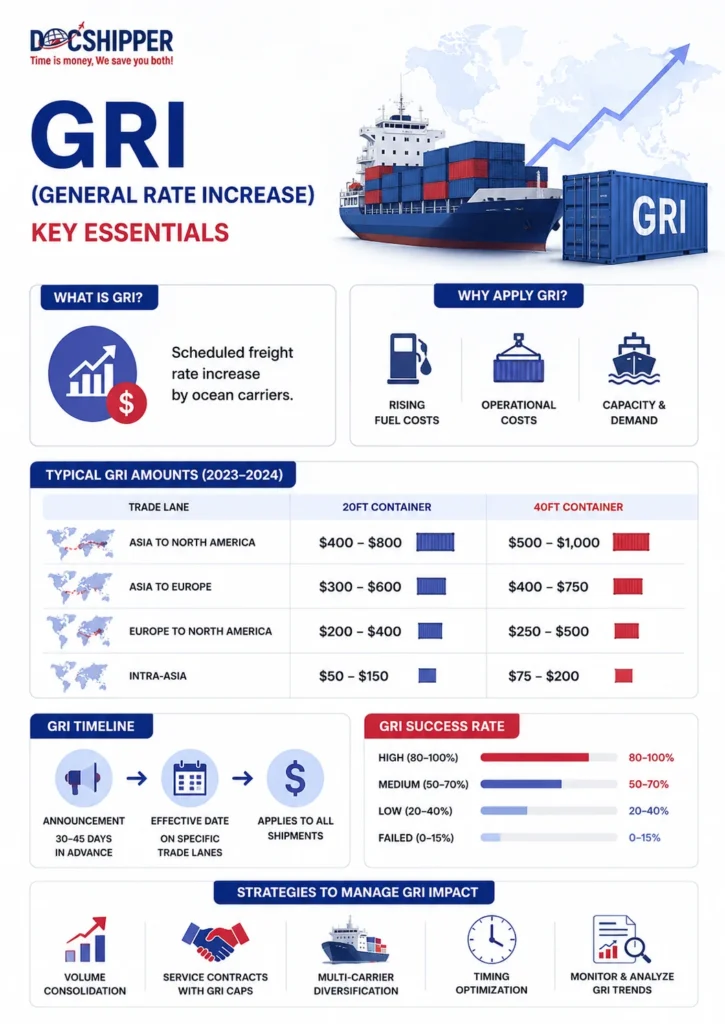
The GRI (General Rate Increase) is a scheduled freight rate adjustment applied by ocean carriers to reflect rising operational costs. Announced weeks in advance, GRIs impact all shipments on specific trade lanes, typically during peak seasons or fuel price surges. Understanding GRIs is crucial for budgeting international shipments and negotiating freight contracts effectively.
Introduction
Importers and exporters often face unexpected freight cost increases that disrupt budgets. The GRI is the primary mechanism carriers use to adjust ocean freight rates systematically. Unlike peak season surcharges or emergency fuel adjustments, GRIs follow predictable cycles and affect entire trade routes simultaneously.
In containerized shipping, GRIs serve as the baseline mechanism for carriers to maintain profitability amid fluctuating bunker fuel prices, port congestion fees, and vessel operating expenses. Recognizing GRI patterns enables logistics managers to negotiate better long-term contracts and time shipments strategically.
Key characteristics of GRIs include:
- Route-specific application: Different increases for Asia-Europe versus Trans-Pacific lanes
- Advance notification: Typically announced 30-45 days before implementation
- Container type variation: Separate rates for 20ft, 40ft, and high-cube containers
- Carrier coordination: Major shipping alliances often align GRI timing
- Contract exemptions: Long-term service contracts may include GRI caps or exclusions
Mechanisms & Strategic Implications
GRIs function as industry-wide rate corrections rather than individual carrier adjustments. When global carriers announce a $500/TEU GRI on the Asia-North America route, they’re signaling coordinated capacity management and cost recovery efforts.
The implementation process follows a structured timeline. Carriers publish GRI notices through industry platforms and direct client communications, specifying the effective date, affected trade lanes, and per-container increases. Unlike spot rate negotiations, GRIs apply uniformly to all shippers using the standard tariff structure.
Legal and commercial implications require careful attention. The Federal Maritime Commission (FMC) in the United States monitors GRI practices to prevent anti-competitive behavior. While carriers can independently set rates, synchronized GRI announcements occasionally trigger regulatory scrutiny under antitrust frameworks.
Contractual considerations significantly impact GRI exposure. Service contracts often include clauses limiting GRI pass-through, while spot market shippers face full increases. At DocShipper, we negotiate GRI protection clauses in annual contracts for high-volume clients, securing predictable freight budgets throughout fiscal periods.
The success rate of GRIs varies dramatically by market conditions. During periods of overcapacity, announced GRIs frequently fail to stick as shippers negotiate lower rates. Conversely, in tight capacity markets, GRIs not only hold but may be supplemented by additional peak season surcharges and congestion fees.
Strategic responses include volume consolidation to strengthen negotiating power, multi-carrier diversification to leverage competition, and shipment timing adjustments to avoid GRI effective dates. Sophisticated shippers analyze historical GRI patterns to identify low-rate windows for non-urgent cargo.
Concrete Examples & Market Data
GRI implementation varies significantly across trade lanes and seasonal cycles. The following table illustrates typical GRI amounts observed across major shipping routes during 2023-2024:
| Trade Lane | GRI Amount (20ft) | GRI Amount (40ft) | Typical Frequency |
|---|---|---|---|
| Asia to North America | $400-$800 | $500-$1,000 | Quarterly |
| Asia to Europe | $300-$600 | $400-$750 | Quarterly |
| Europe to North America | $200-$400 | $250-$500 | Semi-annually |
| Intra-Asia | $50-$150 | $75-$200 | Monthly |
Use Case: Electronics Importer
A European retailer importing 150 TEU monthly from Shenzhen faces a $600/40ft GRI announced for May 1st. Without mitigation, this adds $90,000 monthly ($600 × 150 containers). By accelerating 50 containers to April shipments and negotiating a service contract capping GRIs at 50%, the actual cost increase drops to $45,000 — a 50% savings achieved through strategic planning.
GRI Success Rate Analysis:
- High implementation rate (80-100%): Occurs during peak shipping seasons (August-October) when capacity is tight
- Medium implementation (50-70%): Standard periods with balanced supply-demand
- Low implementation (20-40%): Post-peak slack seasons when carriers compete for volume
- Failed GRIs (0-15%): Overcapacity markets where spot rates remain below announced levels
- Premium routes: Trans-Pacific lanes show higher GRI adherence than secondary corridors
Market intelligence from the Drewry World Container Index shows that successful GRI implementation correlates strongly with vessel utilization rates above 85%. When global fleet utilization drops below 80%, announced GRIs frequently collapse under competitive pressure.
Conclusion
The GRI remains the primary mechanism for ocean freight rate adjustments, directly impacting logistics budgets across all industries. Mastering GRI patterns, contract protections, and timing strategies transforms this challenge into a competitive advantage for informed shippers.
Need expert guidance on managing GRI impacts or negotiating better freight contracts? Contact DocShipper for customized logistics solutions that protect your bottom line.
📚 Quiz
Test Your Knowledge: GRI (General Rate Increase)
1. What is the primary characteristic of a GRI in ocean freight?
2. A shipper believes GRIs always successfully increase freight rates as announced. Is this understanding correct?
3. An importer faces a $600/40ft GRI on 100 containers monthly. Which strategy best minimizes cost impact?
🎯 Your Result
📞 Free Quote in 24hFAQ | GRI (General Rate Increase): Definition, Calculation & Concrete Examples
A GRI is a permanent base rate increase applied to standard tariffs, while peak season surcharges (PSS) are temporary fees added during high-demand periods. GRIs remain in effect indefinitely unless offset by market rate decreases, whereas PSS typically expire after 2-4 months. Both can apply simultaneously during peak shipping seasons.
Industry standard is 30-45 days' notice, though regulations vary by region. U.S. trades require minimum 30 days under FMC tariff filing rules. European trades often see 45-60 day announcements. Short-notice GRIs (under 30 days) typically indicate emergency cost recovery situations like sudden fuel price spikes.
Yes, long-term service contracts frequently include GRI mitigation clauses. Common provisions include GRI caps (maximum increase limits), partial pass-through agreements (carrier absorbs 50%), or fixed-rate periods (no GRIs for 6-12 months). Negotiating leverage depends on annual volume commitments and market conditions at contract signing.
GRIs fail when market demand cannot support the increased rates. During overcapacity periods, carriers compete for volume by offering rates below published GRI levels. Industry data shows 30-40% of announced GRIs partially erode through spot market discounting within 60 days of implementation, particularly on slack-season trade lanes.
Standard GRIs specify separate increases for 20ft ($300-500), 40ft ($400-800), and 40ft high-cube containers ($450-900). Reefer containers typically face 20-30% higher GRIs due to specialized equipment costs. Hazardous cargo may see additional surcharges layered on top of base GRIs, while empty container repositioning rates remain exempt.
Primary triggers include rising bunker fuel costs (accounting for 30-50% of voyage expenses), port congestion fees, increased labor costs, and low freight rate environments requiring correction. Carriers also use GRIs to offset alliance restructuring costs, new environmental compliance expenses (IMO regulations), and vessel repositioning expenses.
Individual carrier GRI announcements are legal rate adjustments. However, coordinated GRI timing among competing carriers may trigger antitrust investigations. The FMC and European Commission monitor GRI patterns for evidence of price-fixing. Carriers defend synchronized GRIs as independent responses to common market conditions rather than collusion.
Small shippers can consolidate cargo through freight forwarders who negotiate pooled volume rates with GRI protections. Joining shipper associations provides collective bargaining power. Alternative strategies include shifting to LCL (less-than-container-load) services, adjusting order quantities to optimize container utilization, or scheduling shipments during low-GRI implementation periods.
Trans-Pacific routes average 15-25% cumulative annual increases through quarterly GRIs during stable markets. Asia-Europe lanes see 10-20% annual escalation. However, volatile periods (2020-2022 pandemic disruption) saw 200-400% annual increases. Current market normalization shows 5-10% annual GRI accumulation as overcapacity pressures rates downward.
GRIs automatically apply to spot market shipments booked under carrier tariffs. Contract rates depend on specific service agreement terms. Most contracts include GRI clauses specifying application conditions—some allow full pass-through, others cap increases, and premium contracts may exclude GRIs entirely for the contract duration.
Online freight booking platforms increase GRI visibility by displaying real-time rate comparisons across carriers. This transparency pressures carriers to justify GRI amounts and reduces successful implementation rates. Platforms like Freightos and Xeneta publish GRI tracking data, enabling shippers to validate announced increases against actual market rates.
GRIs represent permanent base rate increases, while BAF (or bunker surcharges) fluctuate with fuel prices on monthly or quarterly cycles. Carriers may implement a GRI to establish a new baseline rate, then apply separate BAF calculations on top. Some modern contracts combine both into simplified all-in rates with periodic GRI adjustments replacing variable BAF formulas.
Need Help with
Logistics or Sourcing ?
First, we secure the right products from the right suppliers at the right price by managing the sourcing process from start to finish. Then, we simplify your shipping experience - from pickup to final delivery - ensuring any product, anywhere, is delivered at highly competitive prices.


Fill the Form
Prefer email? Send us your inquiry, and we’ll get back to you as soon as possible.
Contact us




