


In short ⚡
Inventory Cost represents the total expenditure incurred to acquire, store, and manage goods held in stock. It includes purchasing costs, warehousing expenses, handling fees, insurance, depreciation, and opportunity costs. Optimizing inventory cost is crucial for maintaining cash flow and profitability in international trade operations.Introduction
Many importers underestimate the true cost of keeping inventory. They focus solely on purchase price, ignoring the hidden expenses that accumulate daily. This miscalculation leads to cash flow problems and reduced competitiveness in global markets.
Understanding inventory cost is fundamental for any business engaged in international trade. It directly impacts pricing strategies, profit margins, and supply chain efficiency. Companies that master inventory cost management gain significant advantages over competitors.
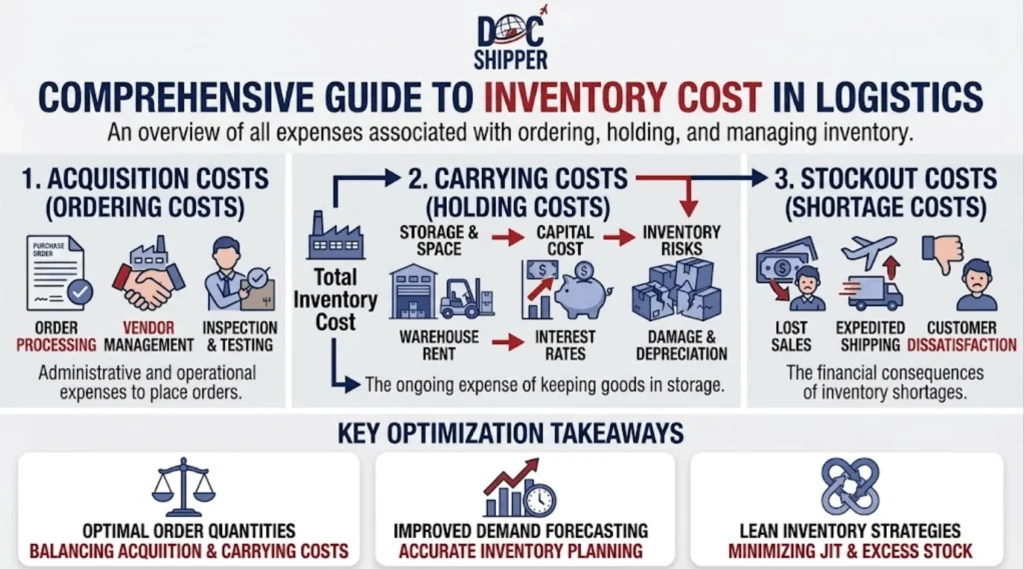
Key components of inventory cost include:
- Acquisition costs: Purchase price, freight, customs duties, and clearance fees
- Holding costs: Warehousing, insurance, taxes, and depreciation
- Ordering costs: Administrative expenses, quality control, and processing
- Shortage costs: Lost sales, expedited shipping, and customer dissatisfaction
- Opportunity costs: Capital tied up in inventory instead of generating returns elsewhere
In-Depth Analysis & Expertise
Inventory cost calculation extends far beyond the invoice price. Carrying costs typically represent 20-30% of inventory value annually. This includes physical storage space, climate control, security systems, and handling equipment. For temperature-sensitive goods, these costs can exceed 40%.
Capital costs represent the most significant hidden expense. Money invested in inventory cannot be deployed elsewhere. If your company’s cost of capital is 12% annually, every $100,000 in inventory costs $12,000 per year in opportunity cost alone.
The risk of obsolescence varies dramatically by product category. Electronics depreciate rapidly, while industrial commodities remain stable. Fashion items face seasonal obsolescence, losing 50-70% of value within months. According to the U.S. Department of Commerce, obsolescence accounts for 8-12% of total inventory costs in technology sectors.
Insurance and taxes create ongoing financial obligations. Property taxes on stored inventory, liability insurance, and fire protection add 2-4% annually to holding costs. Import duties paid upfront remain locked in inventory until goods sell.
At DocShipper, we conduct comprehensive inventory cost analyses for our clients, identifying optimization opportunities throughout the supply chain. We’ve helped companies reduce total inventory costs by 15-25% through strategic warehousing decisions and improved order management.
Just-in-Time (JIT) strategies minimize inventory costs but increase vulnerability to supply chain disruptions. The optimal balance depends on product characteristics, demand predictability, and supplier reliability. Manufacturers typically maintain 30-90 days of inventory, while retailers operate with 45-60 days on average.
Concrete Examples & Data
Let’s examine a realistic scenario for an electronics importer. Consider a company importing wireless headphones from China to the United States. Understanding the complete cost structure is essential for profitability.
| Cost Component | Amount (USD) | % of Total |
|---|---|---|
| Unit Purchase Price (1,000 units @ $25) | $25,000 | 68.5% |
| Ocean Freight & Insurance | $1,800 | 4.9% |
| Customs Duties (3.7%) | $925 | 2.5% |
| Warehousing (3 months @ $400/month) | $1,200 | 3.3% |
| Insurance & Handling | $650 | 1.8% |
| Capital Cost (12% annual, 3 months) | $825 | 2.3% |
| Quality Control & Documentation | $450 | 1.2% |
| Obsolescence Risk (2% quarterly) | $550 | 1.5% |
| Total Inventory Cost | $36,500 | 100% |
| True Cost Per Unit | $36.50 (vs. $25.00 purchase price) |
This example reveals that the actual inventory cost is 46% higher than the purchase price alone. Many businesses fail to account for these additional expenses, leading to underpricing and margin erosion.
Key insights from industry data include:
- Holding costs average 25% annually: For every $1 million in inventory, expect $250,000 in yearly carrying costs
- Fast-moving goods reduce costs: Inventory turnover of 8-12 times annually minimizes exposure to holding expenses
- Location matters significantly: U.S. West Coast warehousing costs $8-12 per square foot monthly, versus $4-7 in Midwest locations
- Technology investments pay off: Companies using advanced inventory management systems reduce total costs by 12-18%
- Batch size optimization: Larger shipments reduce per-unit acquisition costs but increase holding expenses—the optimal order quantity balances both factors
At DocShipper, we help clients implement cost-reduction strategies including consolidated shipping, strategic warehousing placement, and demand forecasting improvements. Our typical client sees inventory cost reductions of $15,000-$50,000 annually on medium-volume import operations.
Conclusion
Inventory cost management separates profitable importers from struggling ones. The difference between nominal purchase price and true total cost often exceeds 40-50%. Strategic inventory optimization improves cash flow, reduces risk, and enhances competitiveness in international markets.
Need expert guidance on reducing your inventory costs? Contact DocShipper today for a comprehensive supply chain analysis and customized cost reduction strategy.
📚 Quiz
Test Your Knowledge: Inventory Cost
What does the term "Inventory Cost" primarily encompass in international trade?
Which statement correctly represents a common misconception about inventory costs?
A company imports electronics worth $100,000 with a 12% annual cost of capital. If goods remain in inventory for 6 months before selling, what is the opportunity cost for that period?
🎯 Your Result
📞 Free Quote in 24hFAQ | Inventory Cost: Definition, Calculation & Concrete Examples
Annual holding costs typically range from 20-30% of inventory value for most products. This includes warehousing, insurance, capital costs, depreciation, and taxes. High-value or perishable goods may see holding costs exceed 40% annually, while stable commodities often fall in the 15-20% range.
Multiply your inventory value by your company's weighted average cost of capital (WACC) or required return rate. If you have $500,000 in inventory and your cost of capital is 12%, the annual opportunity cost is $60,000. This represents returns you could earn by investing that capital elsewhere in your business.
Optimal turnover varies by industry. Retailers typically target 8-12 turns annually, manufacturers 4-8 turns, and wholesalers 6-10 turns. Higher turnover reduces holding costs but increases ordering frequency and potential stockout risk. The goal is balancing cost minimization with service level maintenance.
Geographic location significantly impacts warehousing expenses, labor costs, and transportation efficiency. Coastal warehouses cost 50-80% more than inland facilities but reduce shipping times to major markets. Strategic placement near customer concentrations minimizes last-mile delivery costs while optimizing inventory investment.
Most inventory-related expenses are deductible, including warehousing rent, insurance, handling labor, depreciation on storage equipment, and property taxes. The cost of goods themselves becomes deductible when sold (cost of goods sold). Consult tax professionals for jurisdiction-specific rules and optimal accounting methods.
Implement demand forecasting systems, reduce order quantities, accelerate inventory turnover, and establish vendor return agreements. For fashion or technology products, consider consignment arrangements or just-in-time delivery. Regular inventory audits identify slow-moving items before they become obsolete, allowing discounting strategies to minimize losses.
EOQ is the optimal order quantity that minimizes total inventory costs by balancing ordering costs against holding costs. The formula is: EOQ = √(2DS/H), where D is annual demand, S is ordering cost per order, and H is holding cost per unit annually. This mathematical model helps determine the most cost-effective purchase quantity.
Customs duties become part of inventory cost basis, remaining locked in stock until goods sell. For a $100,000 shipment with 5% duties ($5,000), that additional capital is tied up for the entire inventory holding period. This affects cash flow and increases the effective carrying cost of imported goods significantly.
Warehouse Management Systems (WMS), automated reorder point systems, RFID tracking, and AI-powered demand forecasting reduce labor costs, minimize stockouts, optimize space utilization, and prevent over-ordering. Companies implementing these technologies typically see 15-25% reductions in total inventory costs within 12-18 months of deployment.
Inventory financing or asset-based lending adds interest costs (typically 6-15% annually) but frees working capital for business operations. When calculating total inventory cost, include financing interest as a capital cost component. Compare this against the opportunity cost of using internal funds to determine the most economical financing approach.
Safety stock is extra inventory maintained to prevent stockouts during demand fluctuations or supply delays. While it increases holding costs by 10-30%, it prevents lost sales and maintains customer satisfaction. Calculate optimal safety stock using demand variability and desired service level to balance cost against stockout risk.
Full physical counts annually are standard, with cycle counting throughout the year for high-value items. Accurate inventory records reduce excess stock, prevent emergency orders, and optimize reordering. Companies with precise inventory tracking reduce carrying costs by 8-15% compared to those relying solely on annual counts.
Need Help with
Logistics or Sourcing ?
First, we secure the right products from the right suppliers at the right price by managing the sourcing process from start to finish. Then, we simplify your shipping experience - from pickup to final delivery - ensuring any product, anywhere, is delivered at highly competitive prices.


Fill the Form
Prefer email? Send us your inquiry, and we’ll get back to you as soon as possible.
Contact us




