


In short ⚡
Inventory Planning Systems are integrated software solutions that forecast demand, optimize stock levels, and automate replenishment decisions across the supply chain. They combine historical data, predictive algorithms, and real-time tracking to minimize carrying costs while preventing stockouts, ensuring operational continuity in international logistics.
Introduction
Many importers struggle with the same paradox: excess inventory drains cash flow, yet insufficient stock disrupts production and damages client relationships. This tension intensifies in cross-border trade, where lead times extend weeks and customs delays create unpredictability.
Inventory Planning Systems resolve this challenge by transforming raw data into actionable forecasts. They orchestrate purchasing, warehousing, and distribution decisions within a unified framework. In import/export operations, these systems account for transit durations, port congestion, and seasonal demand fluctuations—variables that manual spreadsheets cannot efficiently manage.
Key characteristics of modern Inventory Planning Systems include:
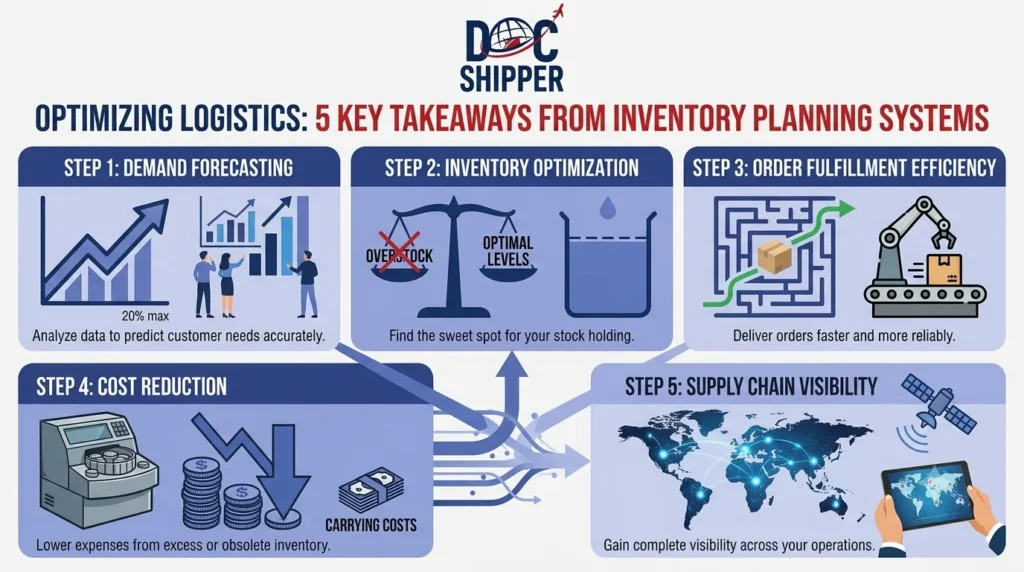
- Demand forecasting: Statistical models predict future requirements using historical sales, market trends, and external factors.
- Safety stock calculation: Algorithms determine buffer quantities to cover lead time variability and demand uncertainty.
- Reorder point automation: Systems trigger purchase orders when inventory reaches predefined thresholds.
- Multi-location visibility: Real-time tracking across warehouses, containers, and distribution centers worldwide.
- Integration capability: Seamless connection with ERP, WMS, and customs brokerage platforms for end-to-end transparency.
Technical Mechanisms & Strategic Implementation
At their core, Inventory Planning Systems operate through three interdependent modules: demand planning, inventory optimization, and replenishment execution. The demand planning module aggregates sales data, seasonality patterns, and promotional calendars to generate rolling forecasts. Advanced systems incorporate machine learning to detect emerging trends invisible to traditional statistical methods.
The optimization engine calculates Economic Order Quantity (EOQ) and safety stock levels using formulas like:
EOQ = √(2DS/H)
Where D = annual demand, S = ordering cost per purchase, H = holding cost per unit. For international shipments, the system adjusts these calculations to account for container minimum order quantities and freight consolidation opportunities.
Replenishment strategies vary by business model. Continuous review systems monitor stock levels constantly and place orders when inventory drops below the reorder point. Periodic review systems assess stock at fixed intervals, useful for coordinating shipments across multiple suppliers. Hybrid approaches combine both methods for different product categories.
Regulatory compliance represents a critical dimension. The system must track HS codes, country-of-origin certificates, and customs valuation methods to ensure import documentation accuracy. According to World Customs Organization data, 30% of customs delays stem from documentation errors—issues that integrated systems prevent through automated validation rules.
At DocShipper, we integrate inventory planning data with our customs clearance workflows. When a client’s system signals an inbound shipment, our team pre-validates documentation against the declared inventory requirements, eliminating last-minute surprises at the port. This synchronization reduces clearance time by an average of 40% for recurring importers.
Advanced analytics capabilities enable scenario modeling. Planners can simulate the impact of supplier lead time changes, tariff increases, or warehouse relocations on total logistics costs. These what-if analyses support strategic decisions like shifting from air freight to ocean freight or establishing regional distribution hubs.
Concrete Examples & Performance Data
Consider a European electronics importer sourcing components from Asia. Before implementing an Inventory Planning System, they maintained 90 days of safety stock to buffer against supply chain uncertainty. After system deployment, demand forecasting accuracy improved from 65% to 89%, allowing them to reduce safety stock to 45 days while maintaining a 98% service level.
The financial impact was substantial:
| Metric | Before System | After System | Improvement |
|---|---|---|---|
| Inventory Turnover Ratio | 4.1x | 8.2x | +100% |
| Carrying Costs (Annual) | €2.4M | €1.3M | -46% |
| Stockout Frequency | 12 incidents/year | 2 incidents/year | -83% |
| Order Processing Time | 6.5 hours | 0.8 hours | -88% |
A second case involves a North American pharmaceutical distributor managing temperature-sensitive products with strict expiration dates. Their Inventory Planning System incorporated batch tracking and FEFO (First-Expired, First-Out) logic. The system automatically prioritized shipments nearing expiration for domestic distribution while routing longer-dated inventory to international markets with extended transit times.
Five measurable outcomes from their implementation:
- Waste reduction: Expired product write-offs decreased from 3.2% to 0.4% of total inventory value.
- Compliance enhancement: Automated lot number documentation reduced FDA audit findings by 78%.
- Working capital release: Optimized stocking freed $8.7 million in previously tied capital.
- Supplier collaboration: Shared forecasts enabled suppliers to allocate production capacity more efficiently, reducing emergency airfreight costs by 62%.
- Customer satisfaction: On-time, in-full delivery performance improved from 91% to 99.2%.
Industry benchmarks reveal that companies using advanced Inventory Planning Systems achieve 15-30% lower total supply chain costs compared to peers relying on manual methods. The ROI typically materializes within 9-14 months, driven primarily by reduced carrying costs and improved forecast accuracy.
Conclusion
Inventory Planning Systems transform reactive logistics into proactive supply chain orchestration, balancing cost efficiency with operational resilience. For international traders, these tools provide the predictive intelligence necessary to navigate complex, multi-jurisdictional supply networks.
Need expert guidance on integrating inventory planning with your customs and freight operations? Contact DocShipper for tailored logistics solutions.
📚 Quiz
Test Your Knowledge: Inventory Planning Systems
What is the primary function of Inventory Planning Systems in international logistics?
According to World Customs Organization data mentioned in the article, what percentage of customs delays stem from documentation errors that Inventory Planning Systems help prevent?
A European electronics importer improved demand forecasting accuracy from 65% to 89% after system implementation. Based on this scenario, which statement accurately reflects the strategic benefit?
🎯 Your Result
📞 Free Quote in 24hFAQ | Inventory Planning Systems: Definition, Calculation & Concrete Examples
While warehouse management systems (WMS) focus on physical storage operations—receiving, putaway, picking—Inventory Planning Systems emphasize forecasting and replenishment strategy. They answer "how much to order and when," whereas WMS addresses "where to store and how to retrieve." Advanced implementations integrate both for end-to-end visibility.
Modern systems employ seasonal decomposition algorithms that separate trend, seasonality, and irregular components in historical data. They apply different forecasting models to each component, then recombine predictions. For extreme seasonality, planners can define promotional profiles that override baseline forecasts during peak periods.
Cloud-based solutions now offer scalable pricing models accessible to businesses importing 10+ containers annually. Entry-level systems focus on core functionalities—demand forecasting, reorder alerts, and basic reporting—without the complexity of enterprise platforms. The critical threshold is typically $500,000 in annual inventory value, where optimization savings justify subscription costs.
Standard integrations include ERP transaction records, point-of-sale data, supplier lead time feeds, freight forwarder tracking APIs, and customs clearance status updates. Advanced implementations incorporate external data like weather forecasts, economic indicators, and social media sentiment to refine demand predictions.
Systems treat customs clearance as a variable lead time component. They analyze historical clearance durations by port, product category, and origin country to calculate probabilistic lead time distributions. Safety stock formulas then incorporate this variability, increasing buffer quantities for high-risk shipment profiles.
Push strategies forecast demand centrally and allocate inventory to distribution points proactively. Pull strategies wait for actual demand signals before triggering replenishment. Inventory Planning Systems support both, often recommending push for stable, high-velocity products and pull for unpredictable, low-volume items.
Safety stock levels and reorder points require quarterly review at minimum. Forecasting models benefit from monthly validation against actual demand. However, systems with machine learning capabilities perform continuous micro-adjustments, learning from each transaction to refine predictions without manual intervention.
Leading platforms include compliance features such as audit trails, supplier validation databases, and documentation archiving. They generate reports required for Authorized Economic Operator (AEO) certification and support CTPAT security criteria by tracking inventory chain-of-custody and flagging anomalies.
ABC analysis categorizes inventory by value contribution: A-items represent 20% of products generating 80% of revenue, B-items are mid-tier, and C-items are low-value, high-volume. Systems apply tighter forecasting and higher service levels to A-items while using simpler replenishment rules for C-items to optimize resource allocation.
Enterprise-grade systems support consolidated planning across legal entities, applying currency conversion at prevailing rates. They reconcile inventory valuation methods (FIFO, weighted average) by jurisdiction and generate country-specific financial reports while maintaining unified operational visibility across the global network.
They employ aging analysis algorithms that flag items exceeding defined turnover thresholds. Some systems automatically adjust reorder quantities downward as inventory ages, reducing future exposure. Advanced platforms recommend markdown strategies or secondary market channels to liquidate obsolete stock before write-off becomes necessary.
AI enhances pattern recognition in complex datasets, identifying demand drivers invisible to traditional statistics. Neural networks predict stockouts days in advance, while reinforcement learning optimizes replenishment policies through simulated trial-and-error. Natural language processing enables planners to query systems conversationally, democratizing access to advanced analytics.
Need Help with
Logistics or Sourcing ?
First, we secure the right products from the right suppliers at the right price by managing the sourcing process from start to finish. Then, we simplify your shipping experience - from pickup to final delivery - ensuring any product, anywhere, is delivered at highly competitive prices.


Fill the Form
Prefer email? Send us your inquiry, and we’ll get back to you as soon as possible.
Contact us




