


In short ⚡
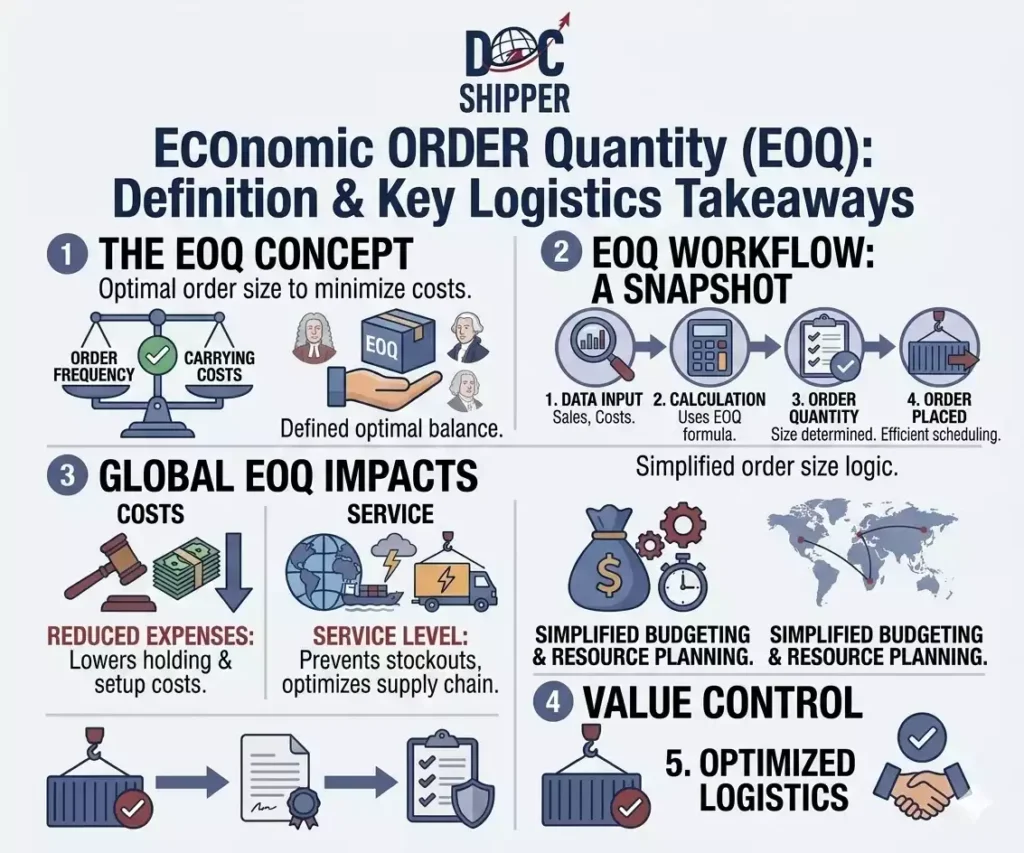
The Economic Order Quantity (EOQ) is a fundamental inventory management formula that determines the optimal order quantity a company should purchase to minimize total inventory costs, including ordering costs and holding costs. This mathematical model helps businesses balance between ordering too frequently (high ordering costs) and holding excessive inventory (high storage costs).
Introduction
Many businesses struggle with a common dilemma: ordering too often increases costs, while ordering too much ties up capital in unsold inventory. This challenge becomes particularly acute in international trade, where shipping costs, lead times, and customs procedures add layers of complexity to inventory decisions.
The Economic Order Quantity model provides a scientific approach to solving this problem. Developed in 1913 by Ford W. Harris, EOQ remains relevant in modern supply chain management, especially for companies engaged in import/export operations where cost optimization directly impacts profitability.
Understanding EOQ is essential because it enables businesses to:
- Minimize total inventory costs by finding the sweet spot between ordering and holding expenses
- Optimize cash flow by preventing capital from being locked in excessive stock
- Reduce warehouse space requirements through strategic inventory levels
- Improve supplier relationships with predictable, rational ordering patterns
- Enhance international shipping efficiency by consolidating orders at optimal intervals
Understanding EOQ Mechanics & Strategic Impact
The EOQ formula calculates the ideal order quantity using three core variables: annual demand, ordering cost per purchase, and holding cost per unit per year. The mathematical expression is: EOQ = √(2DS/H), where D represents annual demand, S represents ordering cost, and H represents holding cost per unit.
This model operates on several critical assumptions. First, demand remains constant throughout the year. Second, ordering costs are fixed per order regardless of quantity. Third, holding costs are proportional to inventory value. Fourth, delivery occurs instantaneously without lead time variations. While real-world conditions rarely match these assumptions perfectly, the formula provides a robust baseline for inventory decisions.
The ordering cost component includes administrative expenses, transportation fees, customs clearance charges, and inspection costs. For international shipments, these costs can be substantial. At DocShipper, we systematically analyze these cost elements to help clients optimize their procurement strategies and reduce unnecessary expenses in cross-border transactions.
The holding cost component encompasses warehousing fees, insurance premiums, depreciation, opportunity cost of capital, and obsolescence risk. According to industry standards, holding costs typically range from 20% to 30% of inventory value annually, making this a significant factor in total cost calculations.
Beyond the basic formula, businesses must consider reorder point calculations. The reorder point determines when to place the next order and accounts for lead time and safety stock requirements. For international shipments, longer transit times and customs processing delays necessitate higher safety stock levels, which EOQ-based strategies must incorporate.
The total cost function in EOQ analysis combines ordering costs (D/Q × S) and holding costs (Q/2 × H), where Q represents order quantity. This U-shaped curve demonstrates that both very small and very large orders increase total costs, while the EOQ represents the minimum point on this curve where total costs are optimized.
Practical Calculations & Industry Applications
Consider a European electronics retailer importing smartphone accessories from Asia. The company faces annual demand of 12,000 units, with ordering costs of $800 per shipment (including freight forwarding, customs, and documentation) and holding costs of $4 per unit per year.
Applying the EOQ formula: EOQ = √(2 × 12,000 × 800 / 4) = √4,800,000 = 2,191 units. This means the optimal order quantity is approximately 2,191 units, resulting in roughly 5-6 orders per year. The total annual cost at this order quantity would be $8,764 (combining ordering and holding costs).
| Order Quantity | Orders per Year | Ordering Cost | Holding Cost | Total Cost |
|---|---|---|---|---|
| 1,000 units | 12 | $9,600 | $2,000 | $11,600 |
| 2,191 units (EOQ) | 5.5 | $4,382 | $4,382 | $8,764 |
| 3,000 units | 4 | $3,200 | $6,000 | $9,200 |
| 6,000 units | 2 | $1,600 | $12,000 | $13,600 |
This table demonstrates that ordering at the EOQ level results in 24.5% cost savings compared to ordering 1,000 units at a time, and 35.6% savings versus ordering the entire annual demand in two large shipments.
Industry-specific applications reveal EOQ’s versatility. In pharmaceutical imports, where shelf life constraints affect holding costs, companies adjust the formula to include obsolescence risk. A medical supply distributor might reduce order quantities below theoretical EOQ to prevent expiration losses, accepting slightly higher ordering costs for significantly reduced waste.
In automotive parts distribution, volume discounts often incentivize larger orders. Businesses must perform sensitivity analysis, comparing EOQ-based costs against discount thresholds. If a supplier offers 8% discount for orders exceeding 3,000 units, the company calculates whether this price reduction offsets the increased holding costs above EOQ levels.
For seasonal products in international trade, demand variability requires EOQ modification. Fashion retailers importing apparel might calculate separate EOQs for peak and off-peak seasons, adjusting their procurement strategies based on forecasted demand patterns rather than annual averages.
Container shipping economics introduce another dimension. Full Container Load (FCL) rates often incentivize ordering in multiples that maximize container utilization. A business might adjust its EOQ calculation to align with container capacity (20ft or 40ft), potentially ordering 2,300 units instead of the calculated 2,191 to achieve better freight rates and eliminate wasted container space.
Conclusion
The Economic Order Quantity model provides a mathematically sound foundation for inventory optimization, particularly valuable in international trade where cost structures are complex and capital efficiency is paramount. While real-world applications require adjustments for lead times, volume discounts, and demand variability, EOQ remains an essential tool for strategic procurement planning.
Need assistance optimizing your international inventory strategy or streamlining your supply chain costs? Contact DocShipper for expert guidance tailored to your specific import/export requirements.
📚 Quiz
Test Your Knowledge: Economic Order Quantity (EOQ)
What is the primary objective of the Economic Order Quantity model?
A common misconception about EOQ is that it works perfectly in all business scenarios. Which limitation does EOQ actually have?
You're importing electronics from Asia. Your EOQ calculation suggests ordering 2,200 units, but your supplier offers a 10% discount for orders of 3,000+ units. What should you do?
🎯 Your Result
📞 Free Quote in 24hFAQ | Economic Order Quantity (EOQ): Definition, Calculation & Concrete Examples
The EOQ formula determines the optimal order quantity that minimizes total inventory costs by balancing ordering expenses against holding costs. It helps businesses avoid the costly extremes of ordering too frequently or maintaining excessive inventory levels, thereby improving cash flow and operational efficiency in supply chain management.
First, identify your annual demand (D), ordering cost per purchase (S), and annual holding cost per unit (H). Then apply the formula: EOQ = √(2DS/H). For example, with 10,000 units annual demand, $500 ordering cost, and $5 holding cost, the calculation becomes √(2×10,000×500/5) = √2,000,000 = 1,414 units as the optimal order quantity.
Ordering costs encompass all expenses incurred each time an order is placed, including purchase order processing, freight charges, customs clearance fees, quality inspection costs, administrative labor, communication expenses, and payment processing charges. For international shipments, these costs typically include freight forwarding services and compliance documentation preparation.
Holding costs include warehouse rental or ownership costs, inventory insurance premiums, capital opportunity costs, depreciation or obsolescence, property taxes on stored goods, handling and labor expenses, and climate control costs where applicable. Industry benchmarks typically estimate total holding costs at 20-30% of average inventory value annually.
Standard EOQ assumes constant demand, so businesses with seasonal fluctuations should calculate separate EOQs for different periods or use modified models that incorporate demand variability. Many companies establish distinct procurement strategies for peak and off-peak seasons, adjusting order quantities and frequencies to match anticipated demand patterns rather than using annual averages.
When suppliers offer price breaks at specific volume thresholds, businesses must compare EOQ-based total costs against costs at discount quantities. Calculate total costs (ordering + holding + purchase) at the EOQ level and at each discount breakpoint. Select the quantity that yields the lowest total cost, even if it exceeds the calculated EOQ, when discount savings outweigh increased holding expenses.
EOQ determines how much to order, while reorder point determines when to order. The reorder point calculation considers lead time demand and safety stock requirements. For example, if lead time is 2 weeks and weekly demand is 100 units, the basic reorder point is 200 units, triggering an order for the EOQ quantity when inventory reaches this threshold.
Yes, but adjustments are necessary. International shipments require incorporating extended lead times into safety stock calculations and considering minimum order quantities driven by container economics. Businesses often modify EOQ to align with full container loads, accepting slight deviations from the theoretical optimal quantity to achieve better freight rates and container utilization efficiency.
EOQ assumes constant demand, fixed costs, instantaneous delivery, and no quantity discounts—conditions rarely perfectly matched in reality. It also doesn't account for storage capacity constraints, multiple product interactions, supply chain disruptions, or cash flow limitations. Despite these limitations, EOQ provides valuable baseline guidance that businesses adapt based on their specific operational constraints and market conditions.
Container shipping introduces fixed-cost structures that may incentivize ordering in quantities that maximize container space utilization. A 20-foot container holds approximately 10-11 standard pallets, while a 40-foot container holds 20-24 pallets. Importers often adjust their EOQ calculations to order quantities that fill containers efficiently, as partial container loads incur proportionally higher per-unit freight costs.
EOQ principles benefit businesses of all sizes. Small companies actually gain proportionally more from optimization since inventory costs represent a larger percentage of their operational budgets. Even simplified EOQ calculations help small importers avoid common mistakes like over-ordering due to volume discount pressure or under-ordering and incurring excessive shipping fees through frequent small shipments.
Companies should review EOQ calculations quarterly or whenever significant changes occur in demand patterns, ordering costs, holding costs, or supplier pricing structures. Businesses experiencing rapid growth may need monthly reviews, while those with stable operations might conduct semi-annual assessments. Major supply chain disruptions, new warehouse facilities, or changed freight rates also warrant immediate EOQ recalculation.
Need Help with
Logistics or Sourcing ?
First, we secure the right products from the right suppliers at the right price by managing the sourcing process from start to finish. Then, we simplify your shipping experience - from pickup to final delivery - ensuring any product, anywhere, is delivered at highly competitive prices.


Fill the Form
Prefer email? Send us your inquiry, and we’ll get back to you as soon as possible.
Contact us




:%20Definition,%20Calculation%20&%20Concrete%20Examples)