


In short ⚡
Immediate Exportation is a customs procedure allowing foreign goods arriving in a country to be re-exported without formal importation, clearance, or duty payment. The merchandise remains under customs supervision from entry to exit, simplifying transit operations and minimizing administrative burden for logistics operators.
Introduction
Many shippers confuse immediate exportation with transit regimes or temporary admission. This confusion leads to costly declaration errors and customs delays. Understanding immediate exportation is essential for companies managing cross-border logistics efficiently.
This customs procedure proves particularly valuable when goods arrive at one port but must depart from another, or when cargo needs urgent rerouting without entering the domestic market. It streamlines operations while maintaining regulatory compliance.
Key characteristics of immediate exportation include:
- No duty payment required: Goods never enter the country’s commercial circuit
- Customs bond protection: Financial guarantee secures potential revenue
- Time-limited procedure: Strict deadlines govern movement authorization
- Full traceability: Continuous customs supervision from arrival to departure
- Documentation simplicity: Reduced paperwork compared to standard imports
Regulatory Framework & Operational Mechanisms
Immediate exportation falls under international customs conventions, particularly the Revised Kyoto Convention. Most countries align their procedures with this framework, though specific requirements vary by jurisdiction.
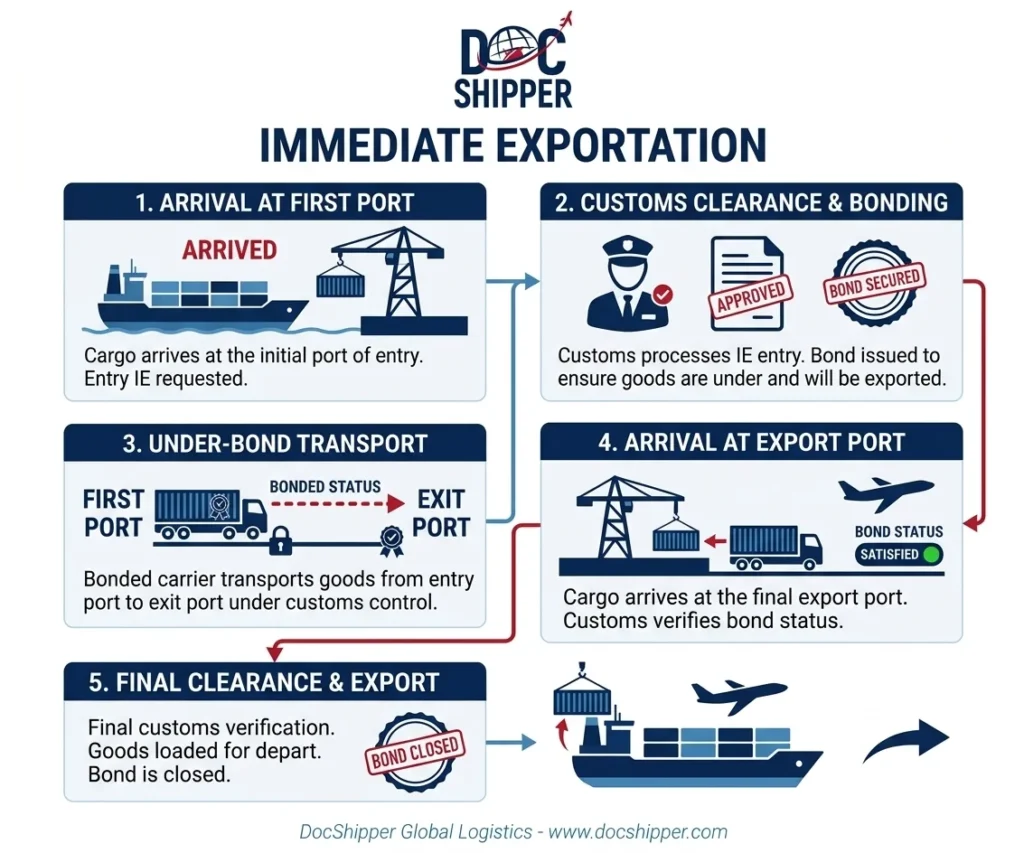
The process begins with arrival notification to customs authorities. The importer or freight forwarder submits an immediate exportation entry, specifying the intended exit point and estimated departure date. This declaration creates a legal commitment to remove goods within the prescribed timeframe.
Customs supervision represents the core principle. Authorities track cargo movement through sealed containers, bonded warehouse storage, or direct transfer protocols. Breaking seals without authorization triggers severe penalties and potential seizure.
The bond requirement protects government revenue. Shippers post financial security covering potential duties and taxes. Bond amounts typically equal 110% to 150% of estimated import charges. Upon proof of exportation, customs releases the bond.
Time limitations prevent indefinite storage under this regime. Most countries impose 30-day to 90-day limits. Extensions require formal applications with justification. Failure to export within deadlines converts the operation to standard import, triggering full duties and administrative penalties.
At DocShipper, we systematically verify immediate exportation eligibility during route planning. Our customs specialists ensure proper documentation, coordinate bond posting, and track deadline compliance to prevent costly regime violations.
Practical Applications & Comparative Data
Immediate exportation serves diverse logistics scenarios. Understanding practical applications helps shippers optimize international routing strategies and reduce operational costs.
Typical Use Cases
| Scenario | Description | Typical Savings |
|---|---|---|
| Port Rerouting | Cargo arrives at wrong port; needs transfer to correct destination | 60-80% cost reduction vs. import-export |
| Transit Consolidation | Multiple shipments combine before final destination | 30-45% time savings in clearance |
| Rejected Shipments | Buyer refuses delivery; goods return to origin | Zero duty payment on rejected goods |
| Exhibition Goods | Trade show materials arriving/departing quickly | Simplified documentation reduces delays |
Comparative Analysis: Immediate Exportation vs. Standard Transit
Consider a machinery shipment from Japan arriving at Los Angeles port, destined for final delivery in Mexico:
Standard Transit Procedure:
- Complete U.S. customs declaration filing
- Inspection probability: 15-20%
- Processing time: 3-5 business days
- Administrative costs: $800-1,200
- Bond requirement: Full value coverage
Immediate Exportation Procedure:
- Simplified entry form submission
- Inspection probability: 5-8%
- Processing time: 4-8 hours
- Administrative costs: $200-400
- Bond requirement: Duty-based calculation only
This example demonstrates immediate exportation efficiency. The procedure reduces costs by 70% and accelerates cargo movement by 80%. For time-sensitive shipments, these savings prove substantial.
Industry statistics reveal growing adoption. According to U.S. Customs data, immediate exportation entries increased by 23% from 2020 to 2023, reflecting shippers’ recognition of procedural advantages.
Conclusion
Immediate exportation offers significant advantages for cross-border logistics: reduced costs, faster processing, and simplified compliance. Mastering this procedure enhances supply chain flexibility and protects profit margins.
Need assistance navigating immediate exportation requirements? Contact DocShipper for expert guidance tailored to your specific shipping scenarios.
📚 Quiz
Test Your Knowledge: Immediate Exportation
What is the primary defining characteristic of immediate exportation?
A shipper believes immediate exportation allows unlimited storage time in the transit country as long as customs seals remain intact. Is this correct?
An electronics manufacturer needs to consolidate shipments from three Asian suppliers arriving at Los Angeles port before final delivery to Mexico. Which statement correctly applies immediate exportation?
🎯 Your Result
📞 Free Quote in 24hFAQ | Immediate Exportation: Definition, Process & Practical Examples
Immediate exportation applies when goods arrive and immediately prepare for re-export without entering commerce. Transit covers inland movement between entry and exit points. The former requires no transit bond movement documentation, while transit demands continuous tracking across domestic territory. Both avoid duty payment but serve different operational purposes.
Most commercial goods qualify, but restrictions exist. Prohibited items (weapons, hazardous materials), perishables requiring inspection, and goods under sanction cannot use this procedure. Additionally, some countries exclude high-value items exceeding specific thresholds. Always verify commodity-specific regulations before planning immediate exportation strategies.
Missing deadlines converts the shipment to formal import status. Customs assesses duties, taxes, and penalty charges retroactively. The posted bond covers these obligations, but administrative fines may exceed bond amounts. In severe cases, goods face seizure. Proactive deadline management and extension requests prevent these consequences.
Standard marine cargo insurance covers immediate exportation movements. However, policy terms should explicitly include customs-supervised transport. Notify insurers about the procedure to ensure continuous coverage. Some insurers offer reduced premiums for bonded movements due to lower theft and damage risks under customs supervision.
Major international ports and airports support this procedure, but smaller facilities may lack infrastructure. Customs stations require bonded warehouse access and trained staff. Before routing shipments, confirm destination ports offer immediate exportation services. Alternative ports might necessitate different customs strategies.
Proof includes stamped export declarations, carrier departure manifests, and customs exit certificates. Electronic systems generate automatic confirmations when goods clear territorial waters or cross land borders. Retain these documents for three to five years, as audits may request verification. DocShipper maintains comprehensive digital records for all immediate exportation transactions.
No. Goods under immediate exportation must remain in their arrival condition. Any manufacturing, assembly, or modification triggers import requirements and duty assessment. Only repackaging, consolidation, or labeling changes align with procedure rules. For value-added operations, consider foreign trade zones or bonded manufacturing regimes.
Customs calculates bonds based on potential duty liabilities. The formula typically includes merchandise value multiplied by applicable duty rates, plus estimated taxes and fees. Most jurisdictions add a 10-50% buffer. Continuous bonds covering multiple shipments prove more economical than single-entry bonds for regular immediate exportation users.
Breaking customs seals without authorization constitutes a serious violation. Penalties include fines ranging from $1,000 to $10,000, immediate duty assessment, cargo seizure, and potential criminal charges for smuggling attempts. Always coordinate seal removal with customs officers. Emergency situations require immediate authority notification and incident reporting.
No. Goods retain their original country-of-origin status throughout immediate exportation. Certificates of origin remain valid without amendment. This preservation benefits products qualifying for preferential trade agreements. However, if goods later enter commerce in the transit country, origin determination follows that jurisdiction's substantial transformation rules.
Yes. This combination offers maximum flexibility. Goods enter a foreign trade zone under immediate exportation status, allowing temporary storage, inspection, or quality control before final export. This strategy suits shipments awaiting vessel connections or requiring minor adjustments. Coordinate both customs procedures simultaneously to avoid procedural conflicts.
E-commerce platforms increasingly use immediate exportation for customer returns. Products shipped to wrong countries or rejected by buyers re-export without import formalities. This procedure reduces reverse logistics costs by 40-60% compared to traditional import-export cycles. Fast-growing cross-border e-commerce makes immediate exportation essential for efficient returns management.
Need Help with
Logistics or Sourcing ?
First, we secure the right products from the right suppliers at the right price by managing the sourcing process from start to finish. Then, we simplify your shipping experience - from pickup to final delivery - ensuring any product, anywhere, is delivered at highly competitive prices.


Fill the Form
Prefer email? Send us your inquiry, and we’ll get back to you as soon as possible.
Contact us




