


In short ⚡
Import/Export (IE) refers to the international trade operations where goods are brought into a country (import) or sent out to foreign markets (export). These activities form the backbone of global commerce, requiring customs clearance, regulatory compliance, documentation management, and logistics coordination to facilitate cross-border movement of merchandise.
Introduction
Many businesses underestimate the complexity of international trade until their first shipment gets detained at customs. Import and export operations require far more than simply sending goods across borders—they demand regulatory knowledge, precise documentation, and strategic planning.
In today’s interconnected economy, IE activities represent the lifeline for businesses seeking global expansion. Whether you’re sourcing raw materials from Asia or selling finished products to European markets, understanding import/export fundamentals determines your competitive advantage.
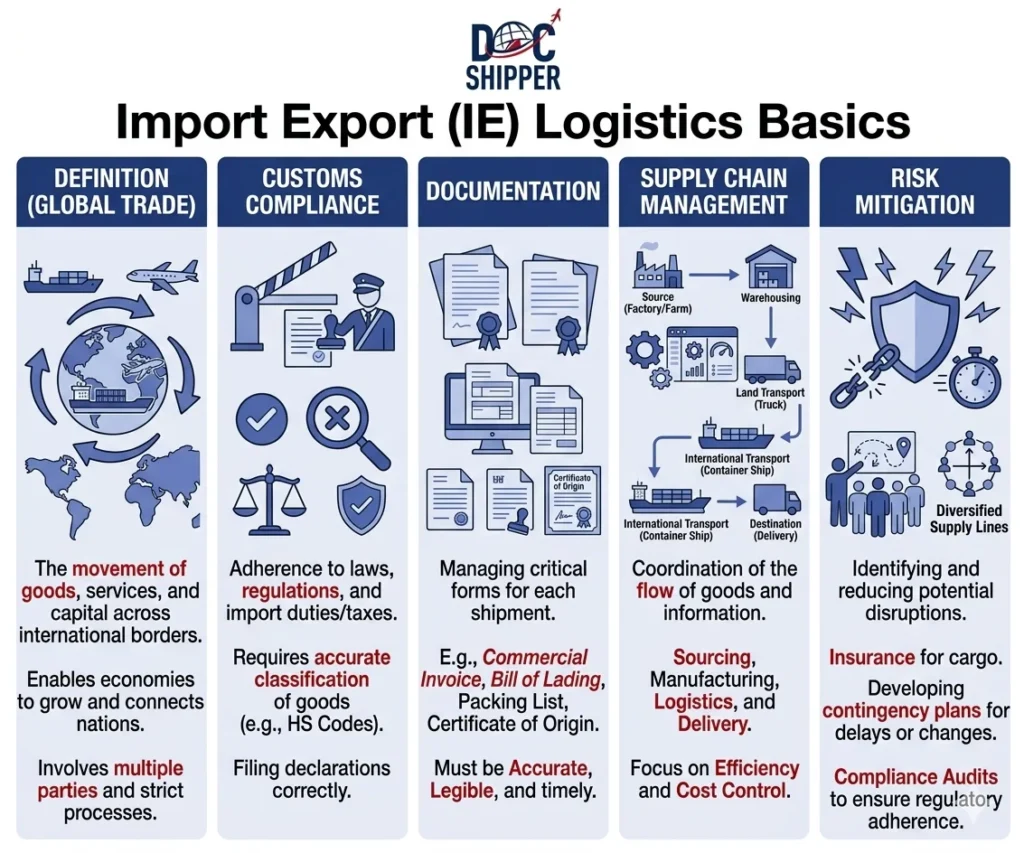
Key characteristics of IE operations include:
- Customs compliance: Adherence to destination country regulations and tariff classifications
- Documentation accuracy: Commercial invoices, packing lists, certificates of origin, and bills of lading
- Regulatory knowledge: Import restrictions, export controls, and trade agreements (FTAs, GSP)
- Logistics coordination: Transportation modes, incoterms, insurance, and freight forwarding
- Financial management: Payment terms, letters of credit, customs duties, and foreign exchange
IE Mechanisms & Trade Expertise
The import/export process involves multiple sequential stages, each with specific requirements. Understanding these mechanisms prevents costly delays and compliance violations.
Import procedures begin with determining the Harmonized System (HS) code—a standardized numerical classification that determines applicable duties and restrictions. Importers must submit entry documentation to customs authorities, typically including a commercial invoice, packing list, and certificate of origin. According to World Customs Organization guidelines, proper classification is the importer’s legal responsibility, with misclassification leading to penalties or shipment rejection.
Export regulations vary significantly by product category and destination. Controlled goods require export licenses—particularly for dual-use items, military equipment, or technologies subject to international sanctions. The Export Administration Regulations (EAR) and International Traffic in Arms Regulations (ITAR) govern US exports, while the EU maintains its own dual-use regulation framework.
Incoterms selection defines the responsibility split between buyer and seller. FOB (Free On Board) transfers risk when goods cross the ship’s rail, while DDP (Delivered Duty Paid) places maximum obligation on the seller. This contractual choice directly impacts logistics costs, insurance requirements, and customs clearance responsibilities.
Customs valuation methods determine duty assessment. The transaction value method—the price actually paid—is most common, but customs authorities may adjust values when related-party transactions or non-market conditions exist. Undervaluation constitutes fraud, while overvaluation unnecessarily increases duty payments.
Trade preference programs offer duty reductions or exemptions. Free Trade Agreements like USMCA, EU-UK TCA, or RCEP provide preferential rates when origin criteria are met. At DocShipper, we systematically analyze eligibility for these programs to minimize our clients’ landed costs and improve competitive positioning.
Practical Examples & Trade Data
Real-world IE scenarios demonstrate how operational decisions impact profitability. Consider these comparative situations:
| Scenario | Import Value | Standard Duty | FTA Duty | Annual Savings |
|---|---|---|---|---|
| Electronics from China to EU | $500,000 | 3.7% | N/A | $0 |
| Automotive parts Mexico to US | $500,000 | 2.5% | 0% (USMCA) | $12,500 |
| Textiles Bangladesh to UK | $500,000 | 12% | 0% (GSP) | $60,000 |
| Machinery Germany to Canada | $500,000 | 0% | 0% (CETA) | $0 |
Use Case: Electronics Manufacturer — A US-based tech company sources components from Vietnam ($2M annual value). By establishing proper documentation proving Vietnamese origin and leveraging the US-Vietnam trade relationship, they reduced duty rates from 4.9% to 0%, saving $98,000 annually. This required implementing origin tracking systems and securing supplier declarations.
Critical success factors for IE operations:
- HS code precision: Wrong classification can increase duties by 5-15% and trigger audits
- Documentation completeness: Missing papers cause 48-72 hour clearance delays, incurring storage fees
- Regulatory monitoring: Trade policies change quarterly; staying current prevents non-compliance
- Carrier selection: Transit time differences of 7-14 days affect inventory costs and customer satisfaction
- Insurance coverage: Marine cargo insurance typically costs 0.3-0.5% of shipment value but prevents total loss exposure
According to World Bank data, countries with streamlined customs procedures process imports 40% faster than those with complex bureaucracies. Singapore clears shipments in 10 hours on average, while some developing nations require 72+ hours. This time differential directly impacts working capital requirements and supply chain reliability.
Conclusion
Import/export mastery transforms international trade from a risk into a strategic advantage. Companies that invest in IE expertise reduce costs, accelerate delivery, and maintain regulatory compliance across multiple jurisdictions.
Need expert guidance on your international trade operations? Contact DocShipper for comprehensive import/export management services tailored to your business requirements.
📚 Quiz
Test Your Knowledge: Import/Export (IE)
What is the primary legal scope of Import/Export (IE) operations?
A company believes HS code classification is the freight forwarder's responsibility. Is this interpretation correct?
A textile importer sources $500,000 worth of goods from Bangladesh to the UK. What is the most appropriate strategy to minimize import costs?
🎯 Your Result
📞 Free Quote in 24hFAQ | IE (Import/Export): Definition, Process & Practical Examples
Core documents include commercial invoice, packing list, bill of lading (sea) or airway bill (air), certificate of origin, and import/export licenses when required. Depending on product category, additional documents like phytosanitary certificates, inspection reports, or conformity declarations may be mandatory. All documents must contain consistent information—discrepancies cause customs delays.
The Harmonized System uses a six-digit base code that countries extend to 8-10 digits. Start by identifying your product's material composition and intended use. Consult your destination country's customs tariff schedule, use online classification tools, or work with a customs broker. Binding rulings from customs authorities provide legal certainty for complex products. Misclassification carries legal liability, so professional verification is advisable.
FOB (Free On Board) means the seller delivers goods onto the vessel and pays loading costs; the buyer assumes all subsequent risks and costs. CIF (Cost, Insurance, Freight) includes the FOB costs plus ocean freight and minimum insurance to the destination port. CIF provides more predictable landed costs but transfers risk to the buyer once goods are loaded. Neither includes destination country duties, customs clearance, or inland delivery.
Most countries allow unrestricted import of general goods but require licenses for regulated categories: agricultural products, pharmaceuticals, chemicals, telecommunications equipment, or items with dual-use potential. Import licensing requirements vary by product classification and country. Some nations maintain automatic licensing systems for statistical purposes even when no restrictions apply. Always verify destination country regulations before shipping.
FTAs eliminate or reduce customs duties on qualifying goods originating in member countries. To claim preferential rates, you must prove origin through certificates (EUR.1, Form A) or origin declarations. Products must meet rules of origin criteria—typically substantial transformation or minimum regional value content. Savings range from 2-15% of goods value depending on product category and agreement terms.
Incoterms are standardized trade terms defining seller and buyer responsibilities for transportation, insurance, customs clearance, and risk transfer. The 2020 revision includes 11 terms applicable to all transport modes or specifically sea/inland waterway. Proper Incoterm selection clarifies contractual obligations, prevents disputes, and determines who handles customs procedures. Mismatched expectations cause payment delays and relationship damage.
Clearance timeframes vary by country, product type, and documentation quality. Developed nations with automated systems process routine shipments in 4-24 hours. Risk-based inspections, incorrect paperwork, or regulated goods extend this to 3-7 days. Countries with manual processes or corruption issues may require weeks. Express clearance programs (AEO, C-TPAT) can reduce processing to under 2 hours for certified traders.
Export controls restrict items with military applications, dual-use technologies, or goods destined for sanctioned countries. The US Export Administration Regulations classify items by Export Control Classification Number (ECCN). Controlled goods require export licenses before shipment. Violations carry severe penalties including fines up to $1 million and criminal prosecution. Software, encryption technology, and certain electronics face particular scrutiny.
Customs duty equals the customs value multiplied by the applicable tariff rate. Customs value typically uses transaction value—the price actually paid—adjusted for certain elements like commissions or royalties. Additional charges may include anti-dumping duties, countervailing duties, or excise taxes. Value-added tax (VAT) is calculated on the duty-paid value. Total landed cost includes all duties, taxes, and clearance fees.
Personal imports under de minimis thresholds (typically $800 in the US, €150 in EU, £135 in UK) often clear informally without commercial documentation. Quantities suggesting commercial intent trigger commercial clearance requirements regardless of stated purpose. Frequent personal imports may require registration as an importer. Restricted goods like food, plants, or controlled substances require permits even for personal use.
Customs may detain shipments for document verification, physical inspection, or suspected violations. Detention notices specify the reason and required actions—usually additional documentation or clarification. Response deadlines are strict (typically 10-30 days). Failure to respond results in goods seizure and potential destruction. Storage fees accrue during detention. Working with a licensed customs broker expedites resolution and minimizes costs.
Shipment rejection occurs when goods don't meet import standards or documentation is insufficient. Options include re-export to origin, destruction (at importer's expense), or correction if possible. Formal protests challenge customs decisions on classification or valuation, requiring detailed technical arguments and supporting evidence. Administrative appeal processes vary by country. Professional representation significantly improves success rates in dispute resolution.
Need Help with
Logistics or Sourcing ?
First, we secure the right products from the right suppliers at the right price by managing the sourcing process from start to finish. Then, we simplify your shipping experience - from pickup to final delivery - ensuring any product, anywhere, is delivered at highly competitive prices.


Fill the Form
Prefer email? Send us your inquiry, and we’ll get back to you as soon as possible.
Contact us




:%20Definition,%20Process%20&%20Practical%20Examples)