


In short ⚡
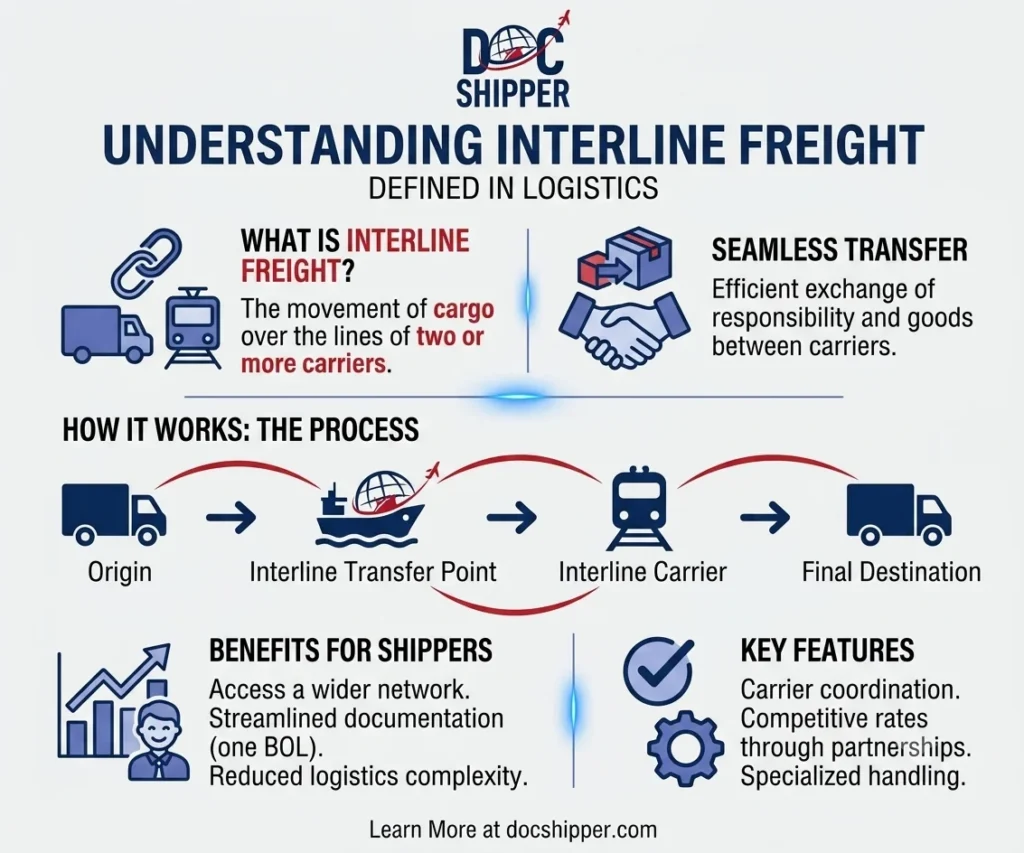
Interline freight refers to shipments transported through multiple carriers under a single contract, where each carrier handles a specific leg of the journey. This cooperative arrangement enables seamless international logistics by combining specialized transportation networks—air, ocean, rail, and road—to reach destinations no single carrier can serve independently.Introduction
Imagine booking a shipment from Shanghai to a landlocked city in Eastern Europe. No single carrier operates the entire route. This is where interline freight arrangements become essential.
In global supply chains, interline freight solves the connectivity problem. It allows shippers to access remote markets through carrier partnerships without negotiating separate contracts for each transport leg. This system underpins multimodal logistics efficiency.
Key characteristics include:
- Single waybill coverage: One document governs the entire journey across multiple carriers.
- Carrier cooperation: Airlines, shipping lines, and ground operators share liability and coordination.
- Rate transparency: Published interline tariffs simplify pricing for complex routes.
- Liability continuity: Clear protocols determine responsibility at each transfer point.
- Schedule integration: Coordinated timetables minimize delays during carrier handoffs.
Mechanisms & Operational Expertise
Interline freight operates through bilateral agreements between carriers. These contracts define handling procedures, liability limits, and revenue sharing. In air freight, the IATA Multilateral Interline Traffic Agreements (MITA) standardize terms among hundreds of airlines globally.
The process begins when the origin carrier (accepting the shipment) issues an Air Waybill (AWB) or Bill of Lading (B/L) covering all transport legs. This master document references interline partners, creating a legal chain. According to the IATA Cargo Services, approximately 40% of international air cargo involves interline connections.
At transfer points, strict protocols govern cargo handovers. The outgoing carrier verifies piece counts, weights, and damage. The incoming carrier assumes custody through digital tracking systems. Discrepancies trigger immediate investigation to maintain end-to-end accountability.
Financial settlement occurs through clearing houses like the IATA Clearing House (ICH) for air freight or similar mechanisms in ocean shipping. Carriers invoice each other for their segments, with the origin carrier collecting full payment from the shipper. This centralized system prevents payment disputes.
At DocShipper, we leverage interline networks to optimize routing for clients. When shipping electronics from Vietnam to Poland, we select combinations like ocean to Hamburg plus rail to Warsaw, utilizing carrier partnerships that our clients wouldn’t access independently. This strategic selection reduces transit time by 15-30% compared to direct-only options.
Concrete Examples & Comparative Data
Consider a pharmaceutical shipment from Boston to Nairobi. No single airline flies this route with temperature-controlled capacity daily. An interline solution might involve:
| Leg | Carrier | Route | Transit Time | Capability |
|---|---|---|---|---|
| 1 | US Carrier | Boston → Amsterdam | 8 hours | Pharma certification |
| 2 | EU Carrier | Amsterdam → Nairobi | 9 hours | Cool chain expertise |
This interline arrangement provides daily departure options versus thrice-weekly direct alternatives. Total transit: 17 hours flying plus 4 hours transfer—versus 22 hours for routings through Middle Eastern hubs.
Cost comparison (1,000 kg shipment):
- Direct single-carrier option: $8,500 (limited frequency)
- Interline two-carrier solution: $7,200 (daily availability)
- Savings: 15% reduction with better schedule flexibility
Another scenario involves ocean-air interline for automotive parts from Japan to Germany. Ocean freight from Yokohama to Los Angeles (12 days) connects with air freight to Frankfurt (11 hours). This hybrid approach costs 60% less than pure air freight while delivering 10 days faster than all-ocean routing via Suez.
DocShipper clients frequently use interline for accessing landlocked markets. A recent textile shipment to Kazakhstan utilized ocean freight to Constanta (Romania), then rail interline to Almaty. The carrier partnership handled customs transit formalities across three borders—a process that would require separate negotiations if arranged independently.
Conclusion
Interline freight transforms disconnected carrier networks into integrated global corridors. It provides shippers with routing flexibility, cost optimization, and liability clarity that single-carrier solutions cannot match. As trade patterns evolve, interline partnerships become increasingly strategic for reaching emerging markets.
Need expertise navigating interline options for your shipments? Contact DocShipper for tailored logistics solutions that leverage optimal carrier combinations.
📚 Quiz
Test Your Knowledge: Interline Freight
Interline freight arrangements primarily enable:
A shipper claims their interline air cargo was damaged. Who typically handles the initial claim?
Your pharmaceutical shipment requires temperature control from Boston to Nairobi. An interline solution combining US Carrier (Boston-Amsterdam) and EU Carrier (Amsterdam-Nairobi) offers:
🎯 Your Result
📞 Free Quote in 24hFAQ | Interline Freight: Definition, Process & Concrete Examples
Interline freight involves multiple carriers of the same transport mode (e.g., two airlines) under cooperative agreements, while multimodal transport combines different modes (air, ocean, rail) under a single operator. Interline focuses on carrier partnerships within one mode, whereas multimodal emphasizes mode integration. Both use unified documentation, but interline specifically addresses route gaps within air or ocean networks through carrier alliances.
Liability depends on where damage occurs. The carrier controlling the cargo at the damage point assumes responsibility under Warsaw Convention (air) or Hague-Visby Rules (ocean). Interline agreements specify inspection protocols at transfer points to establish custody. If damage cannot be pinpointed, the origin carrier typically handles claims and pursues recovery from partners. Comprehensive cargo insurance remains advisable for high-value shipments.
Rates combine each carrier's published tariff for their segment, plus a handling fee at transfer points. IATA's Cargo Accounts Settlement Systems (CASS) standardize air interline pricing. Carriers may offer through-rates (single price for entire journey) negotiated through alliances. Volume shippers often secure preferential interline rates. Fuel surcharges and security fees apply per segment. Total costs usually undercut single-carrier premiums for difficult routes.
Yes, through the master waybill number issued by the origin carrier. Modern cargo tracking systems integrate multiple carrier networks, providing milestone updates at each transfer. IATA's Cargo-XML messaging standard enables real-time data exchange between interline partners. However, tracking granularity varies—some carriers offer GPS-level visibility while others provide airport-to-airport updates. Third-party platforms aggregate tracking across carriers for unified monitoring.
The origin carrier typically rebooks cargo on the next available interline flight or sailing at no additional charge, as delays within the network fall under carrier responsibility. Interline agreements specify rebooking priorities—perishable and high-value goods receive preference. If delays exceed 24 hours, shippers may claim compensation under applicable conventions. DocShipper's monitoring systems alert clients to connection risks, enabling proactive rebooking before disruptions occur.
Most general cargo qualifies, but dangerous goods, live animals, and human remains require special interline certifications. Not all carrier partnerships handle hazmat due to varying national regulations. Perishables need cold-chain continuity across all partners. Oversized cargo may face limitations if intermediate hubs lack handling equipment. Before booking, verify that all interline carriers in the routing possess required certifications for your commodity type.
Cargo typically travels under customs transit bonds or TIR Carnets at intermediate points, avoiding full clearance until final destination. Interline carriers coordinate bonded warehouse transfers and documentation flow. The master waybill includes customs information for all transit countries. However, shippers remain responsible for ensuring proper export/import documentation. Errors discovered mid-route can trigger costly rerouting or storage fees across the interline chain.
Online carriers operate the entire route with their own assets and booking systems, while interline carriers form partnerships to cover routes neither serves individually. Online service offers simpler coordination but limited geographic reach. Interline provides access to more destinations through carrier combinations. Airlines distinguish these with "own metal" (online) versus "partner metal" (interline) in booking systems. Pricing and liability terms differ—online typically offers lower rates for routes they dominate.
Yes, though typically through freight forwarders who consolidate shipments to meet minimum volume thresholds. Individual shippers rarely negotiate direct interline contracts—these require significant annual tonnage commitments. Forwarders like DocShipper leverage master agreements with interline carriers, passing volume discounts to smaller clients. Consolidation also simplifies documentation, as the forwarder manages interline coordination. For occasional shippers, forwarder-arranged interline often proves more economical than direct carrier bookings.
Interline shipments generally carry longer transit estimates than direct services, as they include scheduled transfer windows. Guarantees depend on contractual terms—some carriers exclude interline connections from money-back assurances. Transfer delays at intermediate hubs represent the primary risk factor. However, interline may offer faster overall delivery for underserved routes where direct alternatives involve circuitous routings or infrequent schedules. Always request estimated delivery ranges accounting for potential connection buffers.
Core documents include a commercial invoice, packing list, and any commodity-specific certificates (phytosanitary, origin, etc.). The origin carrier issues a through Air Waybill or Bill of Lading listing all interline partners. For air freight, the "conditions of contract" box specifies interline terms. Export/import licenses must cover all transit countries. If routing includes different customs territories, ATA Carnets or transit declarations may apply. Ensure all documents reference the master waybill number for seamless carrier handoffs.
Alliances like SkyTeam Cargo or Ocean Alliance standardize interline procedures, shared booking platforms, and reciprocal handling agreements among member carriers. This reduces coordination complexity and improves schedule synchronization. Alliance members often prioritize each other's cargo at transfer points, reducing delay risks. Volume commitments within alliances unlock preferential interline rates. However, alliance networks may exclude certain routes where members compete directly, necessitating non-alliance interline partnerships for comprehensive global coverage.
Need Help with
Logistics or Sourcing ?
First, we secure the right products from the right suppliers at the right price by managing the sourcing process from start to finish. Then, we simplify your shipping experience - from pickup to final delivery - ensuring any product, anywhere, is delivered at highly competitive prices.


Fill the Form
Prefer email? Send us your inquiry, and we’ll get back to you as soon as possible.
Contact us




