


In short ⚡
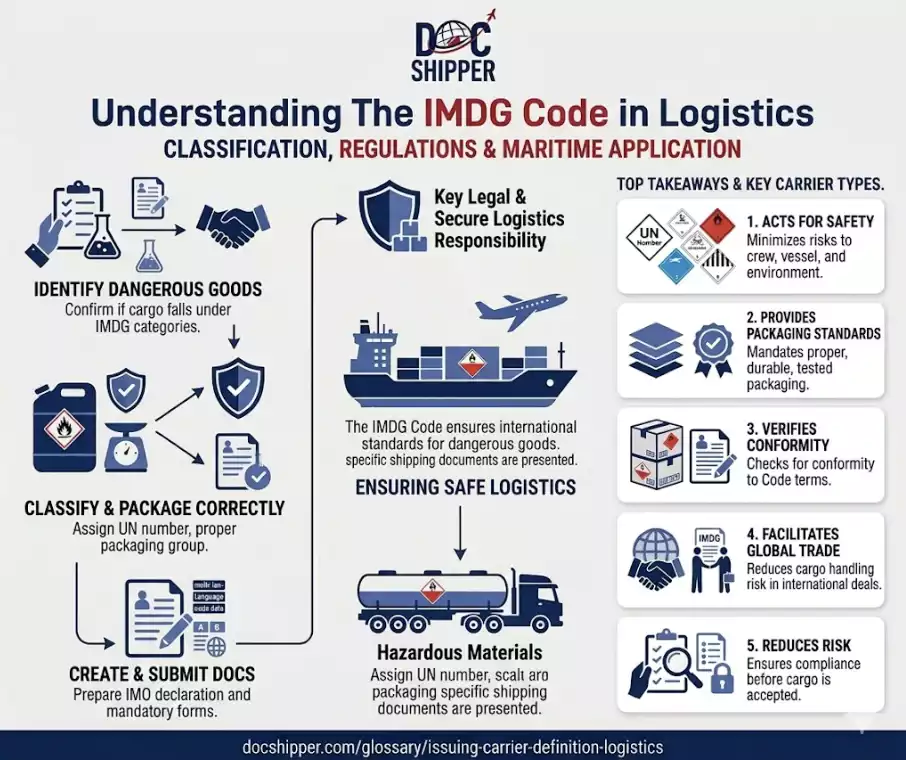
The IMDG Code (International Maritime Dangerous Goods Code) is the global regulatory framework established by the International Maritime Organization (IMO) to ensure safe transportation of hazardous materials by sea. It classifies dangerous goods into nine categories, defines packaging requirements, labeling standards, and emergency procedures to prevent accidents during maritime shipping operations worldwide.
Introduction
Shipping hazardous materials internationally exposes logistics operators to severe legal penalties, cargo rejection, and environmental disasters costing millions in damages. Many exporters misclassify products or underestimate documentation requirements, leading to port delays and safety incidents.
The IMDG Code addresses this challenge by establishing universal safety protocols for dangerous goods transported by container ships. It affects industries from chemicals and batteries to pharmaceuticals and automotive parts.
Key characteristics of IMDG compliance include:
- Nine hazard classes covering explosives, gases, flammable liquids, toxic substances, and radioactive materials
- Strict packaging specifications with UN certification requirements for containers and inner packaging
- Mandatory documentation including the Dangerous Goods Declaration (DGD) and Material Safety Data Sheets (MSDS)
- Labeling and placarding systems using internationally recognized diamond-shaped symbols and color codes
- Segregation rules preventing incompatible substances from being stowed together on vessels
Regulatory Framework & Technical Requirements
The IMDG Code operates under the International Maritime Organization’s SOLAS Convention (Safety of Life at Sea). Updated every two years, it harmonizes with air transport regulations (IATA) and road transport standards (ADR) through the UN Model Regulations.
The classification system divides dangerous goods into nine primary classes based on physical and chemical properties. Class 1 covers explosives with six subdivisions by sensitivity. Class 2 includes compressed gases (flammable, non-flammable, toxic). Class 3 addresses flammable liquids with different flash point thresholds.
Each substance receives a UN number (four-digit identifier) and proper shipping name. The UN number determines packaging groups (I, II, III) indicating danger levels. Packing Group I represents high danger requiring the most robust containers. Packaging must pass drop tests, stacking tests, and leakproofness verification.
The Dangerous Goods Declaration serves as the legal document certifying compliance. It must include the UN number, proper shipping name, class, packing group, quantity, and emergency contact. False declarations can result in criminal prosecution and vessel detention.
At DocShipper, our compliance specialists verify IMDG documentation accuracy before cargo leaves the warehouse, eliminating customs rejection risks and ensuring maritime safety standards are met at every handling point.
The Code mandates segregation matrices preventing chemical reactions between incompatible goods. Acids cannot be stowed near alkalis. Flammable materials must be separated from oxidizers. Violations can cause fires, explosions, or toxic gas releases at sea.
Practical Classifications & Shipping Examples
Understanding how IMDG applies to real-world shipments helps exporters avoid costly compliance failures. The following table illustrates common products and their classification requirements:
| Product Type | IMDG Class | UN Number | Key Requirement |
|---|---|---|---|
| Lithium-ion batteries (loose) | Class 9 | UN3480 | Special packing with 30% charge limit |
| Paint thinner (acetone-based) | Class 3 | UN1090 | Flammable liquid label, metal drums |
| Compressed oxygen cylinders | Class 2.2 | UN1072 | Pressure testing certification required |
| Pesticides (liquid toxic) | Class 6.1 | UN2903 | Double packaging, poison label |
| Airbag inflators (explosive) | Class 1.4G | UN3268 | Limited quantity exemptions possible |
Case Study: An automotive parts exporter shipping 5,000 lithium batteries from China to Europe faced port rejection in Hamburg. The batteries were classified under UN3480 (Class 9) but packed in non-certified cardboard boxes instead of required fiber drums with inner cushioning. The entire container was quarantined for 14 days while proper packaging was sourced locally, costing €12,000 in demurrage fees.
The incident could have been prevented through proper pre-shipment verification. Batteries exceeding 100Wh require UN38.3 testing certificates proving they withstand altitude simulation, thermal cycling, and vibration tests. Documentation must accompany the shipment with emergency response procedures in five languages.
Another common scenario involves limited quantity provisions. Small amounts of dangerous goods (e.g., perfume samples with alcohol content) may qualify for reduced packaging and labeling requirements if properly declared. However, exporters must still apply the limited quantity mark (diamond with “LQ” text) and comply with maximum inner packaging limits.
DocShipper’s dangerous goods team provides classification audits, arranges UN-certified packaging suppliers, and prepares compliant DGD documentation, ensuring your hazardous cargo moves smoothly through global shipping lanes without regulatory obstacles.
Five critical compliance checkpoints before shipping IMDG cargo:
- Accurate UN classification confirmed through technical datasheets and chemical composition analysis
- Packaging certification verified through UN approval codes printed on containers (e.g., “4G/Y150/S/17”)
- Proper labeling with primary and subsidiary hazard diamonds measuring at least 100mm x 100mm
- Complete documentation including signed DGD, 24-hour emergency contact, and container packing certificate
- Carrier approval obtained before booking, as some shipping lines restrict specific hazard classes
Conclusion
Mastering IMDG Code requirements protects your business from legal liability while ensuring maritime safety across international supply chains. Compliance transforms from regulatory burden into competitive advantage when executed correctly.
Need expert guidance on dangerous goods classification or documentation preparation? Contact DocShipper for specialized support navigating IMDG complexities across all shipping routes.
📚 Quiz
Test Your Knowledge: IMDG Code
What is the primary purpose of the IMDG Code?
A company ships lithium-ion batteries loose in standard cardboard boxes. According to IMDG requirements, this approach is:
An exporter wants to ship flammable paint thinner (Class 3) and compressed oxygen cylinders (Class 2.2) in the same container. Which statement correctly applies IMDG segregation rules?
🎯 Your Result
📞 Free Quote in 24hFAQ | IMDG (International Maritime Dangerous Goods): Definition, Regulations & Practical Examples
Mislabeling dangerous goods can result in cargo rejection at port, fines up to €50,000 per incident, criminal prosecution for serious violations, and blacklisting by shipping lines. Port authorities may also order container destuffing and disposal at shipper's expense. Insurance policies typically exclude coverage for non-compliant shipments, leaving exporters financially liable for accidents.
Lithium batteries qualify as Class 9 dangerous goods under UN3480 (standalone batteries) or UN3481 (batteries packed with equipment). However, small batteries under 100Wh with proper packaging may use simplified "Section II" procedures. Batteries installed in equipment sometimes exempt from full IMDG requirements but still need safety documentation. Always verify specific UN number applicability.
The IMO publishes IMDG Code amendments every two years, with mandatory implementation approximately six months after release. Amendment 41-22 became effective January 1, 2024. Updates typically add new UN numbers, revise packaging specifications, and incorporate technological advances like electric vehicle battery transport. Logistics providers must maintain current editions for compliance verification.
No legitimate carrier will accept dangerous goods without a properly executed DGD. This signed document legally certifies that cargo complies with IMDG requirements. Missing or incomplete DGD results in automatic cargo refusal. Even "limited quantity" shipments require marking and simplified documentation. Electronic DGD formats are acceptable if digitally signed and carrier-approved.
Both codes follow UN Model Regulations but apply different transport modes. IMDG governs sea freight with focus on container stowage and vessel safety. IATA covers air freight with stricter quantity limits due to altitude and pressurization concerns. Many substances prohibited by air (UN1090 acetone in large quantities) move freely by sea. Packaging may differ between modes.
Packaging manufacturers test containers through accredited laboratories following UN protocols. Compliant packaging displays a UN marking code indicating type, material, performance group, and approval country (example: "4G/Y150/S/17/NL/VL2345" for fiber drum). Exporters must verify this code matches the required packing group for their UN number. Certification expires and requires retesting.
Flammable liquids (Class 3) ship in standard containers if properly packaged and declared. However, they require specific stowage locations on vessels away from heat sources and incompatible cargo. High flash point substances may have reduced restrictions. Quantities exceeding tank container thresholds need specialized ISO tanks with pressure relief valves and emergency venting systems.
Shippers must provide 24-hour emergency contact numbers on the DGD for incident response. Material Safety Data Sheets (MSDS) or Safety Data Sheets (SDS) detail chemical properties, first aid measures, and firefighting procedures. The IMDG Code requires Emergency Schedule (EmS) numbers indicating ship crew response actions. Port authorities and coast guards access this information during emergencies.
Consolidation is permitted if segregation rules are followed. IMDG segregation tables define "away from," "separated from," and "separated by a complete compartment" requirements between incompatible classes. Class 1 explosives have strictest segregation needs. Consolidators must issue a Container Packing Certificate confirming proper stowage. Mixed loads increase inspection probability at ports.
While IMDG is internationally recognized, enforcement varies by port authority. EU ports apply strict controls with container scanning and documentation audits. Some developing countries have less rigorous checks but still hold shippers liable for accidents. Major shipping lines enforce IMDG globally regardless of destination. Non-compliance discovered at transshipment ports causes cascading delays across multiple countries.
Start with product Safety Data Sheets (SDS) which list hazard classifications per GHS standards. If SDS indicates flammability, toxicity, corrosiveness, or reactivity, IMDG likely applies. Consult UN classification databases or engage a dangerous goods consultant for technical analysis. When in doubt, declare as dangerous goods rather than risk non-compliance. Certain products like perfumes, aerosols, and cleaning agents surprise exporters with hidden classifications.
Penalties include immediate cargo detention, fines ranging from €5,000 to €100,000 depending on severity and jurisdiction, criminal charges for reckless endangerment if accidents occur, permanent bans from specific ports or shipping lines, and civil liability for environmental damage. Insurance exclusions mean violators personally fund cleanup operations. Repeat offenders face license revocations for freight forwarding operations.
Need Help with
Logistics or Sourcing ?
First, we secure the right products from the right suppliers at the right price by managing the sourcing process from start to finish. Then, we simplify your shipping experience - from pickup to final delivery - ensuring any product, anywhere, is delivered at highly competitive prices.


Fill the Form
Prefer email? Send us your inquiry, and we’ll get back to you as soon as possible.
Contact us




:%20Definition,%20Regulations%20&%20Practical%20Examples)