


In short ⚡
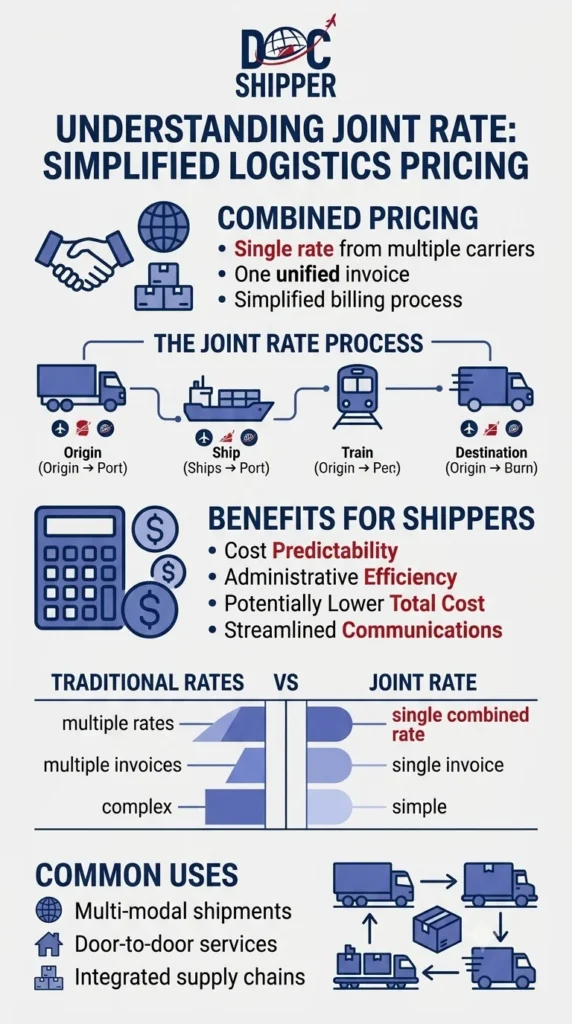
The Joint Rate is a single, combined freight charge applied when shipment requires multiple carriers to complete the journey from origin to destination. Instead of negotiating separate rates with each carrier, shippers pay one consolidated price covering the entire multi-modal or multi-leg transportation route.
Introduction
Many importers face confusion when their cargo requires multiple carriers. Should they negotiate with each carrier separately or secure a single rate? The Joint Rate eliminates this complexity by providing one transparent price for the entire journey.
In international logistics, most shipments cross multiple jurisdictions and transport modes. Ocean freight, rail, and trucking often combine to move goods efficiently. Understanding Joint Rates becomes critical for accurate cost forecasting and supplier negotiations.
- Single invoice: Simplified billing across multiple carriers
- Coordinated liability: One party responsible for claims throughout transit
- Cost efficiency: Often cheaper than separate individual rates
- Simplified documentation: Reduced paperwork and administrative burden
- Streamlined scheduling: Carriers coordinate transfers and timing
How Joint Rates Work & Legal Framework
Joint Rates emerge from interline agreements between carriers. These contracts establish revenue division formulas, liability protocols, and service standards. The lead carrier collects payment and distributes portions to participating carriers according to pre-negotiated splits.
The legal foundation varies by region. In the United States, the Surface Transportation Board governs rail Joint Rates under 49 U.S.C. § 10705. European regulations follow the CMR Convention for road transport, while maritime Joint Rates operate under commercial agreements rather than specific treaties.
Three pricing models dominate the market. Proportional Joint Rates divide charges based on distance covered by each carrier. Blanket Joint Rates apply uniform pricing regardless of specific routing. Arbitrary Joint Rates add fixed amounts to base rates when shipments require additional services beyond standard routes.
Liability allocation follows the “prima facie” rule in most jurisdictions. The contracting carrier assumes responsibility for the entire shipment unless they prove damage occurred on another carrier’s segment. This protection simplifies claims for shippers who deal with one entity instead of multiple carriers.
At DocShipper, we systematically verify Joint Rate agreements to ensure our clients receive optimal pricing and clear liability coverage. Our expertise helps identify when Joint Rates offer advantages over separate carrier negotiations, particularly for complex multi-modal shipments requiring specialized freight forwarding services.
Practical Examples & Cost Comparisons
Consider a shipment from Shanghai to Chicago. The cargo travels by ocean to Los Angeles, then rail to Chicago. Separate negotiations might cost $2,100 ocean + $850 rail = $2,950. A Joint Rate could consolidate this to $2,600 total, saving $350 through carrier coordination and volume commitments.
| Routing Scenario | Separate Rates | Joint Rate | Savings |
|---|---|---|---|
| Shanghai-LA (ocean) + LA-Chicago (rail) | $2,950 | $2,600 | $350 (12%) |
| Hamburg-Rotterdam (truck) + Rotterdam-UK (ferry) | $780 | $720 | $60 (8%) |
| Tokyo-Vancouver (ocean) + Vancouver-Toronto (rail) | $3,200 | $2,850 | $350 (11%) |
Use Case: Electronics Import
A tech company imports 45 pallets of laptops quarterly from Shenzhen to Dallas. Their logistics manager initially secured separate quotes: ocean carrier ($3,800), drayage ($450), and rail ($1,100). Total expenditure: $5,350 per shipment.
After consulting DocShipper, they switched to a Joint Rate agreement combining all segments. The new rate: $4,700 per shipment. Annual savings across four quarterly shipments reached $2,600, while claim processing time dropped from 45 days to 18 days due to unified carrier responsibility.
Key advantages observed in this transition included predictable pricing immune to mid-route surcharges, synchronized scheduling reducing warehouse storage fees by 20%, and simplified customs clearance through single-point documentation. The company also gained leverage for future negotiations by demonstrating consistent volume through one carrier network.
Conclusion
Joint Rates transform complex multi-carrier logistics into manageable, cost-effective solutions. By consolidating pricing and responsibility, they reduce administrative burden while often delivering significant cost savings for shippers managing international supply chains.
Need expert guidance on securing optimal Joint Rates for your import routes? Contact DocShipper for customized logistics solutions.
📚 Quiz
Test Your Knowledge: Joint Rate
What is the primary definition of a Joint Rate?
Who handles damage claims when cargo is shipped under a Joint Rate agreement?
A company ships electronics from Shanghai to Dallas via ocean to Los Angeles, then rail inland. When would a Joint Rate be most appropriate?
🎯 Your Result
📞 Free Quote in 24hFAQ | Joint Rate: Definition, Calculation & Concrete Examples
While both terms describe single charges for multi-carrier shipments, Joint Rates specifically involve formal interline agreements with revenue-sharing formulas. Through rates may simply represent bundled pricing without underlying carrier partnerships. Joint Rates typically offer better service coordination and clearer liability provisions than basic through rates.
Large shippers with significant volume can negotiate directly, but most companies benefit from freight forwarder expertise. Forwarders leverage combined client volumes to secure better Joint Rates than individual shippers could obtain. They also manage the complexity of multi-carrier coordination and documentation requirements throughout the shipping process.
Revenue division follows predetermined formulas based on factors like distance covered, equipment provided, and liability assumed. Proportional splits allocate payments matching each carrier's contribution. Alternative methods include fixed division percentages or terminal-to-terminal calculations. These formulas remain confidential between carriers but don't affect shipper costs.
Not necessarily. Joint Rates offer savings when carriers coordinate efficiently and share volume commitments. However, shippers with exceptional negotiating leverage on specific routes might secure lower individual carrier rates. The non-financial benefits—simplified administration, unified liability, coordinated scheduling—often justify Joint Rates even when absolute costs are comparable.
The originating or contracting carrier assumes primary responsibility regardless of where damage occurred. They investigate the claim and compensate the shipper, then pursue recovery from the actual at-fault carrier through interline settlement procedures. This unified liability simplifies the claims process compared to determining which specific carrier caused damage.
Yes, though less commonly than in ocean-rail combinations. Air cargo Joint Rates typically involve partnerships between international and domestic carriers for shipments requiring connections beyond gateway airports. IATA facilitates these agreements through standardized proration rules and neutral settlement systems that simplify revenue distribution among participating airlines.
Contract duration varies from spot agreements for single shipments to multi-year service contracts. Most commercial Joint Rate agreements span 12-36 months with quarterly rate review clauses. Longer commitments often secure better pricing but reduce flexibility to respond to market changes. Shippers should balance cost savings against potential need to adjust carrier partnerships.
Some comprehensive Joint Rates incorporate customs brokerage as part of the total charge, though this remains less common than pure transportation rates. When included, one carrier typically subcontracts clearance services while maintaining overall responsibility. Shippers should verify exactly which services the Joint Rate covers to avoid unexpected charges at destination.
The contracting carrier remains obligated to complete delivery, either through alternate carriers or their own resources. Shippers protected by Joint Rate contracts don't face service interruption or additional costs. The surviving carriers absorb any financial losses from the bankrupt partner's failure. This protection represents a significant advantage over separate individual carrier contracts.
Fuel surcharges can be built into the flat Joint Rate or applied as separate line items. Most agreements specify surcharge calculation methodology upfront, often using industry-standard indices like the U.S. DOE diesel price or maritime bunker fuel rates. Transparent surcharge formulas prevent disputes while allowing rates to reflect actual fuel cost fluctuations.
Standard Joint Rates typically include reasonable dwell time at transfer terminals—usually 24-48 hours for container transfers. Extended storage beyond these free periods incurs additional charges. Shippers should clarify included dwell time when negotiating Joint Rates, as excessive storage fees can eliminate transportation savings on shipments facing customs delays or inspection holds.
Switching depends on existing contract terms and carrier willingness to restructure agreements. Some shippers successfully transition by demonstrating consistent volume that justifies Joint Rate economics. Others must wait for contract renewals. Freight forwarders often facilitate these transitions by leveraging relationships and aggregating multiple client shipments to meet Joint Rate volume thresholds.
Need Help with
Logistics or Sourcing ?
First, we secure the right products from the right suppliers at the right price by managing the sourcing process from start to finish. Then, we simplify your shipping experience - from pickup to final delivery - ensuring any product, anywhere, is delivered at highly competitive prices.


Fill the Form
Prefer email? Send us your inquiry, and we’ll get back to you as soon as possible.
Contact us




