


In short ⚡
A Joint Supplier Agreement (JSA) is a contractual framework where two or more suppliers collaborate to fulfill a single procurement order or supply chain obligation. This arrangement enables shared responsibilities, risk distribution, and combined expertise to deliver complex goods or services that individual suppliers cannot provide independently. JSAs are particularly valuable in international logistics, manufacturing, and large-scale infrastructure projects.
Introduction
Global supply chains face increasing complexity. Single suppliers often struggle to meet multifaceted requirements involving diverse product categories, geographical constraints, or technical specifications. This challenge creates contractual ambiguity and operational risks.
The Joint Supplier Agreement addresses this gap. It establishes clear collaboration terms between multiple vendors serving a common buyer. In international trade, JSAs enable seamless coordination across borders, optimizing cost efficiency and delivery timelines.
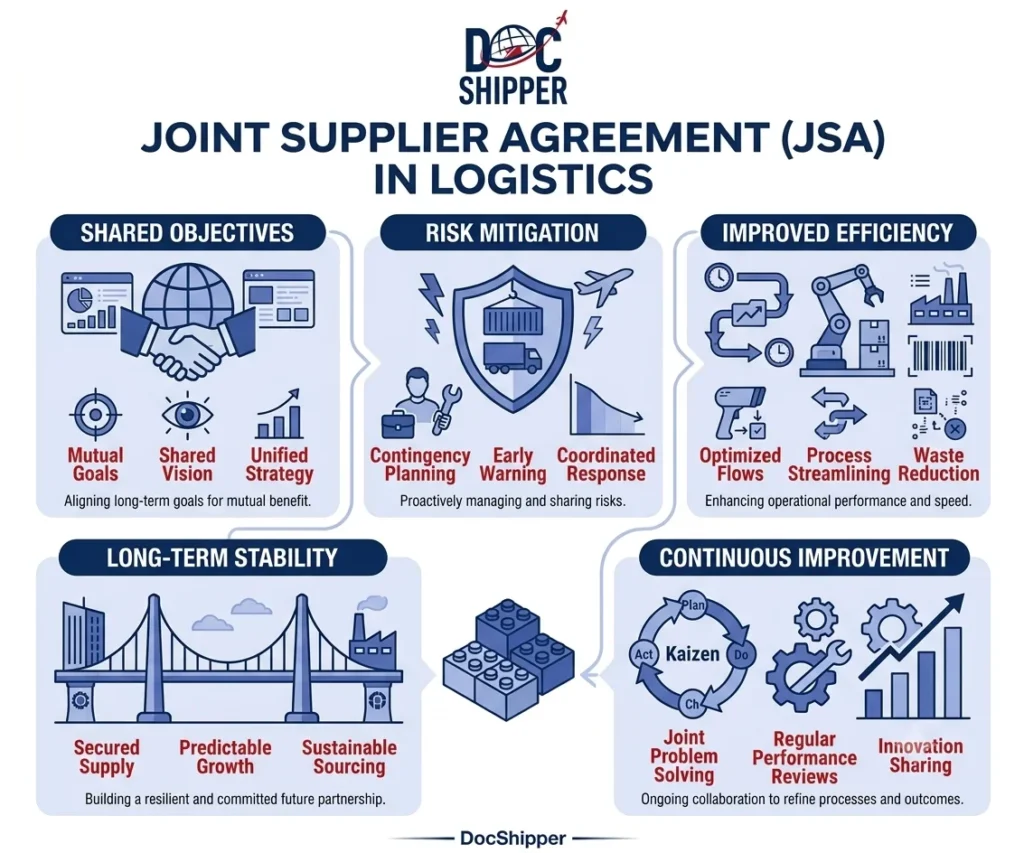
Key characteristics of effective JSAs include:
- Defined liability allocation – Specifies each party’s responsibility for defects, delays, or contractual breaches
- Unified communication channels – Establishes single points of contact to prevent buyer confusion
- Shared intellectual property protocols – Protects proprietary information when suppliers collaborate on design or manufacturing
- Coordinated delivery schedules – Synchronizes production and shipping to meet buyer deadlines
- Payment distribution mechanisms – Outlines how buyer payments are divided among suppliers
Legal Framework & Operational Mechanisms
A Joint Supplier Agreement operates under contract law principles governing joint and several liability or proportionate responsibility. The chosen structure dramatically impacts risk exposure. Under joint liability, the buyer can claim full compensation from any supplier, who then seeks reimbursement from co-suppliers. Proportionate models limit each supplier’s obligation to their contractual share.
International JSAs must address jurisdictional conflicts. When suppliers operate across multiple countries, the agreement should specify governing law and dispute resolution forums. The ICC International Court of Arbitration frequently resolves such disputes through neutral arbitration.
Key operational mechanisms include:
- Lead supplier designation – One party manages buyer communication while subcontracting to partners
- Consortium structures – All suppliers maintain direct contractual relationships with the buyer through a master agreement
- Performance guarantees – Bank guarantees or bonds ensure delivery despite individual supplier failures
- Quality control protocols – Standardized inspection procedures prevent liability disputes over defective components
- Exit clauses – Conditions allowing supplier withdrawal without penalizing remaining parties
Customs authorities scrutinize JSAs during import processing. Goods from multiple suppliers under one purchase order require precise invoice consolidation and valuation documentation. At DocShipper, we coordinate multi-supplier shipments by harmonizing commercial invoices and ensuring HS code consistency across all components to prevent clearance delays.
Incoterms selection becomes complex in JSAs. When Supplier A ships finished goods while Supplier B provides spare parts, the agreement must clarify whether transport costs are bundled or separated. Misaligned Incoterms create cost disputes and insurance gaps.
Practical Applications & Industry Examples
Joint Supplier Agreements dominate industries requiring complementary expertise or geographic diversification. The following scenarios illustrate their strategic value:
| Industry | Supplier Roles | JSA Benefit |
|---|---|---|
| Automotive Manufacturing | Supplier A: Engine components (Germany) Supplier B: Electronic systems (Taiwan) | Synchronized just-in-time delivery to assembly plant |
| Pharmaceutical Distribution | Supplier A: Active ingredients (India) Supplier B: Cold chain logistics (Dubai) | Maintains temperature-controlled integrity across segments |
| Construction Projects | Supplier A: Steel beams (China) Supplier B: Installation services (Local) | Combines material supply with specialized labor |
| Electronics Assembly | Supplier A: Semiconductors (South Korea) Supplier B: PCB manufacturing (Vietnam) | Reduces lead times through regional supply chain clustering |
Use Case: Medical Equipment Procurement
A European hospital network orders 500 MRI machines requiring imaging hardware and AI diagnostic software. Supplier A (Japan) manufactures the hardware, while Supplier B (USA) provides proprietary software. The JSA stipulates:
- Supplier A handles shipping under DDP Incoterms to hospital destinations
- Supplier B installs software remotely post-delivery within 48 hours
- Payment split: 70% to Supplier A, 30% to Supplier B upon final acceptance
- Joint warranty covering both hardware and software for 3 years
This arrangement eliminates the buyer’s need to coordinate separately with two vendors. However, if software integration fails, the JSA’s liability clause determines whether Supplier A shares responsibility for delayed commissioning.
DocShipper frequently structures JSAs for clients importing from multiple Asian manufacturers. We consolidate shipments in our Hong Kong warehouse, manage customs documentation as a single entity, and distribute goods according to the agreement’s payment terms. This reduces import duties through optimized valuation methods.
Conclusion
Joint Supplier Agreements transform complex procurement into streamlined collaboration. By formalizing multi-party responsibilities, JSAs mitigate supply chain risks while unlocking capabilities beyond individual supplier capacities. Success depends on meticulous contract drafting and proactive coordination.
Need expert guidance structuring a Joint Supplier Agreement for your international shipments? Contact DocShipper for tailored logistics solutions.
📚 Quiz
Test Your Knowledge: Joint Supplier Agreement (JSA)
1. What is the core definition of a Joint Supplier Agreement?
2. Under "joint and several liability" in a JSA, what is the buyer's legal right?
3. A European hospital orders MRI machines requiring hardware from Japan and software from the USA. How does a JSA benefit this procurement?
🎯 Your Result
📞 Free Quote in 24hFAQ | Joint Supplier Agreement (JSA): Definition, Key Components & Practical Examples
In subcontracting, the buyer contracts with one prime supplier who independently hires secondary suppliers. A JSA establishes direct or coordinated contractual relationships between the buyer and multiple suppliers, often with shared liability. This structure provides the buyer greater control over quality and delivery terms across all suppliers.
Customs authorities require consolidated commercial invoices reflecting all suppliers' contributions. The transaction value must account for payments to each party. Incorrect allocation can trigger valuation audits or penalty assessments. Proper documentation should itemize costs per supplier while demonstrating the unified nature of the transaction.
JSAs must comply with international trade sanctions and export controls. Including a supplier from a sanctioned jurisdiction may violate OFAC, EU, or UN restrictions depending on the buyer's location and goods involved. Legal counsel should review the agreement to ensure compliance with applicable embargoes and licensing requirements.
The outcome depends on the liability structure. Under joint and several liability, the buyer can claim full damages from any supplier, who then pursues the defaulting party. Proportionate liability limits claims to each supplier's contractual share. Well-drafted JSAs include step-in rights allowing remaining suppliers to fulfill the defaulting party's obligations at their cost.
Enforceability depends on the agreement's governing law clause and whether signatory countries recognize the chosen jurisdiction. International JSAs typically include arbitration clauses under UNCITRAL or ICC rules to avoid conflicting national court systems. Choice of law provisions should consider the enforceability of judgments in all suppliers' home countries.
The agreement should designate a primary currency for the buyer's payment, with exchange rate mechanisms for distributing funds to suppliers paid in different currencies. Common approaches include fixing exchange rates at contract signing or using a reference rate (e.g., ECB daily rates) on the payment date. Currency hedging instruments may be specified to protect against volatility.
Standard single-supplier policies may not cover JSA risks adequately. Buyers should obtain contingent liability insurance protecting against one supplier's failure impacting the entire delivery. Suppliers need errors and omissions coverage addressing their collaborative role. Marine cargo insurance must clarify which party holds insurable interest when goods originate from multiple sources.
Yes, but joint ownership requires explicit provisions defining usage rights, licensing terms, and revenue sharing from derivative works. Without clear IP clauses, disputes arise over who can commercialize jointly developed innovations. Agreements should address background IP (pre-existing knowledge) versus foreground IP (created through collaboration) separately.
A lead supplier acts as the primary interface with the buyer, coordinating schedules, consolidating invoices, and managing quality control across all participating suppliers. They typically assume greater liability in exchange for a coordination fee. The lead supplier model simplifies buyer administration but requires robust subcontractor management capabilities.
Warranty clauses should distinguish between individual component failures and system integration issues. A tiered approach often applies: each supplier warrants their deliverables separately, while a joint warranty covers interoperability. Root cause analysis protocols determine which supplier bears repair costs for failures involving multiple components.
Several sectors have developed standardized frameworks. The construction industry uses FIDIC contracts with consortium provisions. Aerospace follows AS9100 quality management standards for multi-supplier arrangements. Technology sectors reference the Open Group's supplier relationship guidelines. While templates provide structure, customization remains essential for specific project requirements.
Termination rights depend on whether the agreement is structured as joint and several or divisible. Joint and several agreements typically require terminating all suppliers simultaneously unless cause exists for individual removal. Divisible JSAs allow phased termination, but interdependencies between suppliers may render partial termination impractical. Exit clauses should address remaining suppliers' ability to fulfill obligations if one party exits.
Need Help with
Logistics or Sourcing ?
First, we secure the right products from the right suppliers at the right price by managing the sourcing process from start to finish. Then, we simplify your shipping experience - from pickup to final delivery - ensuring any product, anywhere, is delivered at highly competitive prices.


Fill the Form
Prefer email? Send us your inquiry, and we’ll get back to you as soon as possible.
Contact us




:%20Definition,%20Key%20Components%20&%20Practical%20Examples)