


In short ⚡
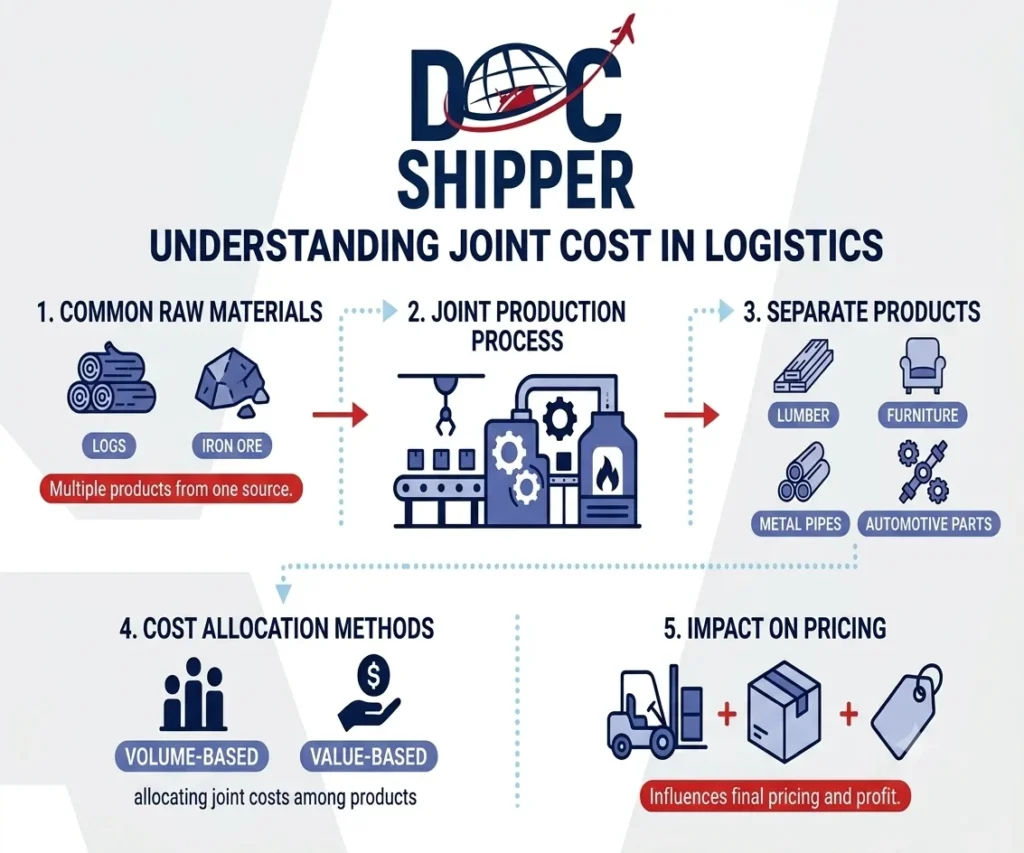
Joint Cost refers to the combined production or transportation expenses incurred when manufacturing or shipping multiple products simultaneously using shared resources. In international logistics, joint costs arise when several goods share container space, transportation routes, or processing facilities, making individual product cost allocation essential for accurate pricing and profitability analysis.
Introduction
Many importers struggle to determine the actual cost of individual products when shipments contain mixed cargo. This confusion leads to inaccurate pricing strategies, margin erosion, and compliance issues with customs valuation rules.
Understanding joint cost allocation becomes critical when multiple products share transportation, warehousing, or processing resources. Proper cost distribution ensures regulatory compliance, competitive pricing, and transparent financial reporting across the supply chain.
In international trade, joint costs commonly appear in:
- Consolidated shipments combining products from different suppliers in one container
- LCL freight where multiple importers share container space
- Multi-product manufacturing using shared production equipment or raw materials
- Bulk cargo transported together before separation at destination ports
- Customs processing fees applied collectively to mixed cargo declarations
Joint Cost Mechanisms & Allocation Methods
Joint costs differ fundamentally from separable costs. While separable costs trace directly to specific products, joint costs require systematic allocation methods to assign shared expenses proportionally.
The split-off point defines where joint products become individually identifiable. Before this point, all costs remain joint; after separation, costs become directly attributable. For ocean freight, the split-off point typically occurs at port arrival when cargo undergoes deconsolidation.
Five primary allocation methods exist:
Physical measurement allocation distributes costs based on weight, volume, or quantity. A 20-foot container costing $3,000 carrying 10 tons total would assign $300 per ton to each product category. This method suits commodities with similar unit values.
Sales value allocation assigns costs proportionally to product revenue potential. Higher-value goods absorb more joint costs, reflecting their ability to bear expenses. Customs authorities often require this method for customs valuation purposes under WTO guidelines.
Net realizable value (NRV) allocation considers final selling price minus separable costs. This method works best when products require additional processing after the split-off point, ensuring profitability analysis accounts for post-separation expenses.
At DocShipper, we systematically apply the most appropriate allocation method during cost calculation, ensuring customs compliance while optimizing your landed cost structure across product categories.
Constant gross margin percentage allocates joint costs to achieve uniform profitability across all products. While theoretically sound, this method proves complex for international shipments with variable market conditions.
Activity-based costing (ABC) identifies specific cost drivers like handling frequency, storage duration, or customs complexity. Though resource-intensive, ABC provides the most accurate allocation for diverse product portfolios.
Practical Applications & Industry Data
Understanding joint cost allocation through real scenarios clarifies its impact on international trade profitability.
Scenario 1: Electronics Importer (Physical Measurement Method)
A US retailer imports a 40-foot container with mixed electronics. Total ocean freight and customs clearance cost $5,200. Container contents:
- Laptops: 800 units, 6,400 kg (40% of weight)
- Tablets: 1,200 units, 4,800 kg (30% of weight)
- Accessories: 2,000 units, 4,800 kg (30% of weight)
Allocation: Laptops = $2,080 ($2.60/unit), Tablets = $1,560 ($1.30/unit), Accessories = $1,560 ($0.78/unit). This straightforward method works when product values correlate with physical dimensions.
Scenario 2: Fashion Importer (Sales Value Method)
A European boutique consolidates LCL shipment costing €3,000. Products have significantly different values:
| Product | Retail Value | % of Total | Allocated Cost |
|---|---|---|---|
| Designer Handbags | €25,000 | 50% | €1,500 |
| Leather Jackets | €15,000 | 30% | €900 |
| Accessories | €10,000 | 20% | €600 |
This method ensures high-value goods absorb proportionate logistics costs, maintaining realistic margin calculations across the product range.
Industry Data: According to Container Trades Statistics data from 2023, approximately 42% of global container shipments involve consolidated cargo requiring joint cost allocation. Incorrect allocation methods cause an estimated 15-20% margin miscalculation in mixed-product imports.
Key considerations for effective joint cost management:
- Documentation requirements: Maintain detailed packing lists showing individual product weights, volumes, and values for audit purposes
- Customs implications: Ensure allocation method aligns with destination country valuation rules to prevent clearance delays
- Margin analysis: Review allocated costs against selling prices to identify unprofitable product lines
- Supplier negotiation: Use accurate cost data to negotiate better pricing when certain products absorb disproportionate logistics expenses
- Inventory valuation: Apply consistent allocation methods for financial reporting and tax compliance
At DocShipper, we calculate joint costs using customs-approved methodologies while optimizing your allocation strategy to support competitive pricing across all product categories.
Conclusion
Mastering joint cost allocation ensures accurate product pricing, customs compliance, and transparent profitability analysis in international trade operations. Selecting the appropriate methodology based on shipment characteristics prevents costly margin errors.
Need assistance implementing proper cost allocation for your consolidated shipments? Contact DocShipper for expert guidance tailored to your specific logistics requirements.
📚 Quiz
Test Your Knowledge: Joint Cost
1. What defines joint costs in international logistics?
2. Which allocation method do customs authorities typically prefer for compliance purposes?
3. A European importer ships a container with designer handbags (€25,000 value) and accessories (€10,000 value). Total freight is €3,500. Using sales value allocation, how much cost should be allocated to the handbags?
🎯 Your Result
📞 Free Quote in 24hFAQ | Joint Cost: Definition, Calculation & Concrete Examples
Joint costs arise from producing multiple products simultaneously using a single process, with products becoming separable at a specific split-off point. Common costs relate to shared overhead expenses like facility rent or administrative salaries that support multiple products but don't result from a unified production process. In logistics, joint costs apply to shared container space, while common costs cover warehouse operations supporting all inventory.
Most customs administrations accept sales value allocation because it aligns with transaction value principles under the WTO Customs Valuation Agreement. This method ensures declared values reflect economic reality, preventing duty avoidance through artificial cost distribution. However, documentation must demonstrate the allocation methodology's reasonableness and consistency across all shipments to satisfy customs scrutiny during audits.
While technically possible, changing allocation methods between shipments creates customs compliance risks and financial reporting inconsistencies. Tax authorities and auditors expect consistent methodology application unless product mix or business circumstances change substantially. If switching methods, document the rationale thoroughly and apply the new approach prospectively. Consistency demonstrates good faith and prevents accusations of profit manipulation or duty evasion.
Customs duties apply to individual product values, not total shipment cost. Joint cost allocation directly impacts declared customs values for each item category. Improper allocation can result in underdeclared values triggering penalties, or overdeclared values causing unnecessary duty payments. Accurate allocation ensures each product's customs value includes its proportionate share of transportation, insurance, and other allowable costs under customs valuation rules.
Retain detailed commercial invoices, packing lists showing individual product specifications, freight invoices, insurance certificates, and allocation calculations. Documentation should clearly trace how total costs divided among products, including the methodology applied. For customs purposes, maintain these records for the statutory retention period (typically 5-7 years) to support your declared values during potential audits or verification procedures.
Under accounting standards like IFRS and GAAP, inventory must include all costs necessary to bring goods to their present location and condition. Joint cost allocation determines each product's carrying value on the balance sheet. Incorrect allocation distorts inventory values, affecting financial ratios, tax liabilities, and profitability metrics. Companies must apply allocation methods consistently to ensure accurate financial reporting and compliance with accounting principles.
Professional logistics providers and customs brokers routinely calculate joint cost allocations as part of landed cost services. They apply approved methodologies, ensure customs compliance, and provide detailed breakdowns for accounting purposes. This outsourcing reduces error risk and administrative burden, particularly for businesses handling frequent consolidated shipments with complex product mixes requiring specialized allocation expertise.
Customs may question allocation methods during routine audits or targeted verifications if declared values appear inconsistent or undervalued. If challenged, provide detailed supporting documentation showing your methodology's reasonableness, consistency, and alignment with accepted practices. Cooperation and transparency typically resolve disputes without penalties. However, proven intentional misallocation can result in duty adjustments, interest charges, penalties, and increased scrutiny of future shipments.
Samples and promotional goods still require proportionate joint cost allocation based on physical characteristics or production costs, even when provided free to customers. For customs purposes, declare the allocated cost as the transaction value equivalent. Zero-value declarations for free goods can trigger customs challenges. Properly allocated costs support duty relief claims under specific customs regimes while maintaining defensible valuation positions during audits.
Yes, joint cost principles apply equally to air freight when multiple products share cargo space. Airlines calculate freight charges by chargeable weight (greater of actual or volumetric weight), requiring allocation across products. Air shipments often use physical measurement methods due to standardized rate structures, though sales value allocation may apply for high-value goods requiring special handling or temperature-controlled transportation.
Review allocation methods annually or when significant business changes occur, such as entering new markets, adding product lines, or changing suppliers. Regular reviews ensure the chosen method remains appropriate for your current product mix and market conditions. Document review outcomes and any methodology adjustments to demonstrate due diligence to auditors and maintain allocation consistency across reporting periods.
Strategic allocation can optimize tax positions by allocating more costs to products sold in higher-tax jurisdictions or timing inventory recognition advantageously. However, allocation methods must follow accepted accounting principles and customs regulations rather than tax minimization alone. Tax authorities scrutinize allocations that appear designed primarily for tax avoidance rather than accurate cost representation. Consult tax professionals to ensure compliance while optimizing legitimate tax planning opportunities.
Need Help with
Logistics or Sourcing ?
First, we secure the right products from the right suppliers at the right price by managing the sourcing process from start to finish. Then, we simplify your shipping experience - from pickup to final delivery - ensuring any product, anywhere, is delivered at highly competitive prices.


Fill the Form
Prefer email? Send us your inquiry, and we’ll get back to you as soon as possible.
Contact us




