


In short ⚡
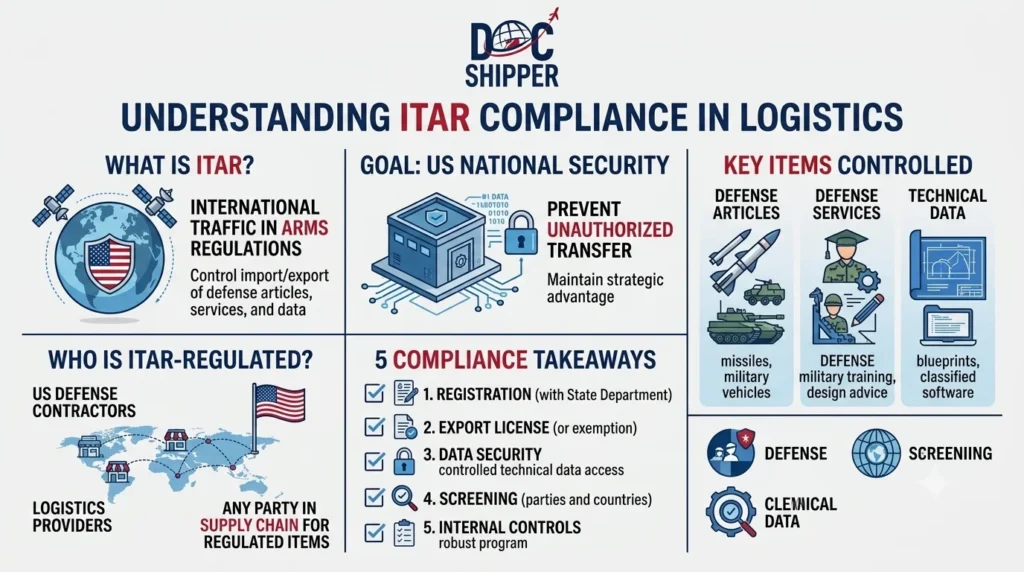
ITAR (International Traffic in Arms Regulations) is a U.S. federal regulatory framework that controls the export, import, and temporary transit of defense-related articles, services, and technical data. Administered by the Department of State's Directorate of Defense Trade Controls (DDTC), ITAR ensures that sensitive military technologies do not fall into unauthorized hands, protecting national security while regulating international defense trade.
Introduction
Many companies underestimate the complexity of ITAR compliance until they face severe penalties or shipment seizures. A single unauthorized export of defense articles can result in millions in fines and criminal prosecution. Understanding ITAR is not optional for businesses involved in defense manufacturing, aerospace, or dual-use technologies—it’s a legal imperative.
ITAR governs every aspect of defense trade, from prototype development to final product delivery. Its scope extends beyond physical goods to include technical data, software, and even verbal discussions with foreign nationals. The regulations impact global supply chains, requiring meticulous documentation and continuous monitoring.
Key characteristics of ITAR include:
- United States Munitions List (USML): Defines controlled defense articles across 21 categories
- Registration requirement: Mandatory for manufacturers, exporters, and brokers of defense articles
- Export licensing: Prior authorization needed for most international transfers
- Technical data controls: Restricts sharing blueprints, specifications, and know-how
- Deemed exports: Applies to foreign nationals accessing controlled information within the U.S.
Regulatory Framework & Legal Implications
ITAR operates under the Arms Export Control Act (AECA), which grants the President authority to control defense article exports. The Department of State publishes the regulations in Title 22 of the Code of Federal Regulations, parts 120-130. These rules apply to any person or entity under U.S. jurisdiction, regardless of physical location.
The USML categorization system underwent significant reform in 2013, transitioning from a catch-all approach to a positive list format. Items are now classified based on specific technical parameters rather than broad descriptions. This change aimed to focus controls on truly military-critical technologies while moving less sensitive items to the Export Administration Regulations (EAR) administered by the Commerce Department.
Registration obligations require companies engaged in defense trade to register with DDTC annually, paying fees ranging from $2,250 to $3,000. Registration alone does not grant export authority—each transaction typically requires an individual export license or compliance with an exemption. At DocShipper, we assist clients in determining their registration requirements and navigating the complex application process to avoid costly delays.
The violation penalties are substantial and multifaceted. Civil fines can reach up to $1,189,323 per violation, while criminal penalties include up to 20 years imprisonment and $1 million in fines. Beyond monetary sanctions, violators face debarment from government contracting, export privilege denial, and reputational damage that can destroy business relationships. The State Department actively prosecutes cases, with recent enforcement actions targeting unauthorized technology transfers to China and Russia.
Technical data controls extend to information in any form—electronic files, printed documents, verbal communications, and visual inspections. Releasing technical data to a foreign person constitutes an export requiring authorization. This includes providing access to foreign employees, contractors, or visitors at U.S. facilities. Companies must implement robust access controls, employee training, and technology control plans to maintain compliance.
Compliance Requirements & Practical Examples
Understanding ITAR in abstract terms is insufficient—practical application requires detailed knowledge of compliance mechanisms and real-world scenarios. Companies must establish comprehensive compliance programs addressing registration, licensing, record-keeping, and employee awareness.
Export licensing scenarios vary significantly based on article type, destination country, and end-user. Consider this comparative analysis:
| License Type | Processing Time | Use Case | Validity Period |
|---|---|---|---|
| DSP-5 (Permanent Export) | 60-90 days | Sale of defense articles to foreign governments or entities | 4 years |
| DSP-73 (Temporary Import) | 30-45 days | Bringing defense articles into U.S. for testing or demonstration | 12 months |
| DSP-61 (Temporary Export) | 45-60 days | Trade shows, demonstrations, trials with return to U.S. | 4 years |
| TAA (Technical Assistance Agreement) | 90-120 days | Providing technical data, defense services, or manufacturing know-how | 5 years (renewable) |
Practical use case: An aerospace manufacturer develops a new satellite imaging sensor with military applications classified under USML Category XV(e). The company receives an order from a NATO ally. The compliance process includes:
- Step 1: Verify DDTC registration is current (annual renewal required)
- Step 2: Prepare DSP-5 license application with technical specifications, end-user documentation, and purchase agreement
- Step 3: Submit application through D-Trade electronic portal, paying $250 licensing fee
- Step 4: Await DDTC review including interagency coordination (typical 75-day timeline)
- Step 5: Upon approval, execute shipment with proper Shipper’s Export Declaration and Destination Control Statement
Record-keeping obligations mandate retention of all export-related documents for five years from final disposition. This includes licenses, shipping documents, correspondence, technical data transfers, and training records. DocShipper implements digital compliance archives for clients, ensuring rapid retrieval during DDTC audits or compliance reviews.
Common pitfall: Companies frequently overlook deemed export rules when hiring foreign nationals or hosting international visitors. A Chinese engineer reviewing ITAR-controlled technical drawings at a U.S. facility constitutes an export to China, requiring prior authorization. Failure to screen personnel nationality and implement access controls has resulted in numerous enforcement actions with penalties exceeding $20 million in aggregate cases.
Conclusion
ITAR compliance demands continuous vigilance, specialized expertise, and robust internal controls. The regulatory landscape evolves constantly, with policy changes, enforcement priorities, and international agreements reshaping compliance requirements. Companies cannot afford reactive approaches—proactive compliance programs prevent costly violations and maintain competitive advantage in defense trade.
Need assistance navigating ITAR requirements for your shipments? Contact DocShipper for expert guidance on export licensing, compliance documentation, and regulatory strategy.
📚 Quiz
Test Your Knowledge: ITAR Compliance
What does ITAR primarily regulate?
Which scenario constitutes a "deemed export" under ITAR?
A U.S. aerospace company needs to permanently export night-vision equipment (USML-controlled) to a NATO ally. What is the correct compliance approach?
🎯 Your Result
📞 Free Personalized QuoteFAQ | ITAR (International Traffic in Arms Regulations): Definition, Compliance & Concrete Examples
ITAR controls defense articles, services, and technical data listed on the United States Munitions List (USML), covering 21 categories including firearms, military aircraft, naval vessels, missiles, space systems, explosives, and related technologies. Items specifically designed or modified for military application fall under ITAR jurisdiction. The 2013 Export Control Reform shifted some items to Commerce Department control, but truly military-critical technologies remain ITAR-controlled.
Any person or entity engaged in manufacturing, exporting, or brokering defense articles must register with DDTC. This includes manufacturers of ITAR-controlled items, exporters facilitating international transfers, and brokers arranging transactions between foreign parties. Registration is required even if no actual exports occur—merely engaging in manufacturing defense articles triggers the obligation. Annual registration fees apply, and failure to register constitutes a violation subject to penalties.
Limited exemptions exist, but most ITAR exports require prior authorization. License exemptions include transactions covered by exemption sections (such as Canada exemption under 126.5), temporary exports to employees who are U.S. persons, and certain government-to-government transfers. However, exemptions contain specific conditions and limitations. Companies must carefully evaluate exemption applicability and maintain documentation proving compliance. When in doubt, seek advisory opinions from DDTC or consult compliance specialists.
A deemed export occurs when controlled technical data is released to a foreign person within the United States. This includes providing access to foreign national employees, contractors, or visitors. The release is treated as an export to the person's country of nationality, requiring the same authorization as physical shipments. Companies must screen employee nationality, implement access controls for technical data, and obtain Technical Assistance Agreements or export licenses before allowing foreign persons access to ITAR information.
Standard processing times range from 60 to 120 days depending on license type and complexity. Simple commodity exports to trusted allies may process in 45-60 days, while Technical Assistance Agreements involving sensitive technologies can require 90-120 days or longer. Congressional notification requirements for certain countries or articles add 30 days to the timeline. Expedited processing is available for urgent requirements with additional justification. Applicants should plan shipments well in advance to accommodate regulatory timelines.
ITAR violations carry severe civil and criminal penalties. Civil fines reach up to $1,189,323 per violation, with violations calculated per shipment, document, or unauthorized disclosure. Criminal penalties include imprisonment up to 20 years and fines up to $1 million for willful violations. Additional consequences include debarment from government contracts, export privilege denial, and Denied Persons List placement. The State Department actively prosecutes violations, with recent cases resulting in multi-million dollar settlements and corporate compliance monitors.
Yes, ITAR applies to foreign subsidiaries, branches, and affiliates of U.S. companies. Any transfer of ITAR-controlled items or technical data from the U.S. parent to a foreign subsidiary constitutes an export requiring authorization. Even foreign subsidiaries established under local law remain subject to ITAR when handling U.S.-origin defense articles. Companies must structure international operations carefully, implementing firewalls to prevent unauthorized technology transfers and obtaining appropriate licenses or Technical Assistance Agreements for legitimate business needs.
ITAR controls military and defense-specific items under State Department authority, while EAR governs dual-use commercial items under Commerce Department jurisdiction. ITAR maintains stricter controls, presumptive denial for certain countries, and requires individual licenses for most exports. EAR allows more liberal licensing exceptions and focuses on preventing proliferation of weapons of mass destruction technologies. Items move between regimes based on military significance—the 2013 Export Control Reform transferred less sensitive technologies from ITAR to EAR, creating a more risk-based control system.
D-Trade is DDTC's electronic licensing system for submitting export license applications, commodity jurisdictions, and other requests. The web-based platform replaced paper submissions in 2014, streamlining the application process. Registered entities create accounts, submit applications electronically, track status in real-time, and receive decisions digitally. D-Trade requires digital certificates for authentication and integrates with customs systems for shipment tracking. While the system improved efficiency, technical issues and learning curves initially challenged users. Companies should familiarize themselves with D-Trade functionality before urgent licensing needs arise.
Electronic transmission of ITAR technical data constitutes an export requiring the same controls as physical shipments. Emailing technical drawings to foreign recipients, storing data on cloud servers accessible to foreign persons, or posting information on unsecured websites violates ITAR without proper authorization. Companies must implement encryption, access controls, and geographic restrictions for electronic data. Cloud storage requires vendor agreements ensuring data remains within U.S. jurisdiction or authorized countries. Best practice involves maintaining dedicated secure systems for ITAR data with multi-factor authentication and audit trails.
A commodity jurisdiction (CJ) determination is an official DDTC ruling on whether an item falls under ITAR or EAR control. Companies submit CJ requests when classification is unclear—particularly for dual-use items with both commercial and military applications. DDTC reviews technical specifications, intended use, and design modifications to issue binding determinations. The process takes 60-90 days and provides legal protection from enforcement if companies follow the determination. CJ requests are essential for managing compliance risk and avoiding inadvertent violations from misclassification. Determinations remain valid unless product specifications change materially.
Effective ITAR compliance programs include senior management commitment, designated compliance officers, written policies and procedures, employee training, technology control plans, and regular audits. Companies should conduct initial risk assessments identifying ITAR-controlled items, foreign persons with potential access, and export activities. Develop standard operating procedures for license applications, deemed export screening, visitor controls, and record-keeping. Implement annual training for all employees with ITAR exposure, emphasizing recognition of defense articles and export scenarios. Conduct periodic internal audits and engage external counsel for compliance reviews. Voluntary disclosures of violations to DDTC can mitigate penalties when discovered through robust compliance programs.
Need Help with
Logistics or Sourcing ?
First, we secure the right products from the right suppliers at the right price by managing the sourcing process from start to finish. Then, we simplify your shipping experience - from pickup to final delivery - ensuring any product, anywhere, is delivered at highly competitive prices.


Fill the Form
Prefer email? Send us your inquiry, and we’ll get back to you as soon as possible.
Contact us




:%20Definition,%20Compliance%20&%20Concrete%20Examples)