


In short ⚡
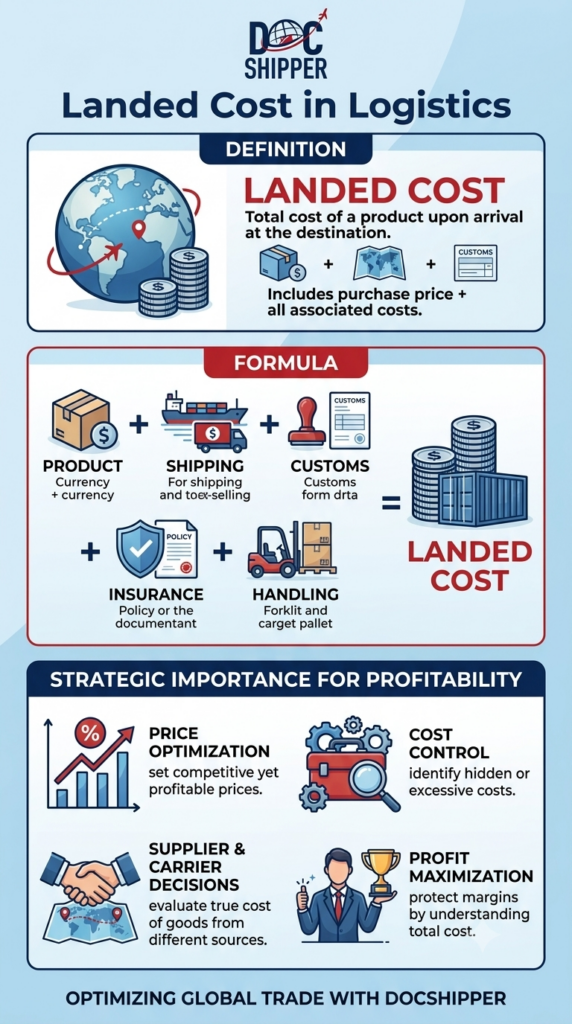
Landed cost is the total price of a product once it has arrived at the buyer's door, including purchase price, freight, insurance, customs duties, taxes, and all logistics fees. It represents the true cost of importing goods, enabling accurate profitability calculations and pricing strategies.
Introduction
Many importers focus solely on the supplier’s invoice price, only to discover that hidden costs inflate their final expenses by 20% to 40%. This miscalculation leads to underpriced products, eroded margins, and failed market entries.
Understanding landed cost is critical for international trade profitability. It provides visibility into the complete financial picture, from factory gate to warehouse receipt. Without accurate landed cost calculations, businesses cannot properly assess supplier competitiveness, set retail prices, or evaluate logistics alternatives.
The landed cost encompasses multiple variable components:
- Product cost: Ex-works or FOB price from the supplier
- International freight: Ocean, air, or multimodal transportation charges
- Insurance: Cargo protection against loss or damage during transit
- Customs duties: Import tariffs based on HS codes and origin country
- Value Added Tax (VAT): Applicable consumption taxes in the destination country
- Logistics fees: Handling, storage, customs brokerage, and delivery costs
Understanding Landed Cost Components & Strategic Implications
The landed cost formula provides a structured approach to total cost calculation. The basic equation is: Product Cost + Shipping + Insurance + Customs Duties + Taxes + Additional Fees = Landed Cost. However, each component requires careful analysis as rates vary significantly by product category, origin, and destination.
Customs duties represent one of the most complex variables. Tariff rates depend on the Harmonized System (HS) classification, country of origin, and existing trade agreements. The same product imported from Vietnam versus China may face dramatically different duty rates under preferential trade programs. Misclassification can result in penalties or delayed clearance.
The insurance premium typically ranges from 0.3% to 1.5% of cargo value, depending on goods nature, route risk, and coverage extent. High-value electronics require comprehensive all-risk coverage, while bulk commodities may use more limited policies. According to International Chamber of Commerce standards, proper insurance protects against total loss, partial damage, and general average contributions.
Incoterms selection fundamentally impacts landed cost structure. Under EXW (Ex Works), the buyer assumes all transportation costs and risks from the supplier’s facility. FOB (Free On Board) transfers responsibility at the origin port. CIF (Cost, Insurance, Freight) includes delivery to the destination port with insurance. DDP (Delivered Duty Paid) means the seller covers everything including import duties—the true landed cost comparison point.
At DocShipper, we systematically calculate landed costs during quotation to provide clients with complete financial visibility before commitment. Our customs experts verify HS classifications and duty rates across 50+ countries to eliminate surprises and optimize routing decisions based on total cost rather than freight alone.
Practical Calculation Examples & Cost Breakdowns
A concrete example illustrates landed cost complexity. Consider importing 1,000 Bluetooth speakers from Shenzhen to Hamburg. The supplier quotes $15 per unit FOB Shenzhen—but this represents only the beginning of total cost calculations.
| Cost Component | Unit Cost | Total (1,000 units) |
|---|---|---|
| Product FOB Price | $15.00 | $15,000 |
| Ocean Freight (20′ container) | $1.80 | $1,800 |
| Cargo Insurance (0.5%) | $0.08 | $84 |
| Customs Duties (3.7% EU rate HS 8518) | $0.62 | $622 |
| VAT Germany (19%) | $3.33 | $3,326 |
| Customs Brokerage & Handling | $0.25 | $250 |
| TOTAL LANDED COST | $21.08 | $21,082 |
The landed cost of $21.08 per unit represents a 40.5% increase over the initial FOB quotation. This differential dramatically affects margin calculations and competitive positioning. A retailer planning to sell at $35 with an assumed $15 cost would enjoy 57% gross margin—but the actual margin drops to 40% when using the true landed cost.
Strategic optimization opportunities emerge from detailed landed cost analysis. Air freight might cost $8 per unit versus $1.80 for ocean, but faster delivery reduces inventory holding costs and enables rapid market response. Consolidating multiple suppliers’ shipments can reduce per-unit freight and handling fees through economies of scale.
Free Trade Agreement utilization can substantially reduce duties. The EU-Vietnam FTA eliminates tariffs on qualifying electronics, potentially saving the 3.7% duty in our example—$622 per shipment. However, obtaining certificates of origin and meeting rules of origin adds administrative complexity that must be weighed against savings.
Comparing landed costs across potential suppliers provides objective decision criteria. A supplier offering $13 FOB from a high-tariff origin may ultimately cost more than a $15 FOB supplier from a preferential trade partner. Total landed cost analysis prevents false economies that focus solely on purchase price.
Conclusion
Landed cost calculation transforms international sourcing from guesswork into strategic decision-making. Accurate total cost visibility enables proper pricing, margin protection, and supplier selection based on true economic value rather than misleading initial quotations.
Need assistance calculating landed costs for your specific products and routes? Contact DocShipper for expert landed cost analysis and import optimization.
📚 Quiz
Test Your Knowledge: Landed Cost
What does landed cost represent in international trade?
A supplier quotes $10 per unit FOB. The actual landed cost will typically be:
When comparing two suppliers for landed cost optimization, which approach is correct?
🎯 Your Result
📞 Free Quote in 24hFAQ | Landed Cost: Definition, Calculation & Practical Examples
FOB (Free On Board) price includes only the product cost and delivery to the origin port. Landed cost encompasses FOB price plus international freight, insurance, customs duties, taxes, and all fees until goods reach the final destination. Landed cost represents the complete acquisition expense, typically 25-50% higher than FOB for most imports.
Import duties depend on three factors: the product's HS (Harmonized System) classification code, country of origin, and destination country tariff schedule. Check your destination customs authority's tariff database using the correct HS code. Duty rates vary from 0% for certain categories to over 25% for protected industries. Free trade agreements may reduce or eliminate duties for qualifying goods.
A rough estimation adds 25-35% to FOB price for ocean freight from Asia to Europe/US, and 15-25% for intra-regional shipments. However, this varies significantly by product category, shipping mode, and destination country tax rates. Electronics from China to EU might see 35-45% markups due to tariffs and VAT, while textiles under preferential agreements might only add 20-25%.
Yes, landed cost includes all taxes required for goods to legally enter commerce in the destination country. This encompasses VAT (Value Added Tax) in EU countries, GST (Goods and Services Tax) in countries like Australia and Canada, and applicable sales taxes. VAT typically ranges from 5% to 27% depending on the country, calculated on the CIF value plus customs duties.
Incoterms determine which party bears specific costs and risks. Under EXW, the buyer's landed cost includes everything from factory pickup onward. FOB transfers responsibility at origin port. CIF includes freight and insurance to destination port. DDP means the seller pays all costs including duties—making the invoice price essentially the landed cost. Always clarify Incoterms when comparing supplier quotations.
Commonly overlooked expenses include: customs examination fees (when cargo is physically inspected), demurrage/detention charges for delayed container returns, port congestion surcharges, currency conversion fees, quality inspection costs, warehouse receiving fees, inland transportation from port to final destination, and compliance documentation charges. These can add 3-8% to the landed cost.
Free Trade Agreements (FTAs) can eliminate or significantly reduce customs duties on qualifying products, sometimes saving 5-25% of product value. However, to benefit, goods must meet rules of origin requirements and proper certificates of origin must be provided. The administrative cost of FTA compliance must be weighed against duty savings, particularly for smaller shipments.
Air freight typically costs 5-10x more per kilo than ocean but delivers 15-30 times faster. The decision depends on total landed cost including inventory carrying costs, stockout risks, and time-to-market value. For high-value, time-sensitive goods (electronics, fashion), air freight's faster cycle may justify higher transport costs. For bulk or low-margin items, ocean freight minimizes landed cost despite longer transit.
Landed costs should be reviewed quarterly at minimum, and immediately when significant variables change: freight rate fluctuations (seasonal peaks), tariff adjustments, exchange rate movements exceeding 5%, or supplier price changes. E-commerce sellers in volatile categories may need monthly recalculation to maintain margin targets and competitive pricing.
Yes, optimizing packaging directly impacts freight costs, which are often calculated by volumetric weight (dimensional weight). Reducing package size by 20% can lower air freight costs by similar percentages. Switching to lighter materials decreases actual weight charges. However, ensure packaging still provides adequate product protection—damage claims and returns can eliminate any freight savings.
Enterprise Resource Planning (ERP) systems like SAP and Oracle include landed cost modules. Trade management platforms such as Amber Road, Descartes, and Livingston provide automated duty calculation and total cost modeling. For smaller businesses, specialized tools like Zonos, Landed Cost Calculator, and customs broker portals offer HS code lookup and rate calculations. Integration with freight forwarder systems provides real-time shipping quotes.
Accurate landed cost determines minimum viable pricing and gross margin reality. Retailers typically apply a 2-3x markup over landed cost to cover operating expenses and profit. Understanding landed cost variations between suppliers enables strategic sourcing decisions. Products with lower landed costs can be priced more competitively or yield higher margins. Landed cost visibility also informs promotion strategies and identifies which products to prioritize for volume sales.
Need Help with
Logistics or Sourcing ?
First, we secure the right products from the right suppliers at the right price by managing the sourcing process from start to finish. Then, we simplify your shipping experience - from pickup to final delivery - ensuring any product, anywhere, is delivered at highly competitive prices.


Fill the Form
Prefer email? Send us your inquiry, and we’ll get back to you as soon as possible.
Contact us




