


In short ⚡
A LASH vessel (Lighter Aboard Ship) is a specialized cargo ship designed to transport barges (lighters) that can be loaded and offloaded without requiring port infrastructure. These vessels use onboard cranes to lift entire barges from water, enabling operations in shallow ports or rivers where conventional container ships cannot access, revolutionizing intermodal logistics efficiency.
Introduction
Traditional shipping faces a critical challenge: millions of tons of cargo remain stranded in ports lacking deep-water infrastructure. Conventional container ships require expensive docking facilities, limiting access to 40% of global river and coastal trade routes.
The LASH system emerged as a strategic solution for intermodal transportation, particularly in regions with underdeveloped port infrastructure. By combining ocean-going vessels with river barges, this innovation unlocked previously inaccessible markets.
Key characteristics of LASH operations include:
- Self-sufficient loading systems: Onboard gantry cranes eliminate dependency on port equipment
- Barge standardization: Each lighter carries 370-450 tons, measuring approximately 18.75m x 9.5m
- Shallow draft capability: Barges navigate waterways as shallow as 2.5 meters
- Reduced port time: Loading/unloading occurs offshore while barges shuttle cargo inland
- Infrastructure independence: Operations feasible in ports without cranes or deep channels
Technical Design & Operational Expertise
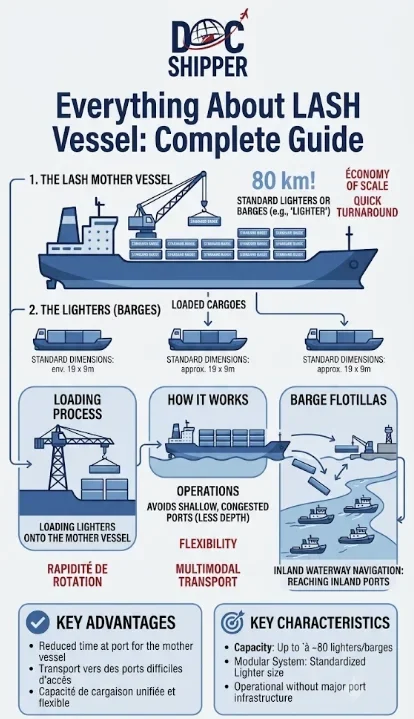
The LASH vessel architecture represents a fundamental departure from conventional cargo ships. The mother ship features a 500-ton capacity gantry crane mounted on stern rails, capable of lifting entire loaded barges from water in 15-20 minutes per unit.
The barge stacking system utilizes a cellular hold structure, accommodating 60-89 lighters depending on vessel class. Barges are stacked up to five high, secured through precision-engineered guides that prevent shifting during ocean transit. This configuration maximizes cargo density while maintaining structural integrity in rough seas.
Operational advantages become evident in ports with limited infrastructure. While a container ship requires 24-48 hours of berth time, a LASH vessel anchors offshore, launching barges that independently navigate to inland terminals. The mother ship simultaneously handles multiple barges, optimizing turnaround efficiency.
The economic model hinges on specific trade scenarios. LASH systems excel in regions where cargo originates far inland—along rivers like the Mississippi, Rhine, or Yangtze. By eliminating transshipment points between river and ocean transport, shippers reduce handling costs by 30-40% compared to traditional break-bulk methods.
From a regulatory perspective, LASH operations must comply with both IMO maritime regulations and inland waterway authorities. The International Convention for the Safety of Life at Sea (SOLAS) mandates specific stability criteria for vessels carrying deck cargo, while barge certifications follow regional inland navigation codes.
At DocShipper, we coordinate LASH shipments for clients requiring deep-penetration logistics, particularly in Southeast Asia and West Africa. Our team verifies barge certifications and ensures compliance with both maritime and riverine transport regulations, preventing costly delays at inland checkpoints.
Practical Examples & Data Analysis
The economic viability of LASH systems varies significantly by trade route. Analyzing real-world scenarios reveals where this technology delivers competitive advantages versus conventional container shipping.
| Transportation Method | Port Infrastructure Required | Cargo Capacity | Average Port Time | Cost per Ton (500km inland) |
|---|---|---|---|---|
| LASH Vessel | None (offshore anchoring) | 26,000-40,000 tons | 8-12 hours | $45-$62 |
| Container Ship + Truck | Deep-water port + crane | 8,000-14,000 TEU | 36-48 hours | $78-$95 |
| Break-Bulk + Barge | Conventional wharf | 10,000-15,000 tons | 48-72 hours | $68-$88 |
Use Case: West African Agricultural Exports
A grain exporter in Mali faces the challenge of transporting 12,000 tons of millet to European markets. The nearest deep-water port (Dakar) lies 1,200km away via poor road infrastructure. Traditional trucking would cost $142 per ton with 18-22 day transit times.
By utilizing a LASH system operating on the Senegal River, the exporter loads barges at an inland river terminal. The LASH mother ship anchors 15km offshore from Saint-Louis, collecting loaded barges while simultaneously deploying empties. Total logistics cost drops to $89 per ton, with transit time reduced to 12 days—a 37% cost reduction.
Decline Factors
Despite initial promise, LASH vessel deployment peaked in the 1970s before declining significantly. The containerization revolution prioritized standardized handling systems, while port infrastructure investments in developing nations reduced the need for barge-based systems. By 2024, fewer than 12 active LASH vessels remain in commercial service, primarily serving niche routes in Southeast Asia and Central Africa.
Modern Applications
Contemporary LASH operations concentrate in regions where geography necessitates shallow-draft solutions:
- Amazon Basin logistics: Moving mining equipment and consumer goods to Brazilian interior cities
- Mekong River commerce: Connecting Laos and Cambodia to ocean ports in Vietnam
- West African cocoa transport: Aggregating small-holder production from riverine communities
- Disaster relief operations: Delivering aid to regions with damaged port infrastructure
At DocShipper, we maintain partnerships with the remaining LASH operators, enabling clients to access remote markets where conventional shipping proves economically unfeasible. Our logistics specialists assess whether LASH systems offer competitive advantages for your specific trade lane and cargo profile.
Conclusion
The LASH vessel represents a specialized solution for infrastructure-challenged trade routes, offering unique advantages when conventional shipping cannot penetrate inland markets. While containerization dominates global logistics, niche applications still justify LASH operations in specific geographic contexts.
Need expert guidance on intermodal transportation solutions? Contact DocShipper to evaluate whether LASH systems align with your supply chain requirements.
📚 Quiz
Test Your Knowledge: LASH Vessel Operations
What is the primary defining feature of a LASH vessel?
Why did LASH vessels decline in commercial use after the 1980s?
A grain exporter in Mali needs to ship 12,000 tons to Europe. The nearest deep-water port is 1,200km away with poor road access. Which statement is correct?
🎯 Your Result
📞 Free Personalized QuoteFAQ | LASH Vessel: Definition, Operations & Concrete Examples
LASH is an acronym for "Lighter Aboard Ship," referring to a vessel system that transports barges (lighters) as cargo units. The mother ship loads and unloads these barges using onboard cranes, eliminating the need for port infrastructure. This term originated in the 1960s when Central Gulf Lines developed the first commercially viable LASH vessel for Mississippi River trade.
Standard LASH vessels accommodate 60-73 barges, while larger SEABEE variants (an evolution of LASH design) can transport up to 89 lighters. Each barge carries approximately 370-450 tons of cargo, resulting in total vessel capacities ranging from 26,000 to 40,000 deadweight tons. The exact number depends on vessel class, barge dimensions, and stacking configuration within the cellular hold structure.
LASH vessels serve niche markets but face significant competition from containerization. Their viability depends on three factors: absence of deep-water ports, high-volume river cargo, and cost-sensitive commodities. Current operations concentrate in West Africa, Southeast Asian river systems, and South American interior routes. For most trade lanes, containers offer superior efficiency, explaining why LASH fleets declined from 50+ vessels in 1980 to fewer than 12 active units today.
SEABEE (Sea Barge) vessels represent an evolutionary improvement over LASH designs. While LASH ships use overhead gantry cranes to lift barges vertically, SEABEE vessels employ a stern elevator platform that lifts barges from water and rolls them horizontally into the hold. SEABEE barges are larger (850-950 tons versus 370-450 tons for LASH), and loading operations prove 40% faster. However, SEABEE systems require more complex engineering, resulting in higher capital costs.
Yes, LASH vessels legally anchor in international waters or designated offshore zones, conducting barge loading operations without formal port entry. However, the barges themselves must clear customs when entering territorial waters. This creates a "mother ship" model where the ocean vessel never technically "imports" cargo—the individual barges handle customs formalities at inland terminals. Customs authorities in most jurisdictions have established procedures for this split-custody arrangement.
LASH systems optimize bulk commodities with high volume-to-value ratios: agricultural products (grain, coffee, cocoa), mining outputs (bauxite, iron ore), construction materials (cement, timber), and heavy machinery. Containerized consumer goods rarely justify LASH logistics due to handling complexity. The ideal LASH cargo originates inland, moves in large batches (200+ tons per shipment), and tolerates slower transit speeds compared to containerized express services.
A fully equipped LASH vessel with a 500-ton gantry crane loads or unloads one barge every 15-20 minutes under optimal conditions. For a 73-barge vessel, complete cargo operations require 18-24 hours of continuous work. This significantly outperforms conventional break-bulk ships (48-72 hours) but cannot match container vessel efficiency (12-16 hours for similar tonnage). Weather conditions and barge positioning logistics directly impact these timelines.
Four factors drove LASH decline: infrastructure investment in developing nations reduced shallow-port constraints; container standardization created economies of scale that LASH could not match; fuel costs made the barge-transfer model less competitive; and improved road networks provided alternative inland access. By the 1990s, most shipping lines abandoned LASH fleets in favor of larger container vessels serving upgraded ports. The technology persists only where geographic or economic conditions prohibit containerization.
LASH operations fall under dual jurisdiction: the mother ship complies with IMO maritime regulations (SOLAS, MARPOL), while individual barges follow inland waterway codes specific to each nation. The International Convention on Load Lines establishes stability requirements for vessels carrying deck cargo. Additionally, barges must meet classification society standards (ABS, Lloyd's) certifying structural integrity for ocean transit aboard the mother ship. Customs documentation treats each barge as a separate shipment.
LASH barges can be configured with container securing systems, allowing TEU transport within the barge structure. However, this hybrid approach sacrifices the primary LASH advantage—direct shore-to-ship loading. Containers must still be lifted onto barges using shoreside equipment, then the loaded barge transfers to the mother ship. This double-handling negates efficiency gains, making dedicated container vessels more practical for box cargo. LASH-container hybrids saw limited use in the 1980s but proved commercially unviable.
LASH vessels operate at service speeds of 15-18 knots (28-33 km/h), slower than modern container ships (20-25 knots). This reduced speed stems from hull design optimized for cargo capacity rather than velocity, plus the additional drag from barge stowage configurations. For time-sensitive cargo, this speed disadvantage compounds with longer loading operations, making LASH unsuitable for just-in-time supply chains. The system works best for scheduled bulk movements where predictable transit times matter more than absolute speed.
LASH barge transfer operations cease when wave heights exceed 1.5 meters or wind speeds surpass 25 knots, as crane lifting becomes hazardous. This weather sensitivity creates operational unpredictability in storm-prone regions. Once loaded and secured, the mother ship handles rough seas comparably to conventional cargo vessels. However, the elevated center of gravity from stacked barges requires careful ballasting. Severe weather during loading can delay operations by 48-72 hours, impacting schedule reliability—a key disadvantage versus all-weather container terminals.
Need Help with
Logistics or Sourcing ?
First, we secure the right products from the right suppliers at the right price by managing the sourcing process from start to finish. Then, we simplify your shipping experience - from pickup to final delivery - ensuring any product, anywhere, is delivered at highly competitive prices.


Fill the Form
Prefer email? Send us your inquiry, and we’ll get back to you as soon as possible.
Contact us




