



In short ⚡
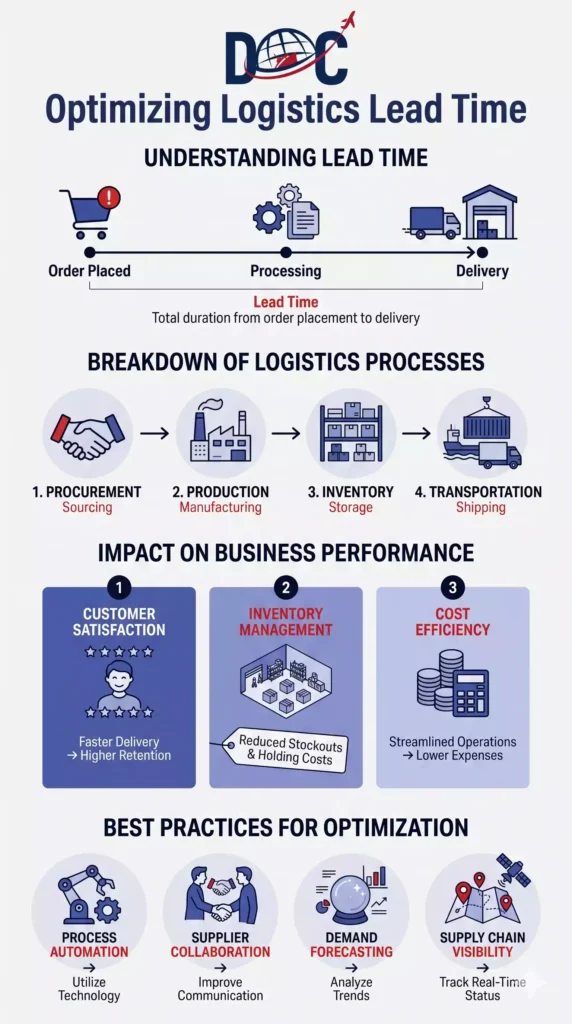
Lead time is the total duration between initiating an order and receiving the finished goods. In international logistics, it encompasses manufacturing, processing, transportation, customs clearance, and final delivery—making it a critical metric for supply chain planning and inventory management.Introduction
Many businesses underestimate the complexity of lead time, treating it as a simple shipping duration. This oversimplification causes stockouts, production delays, and dissatisfied customers. Understanding lead time’s components is essential for optimizing your supply chain.
In international trade, lead time directly impacts cash flow, inventory costs, and competitive positioning. A manufacturer in Vietnam shipping to Germany faces vastly different lead time variables than one operating domestically.
Key characteristics of lead time in global logistics:
- Manufacturing Lead Time: Production duration from raw materials to finished goods
- Procurement Lead Time: Time to source and receive materials from suppliers
- Transportation Lead Time: Duration from factory gate to destination port/warehouse
- Customs Clearance Time: Administrative processing at borders (highly variable)
- Last-Mile Delivery: Final transportation to end customer or facility
In-Depth Analysis & Expertise
Lead time calculation requires understanding each supply chain segment. The formula is deceptively simple: Total Lead Time = Order Processing + Manufacturing + Transit + Customs + Delivery. However, each component contains hidden complexities.
Manufacturing variability depends on production capacity, order volume, and seasonal demand. A supplier running at 90% capacity will have longer lead times than one at 60%. At DocShipper, we assess supplier capacity before committing to delivery schedules, preventing unrealistic expectations.
Transportation mode selection dramatically affects lead time. Sea freight from Shanghai to Rotterdam takes 35-40 days, while air freight requires only 5-7 days. The cost difference is substantial—air freight costs 8-10 times more per kilogram. According to International Chamber of Commerce data, 90% of global trade moves by sea despite longer lead times.
Customs clearance unpredictability represents the highest risk factor. Standard clearance takes 1-3 days, but documentation errors, inspections, or compliance issues can extend this to weeks. The EU’s Union Customs Code requires specific data elements—missing information triggers delays.
Seasonal fluctuations create lead time variations. Chinese New Year adds 2-3 weeks to typical lead times as factories close. Peak shipping seasons (August-October for retail) cause port congestion, extending dwell times by 5-10 days.
Safety stock requirements directly correlate with lead time reliability. Longer or more variable lead times necessitate higher inventory buffers, increasing carrying costs. DocShipper clients reduce safety stock by 15-25% through improved lead time predictability and real-time tracking systems.
Concrete Examples & Data
Understanding lead time through real scenarios helps businesses make informed decisions. Below we compare different shipping methods and their practical implications.
| Shipping Method | Route Example | Average Lead Time | Cost per kg | Best For |
|---|---|---|---|---|
| Sea Freight (FCL) | Shenzhen → Hamburg | 32-38 days | $0.80-$1.20 | Large volumes, non-urgent |
| Sea Freight (LCL) | Ho Chi Minh → Los Angeles | 28-35 days | $1.50-$2.50 | Smaller shipments |
| Air Freight | Guangzhou → Paris | 5-8 days | $8.00-$12.00 | High-value, urgent goods |
| Express Courier | Shanghai → New York | 2-4 days | $15.00-$25.00 | Critical documents, samples |
| Rail Freight | Chongqing → Duisburg | 16-20 days | $3.50-$5.00 | EU-Asia corridor |
Use Case: Electronics Manufacturer
A European electronics company sources components from three Asian suppliers. Initial lead time estimates were 45 days, but reality proved different:
- Supplier A (China): Manufacturing = 12 days, Sea freight = 32 days, Customs = 3 days, Delivery = 2 days. Total: 49 days
- Supplier B (Vietnam): Manufacturing = 10 days, Sea freight = 28 days, Customs = 5 days (documentation issues), Delivery = 2 days. Total: 45 days
- Supplier C (Taiwan): Manufacturing = 8 days, Air freight = 6 days, Customs = 2 days, Delivery = 1 day. Total: 17 days
The company shifted 30% of orders to air freight for critical components, reducing average lead time to 38 days and eliminating production line stoppages. The 15% increase in logistics costs was offset by eliminating expedited fees and maintaining production schedules.
Lead Time Reduction Strategies
- Supplier Consolidation: Reducing suppliers from 15 to 8 cut coordination time by 40%
- Pre-positioned Inventory: Strategic warehousing reduces final delivery from 14 to 3 days
- Customs Pre-clearance: Advanced filing reduces border delays by 60-70%
- Digital Documentation: Electronic processing cuts administrative time by 3-5 days
- Freight Forwarder Partnership: Consolidated bookings reduce wait times during peak seasons
Conclusion
Lead time mastery separates efficient supply chains from reactive ones. Understanding each component—from manufacturing to final delivery—enables accurate planning, cost optimization, and customer satisfaction.
Reducing lead time isn’t always about speed; it’s about predictability and reliability. Need expert guidance on optimizing your import/export lead times? Contact DocShipper for tailored solutions.
📚 Quiz
Test Your Knowledge: Lead Time
What does total lead time encompass in international logistics?
A shipment averages 30 days with ±2 days variability versus another averaging 25 days with ±8 days variability. Which is typically more valuable for supply chain planning?
Your supplier offers sea freight (35 days, $1/kg) or air freight (6 days, $10/kg) from Asia to Europe. Which scenario best justifies choosing air freight?
🎯 Your Result
📞 Free Quote in 24hFAQ | Lead Time: Definition, Calculation & Real-World Examples
Lead time encompasses the entire process from order placement to delivery, including manufacturing, processing, and transportation. Delivery time refers only to the transportation phase—the period goods spend in transit. Lead time is always longer than delivery time as it includes pre-shipment activities.
Add together: order processing time (1-3 days), manufacturing duration (varies by product), inland transportation to port (1-5 days), sea/air transit time (5-40 days depending on mode), customs clearance (1-7 days), and final delivery (1-3 days). Always include buffer time for potential delays. The formula is: Total Lead Time = Sum of All Sequential Activities + Safety Buffer.
The top five factors are: customs documentation errors or inspections (adding 3-14 days), peak season port congestion (5-10 day delays), supplier production delays (highly variable), incorrect Incoterms causing responsibility confusion, and force majeure events like weather or political disruptions. Proactive communication and documentation accuracy mitigate most controllable delays.
Yes, through several strategies: consolidate suppliers geographically to reduce collection time, implement vendor-managed inventory systems, use customs brokers for pre-clearance, optimize packaging to reduce handling time, and establish hub-and-spoke distribution networks. These methods can reduce sea freight lead times by 15-25% without mode changes.
Longer lead times require higher safety stock levels to prevent stockouts, increasing carrying costs. The relationship is exponential—doubling lead time typically requires 40-60% more inventory. Businesses use the formula: Safety Stock = Z-score × Standard Deviation of Demand × √Lead Time. Reducing lead time variability is often more valuable than reducing average lead time.
Lead time variability measures inconsistency in delivery schedules—the difference between fastest and slowest shipments. High variability (standard deviation >20% of mean) forces companies to maintain excessive safety stock. A shipment averaging 30 days with ±2 days variability is more valuable than one averaging 25 days with ±8 days variability for planning purposes.
Incoterms define transfer points but don't directly change lead time duration. However, they affect who manages each segment. Under FOB, the buyer controls ocean freight and may optimize carrier selection. Under DDP, the seller manages the entire journey, potentially offering better coordination but less buyer control. Misunderstanding responsibilities causes delays when parties assume the other is handling logistics.
Sea freight (FCL): 32-38 days port-to-port, plus 3-7 days for inland transport and customs. Air freight: 5-8 days total. Rail freight via Trans-Siberian/China-Europe routes: 16-20 days. These are baseline figures—add 20-30% during peak seasons (August-October, pre-Chinese New Year). Always confirm current transit times as geopolitical factors and carrier schedules change.
EU countries average 1-3 days with proper documentation through Union Customs Code procedures. The United States averages 1-5 days through ACE (Automated Commercial Environment). Developing markets may require 5-14 days. Countries with Free Trade Agreements typically clear 30-50% faster. The World Bank's Trading Across Borders index provides country-specific data on typical clearance times.
Transport Management Systems (TMS) provide real-time visibility across carriers. IoT devices on containers offer GPS tracking and condition monitoring. Predictive analytics using machine learning analyze historical data to forecast delays. Blockchain-based platforms enable document sharing, reducing administrative time. API integrations between ERPs and freight forwarders automate status updates. These technologies collectively reduce lead time uncertainty by 30-40%.
For most businesses, consistency matters more than absolute speed. A reliable 35-day lead time enables accurate production and inventory planning, while a 25-day average with high variability (±10 days) creates chaos. Focus on reducing variability first through process standardization and reliable partners. Once consistent, evaluate if speed improvements justify additional costs through service-level analysis.
Plan around three major periods: Chinese New Year (January-February, adds 2-3 weeks), Golden Week in China (October, adds 1-2 weeks), and peak shipping season (August-October, adds 5-10 days due to congestion). Retail businesses should place orders 45-60 days before these periods. Manufacturing capacity also tightens in Q4 as suppliers prioritize existing clients, potentially adding 1-2 weeks to production lead times.
Need Help with
Logistics or Sourcing ?
First, we secure the right products from the right suppliers at the right price by managing the sourcing process from start to finish. Then, we simplify your shipping experience - from pickup to final delivery - ensuring any product, anywhere, is delivered at highly competitive prices.


Fill the Form
Prefer email? Send us your inquiry, and we’ll get back to you as soon as possible.
Contact us




