


In short ⚡
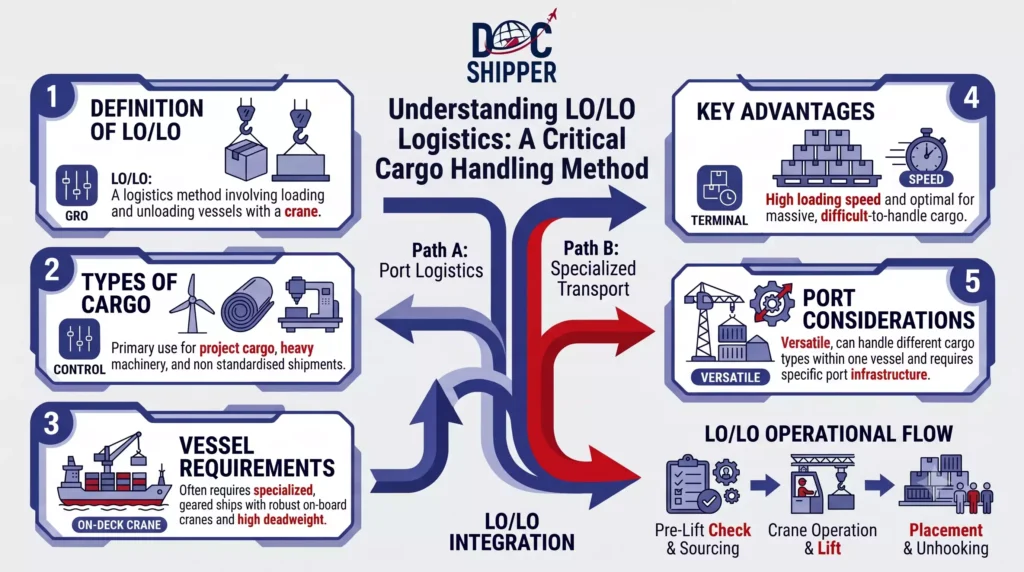
Lift On, Lift Off (LO/LO) is a cargo handling method where freight is loaded onto and unloaded from vessels using cranes or lifting equipment, commonly employed for heavy or oversized cargo that cannot fit into standard containers. This technique is essential for project cargo, machinery, and bulk shipments in international logistics.
Introduction
Many importers struggle with shipping non-containerized cargo, unsure whether their equipment or materials can be transported efficiently by sea. The LO/LO method provides a proven solution for handling oversized, heavy, or irregularly shaped freight.
In international shipping, not all cargo fits neatly into 20-foot or 40-foot containers. Industrial machinery, construction equipment, steel structures, and project cargo often require specialized handling. LO/LO operations address this need by utilizing ship-mounted or shore-based cranes to lift cargo directly onto the vessel’s deck or into holds.
Key characteristics of LO/LO operations include:
- Crane dependency: All loading and unloading operations require lifting equipment
- Flexible cargo dimensions: Accommodates oversized and heavy items beyond container limits
- Specialized vessels: Typically uses general cargo ships, multipurpose vessels, or heavy-lift ships
- Port infrastructure requirements: Both origin and destination ports must have adequate crane capacity
- Higher handling costs: More labor-intensive and time-consuming than containerized shipping
Technical & Operational Framework
The LO/LO methodology involves detailed planning and execution across multiple stages. Unlike Roll-on/Roll-off (RO/RO) shipping where cargo drives or rolls onto vessels, LO/LO requires vertical lifting operations for each piece of freight.
The process begins with cargo assessment and surveying. Shippers must provide exact dimensions, weight, center of gravity, and lifting points. Engineers calculate load distribution to prevent vessel instability. Documentation includes detailed stowage plans showing precisely where each item will be positioned.
Critical operational parameters include crane capacity and reach. Port cranes typically range from 40 to 500 tons lifting capacity. Heavy-lift vessels may feature onboard cranes exceeding 700 tons for exceptional cargo. The vessel’s gear must match or exceed the cargo’s weight, factoring in rigging equipment and safety margins.
Lashing and securing represent essential safety measures. After placement, cargo undergoes comprehensive securing using chains, wires, turnbuckles, and wooden dunnage. Maritime regulations require securing arrangements to withstand forces from vessel motion, weather conditions, and sea states. Improper securing can lead to cargo damage, vessel instability, or maritime accidents.
The legal and insurance framework surrounding LO/LO differs from containerized shipping. Cargo owners typically bear greater responsibility for proper packaging and marking. Insurance premiums reflect higher risk profiles due to exposure to weather and handling complexity. According to International Maritime Organization standards, all LO/LO cargo must comply with the Code of Safe Practice for Cargo Stowage and Securing (CSS Code).
At DocShipper, we coordinate comprehensive LO/LO operations including surveying, rigging specifications, port equipment verification, and customs documentation to ensure seamless handling of your oversized cargo from origin to destination.
Practical Examples & Data
Understanding LO/LO operations becomes clearer through real-world scenarios and comparative analysis. The following examples illustrate typical applications and cost structures.
Use Case: Industrial Machinery Export
A German manufacturer ships a 45-ton CNC milling machine to Brazil. The equipment measures 6.2m × 3.8m × 4.1m, exceeding standard container dimensions. The shipper chooses LO/LO on a multipurpose vessel.
| Operation Phase | Details | Cost (USD) |
|---|---|---|
| Pre-shipment survey | Dimensions, center of gravity, lifting points verification | $850 |
| Packing & crating | Weather-resistant crating, moisture barriers | $3,200 |
| Origin port handling | Crane usage (80-ton capacity), stevedoring, lashing | $4,500 |
| Ocean freight | Hamburg to Santos, 28-day transit | $12,800 |
| Destination port handling | Discharge, customs clearance support | $5,100 |
| Total LO/LO Cost | $26,450 |
Comparative Analysis: LO/LO vs. Alternative Methods
For a 25-ton transformer shipment from South Korea to UAE, shippers evaluated three options:
- LO/LO (General Cargo Vessel): Transit time 18 days, total cost $18,500, requires port cranes at both ends, moderate weather exposure
- Heavy-Lift Charter: Transit time 14 days, total cost $34,200, includes specialized vessel and onboard cranes, premium service
- Air Freight (Charter): Transit time 2 days, total cost $127,000, fastest option but cost-prohibitive for regular shipments
The shipper selected LO/LO, balancing cost efficiency with reasonable transit times. This decision saved 46% compared to heavy-lift charter while maintaining acceptable delivery schedules.
Industry Statistics:
- LO/LO handling costs average $85-$150 per ton depending on port infrastructure and cargo complexity
- Approximately 12-15% of global seaborne cargo moves via LO/LO methods annually
- Average loading time: 4-6 hours per heavy-lift unit versus 20-30 minutes per container
- Claims frequency for LO/LO cargo is 2.3 times higher than containerized freight due to handling exposure
- Peak demand sectors: construction equipment (28%), industrial machinery (23%), renewable energy components (19%)
Conclusion
The LO/LO method remains indispensable for moving oversized, heavy, or project cargo that defies containerization standards. While requiring specialized equipment and higher handling costs, it provides flexible solutions for complex international shipments.
Need expert guidance on LO/LO shipping for your oversized cargo? Contact DocShipper for comprehensive logistics support from surveying to final delivery.
📚 Quiz
Test Your Knowledge: Lift On, Lift Off (LO/LO)
What is the primary defining characteristic of LO/LO cargo handling operations?
A shipper has a 35-ton industrial machine measuring 5.8m × 3.2m × 3.9m. Which statement reflects the correct application of LO/LO?
Which factor primarily determines whether a port can handle LO/LO operations for heavy project cargo?
🎯 Your Result
📞 Free Personalized QuoteFAQ | Lift On, Lift Off (LO/LO): Definition, Operations & Concrete Examples
Standard port cranes typically handle cargo up to 100-150 tons. For heavier loads, specialized heavy-lift vessels with onboard cranes can accommodate weights exceeding 500 tons. The actual limit depends on port infrastructure and vessel specifications at both origin and destination.
LO/LO uses cranes to vertically lift cargo onto vessels, suitable for non-wheeled or oversized items. RO/RO involves rolling or driving cargo onto ships via ramps, ideal for vehicles and wheeled equipment. LO/LO offers greater flexibility for irregular cargo shapes but requires more handling time and specialized equipment.
Essential documents include detailed cargo specifications (weight, dimensions, center of gravity), lifting point diagrams, stowage plans, commercial invoice, packing list, bill of lading, certificate of origin, and insurance certificates. Some cargo may require additional certifications depending on type and destination regulations.
Extremely fragile items sensitive to crane vibrations, cargo requiring climate-controlled environments, and goods susceptible to weather damage may be unsuitable. Highly valuable or theft-prone items might also be better suited to containerized shipping for enhanced security. Each case requires individual assessment.
A single heavy-lift unit typically requires 3-6 hours for loading, including positioning, lifting, securing, and safety checks. In contrast, container loading averages 20-30 minutes per unit using standardized equipment. LO/LO operations are more time-intensive but necessary for non-containerizable cargo.
LO/LO shipments typically require marine cargo insurance with higher premiums reflecting increased handling risks. Coverage should address deck cargo exposure, crane operation risks, lashing failure, and weather damage. Many insurers mandate pre-shipment surveys and certified securing arrangements for high-value loads.
Yes, multipurpose vessels frequently carry both containerized and LO/LO cargo. However, LO/LO items typically occupy deck space or specialized holds, while containers stack in designated areas. Proper stowage planning ensures weight distribution and accessibility for both cargo types during loading and discharge operations.
Deck cargo faces direct weather exposure requiring protective measures such as tarpaulins, shrink-wrapping, corrosion-preventive coatings, and moisture barriers. Shippers should specify weather-resistant packaging in contracts. Some high-value cargo may require enclosed securing or voyage-specific weather routing to avoid severe conditions.
Rates typically combine weight (per metric ton) or volume (per cubic meter) calculations, whichever yields higher revenue. Additional factors include cargo dimensions, handling complexity, port charges, crane rental fees, lashing materials, and special equipment requirements. Quotations should specify whether rates include THC (Terminal Handling Charges) and other surcharges.
Primary damage causes include inadequate lashing allowing cargo movement during transit, improper lifting point selection causing structural stress, weather exposure to deck cargo, crane operation accidents during loading/unloading, and insufficient packaging for maritime conditions. Comprehensive surveys and certified securing arrangements minimize these risks.
Not all ports possess adequate crane capacity or operational expertise for heavy-lift LO/LO operations. Major industrial ports typically offer comprehensive facilities, while smaller regional ports may have limited lifting capacity. Shippers should verify destination port capabilities during planning stages to avoid costly transshipment or equipment rental.
The fundamental customs procedures remain similar, but LO/LO cargo often requires physical inspection due to non-standard packaging and higher declared values. Oversized items may need special permits, route surveys for inland transport, and additional documentation detailing cargo specifications. Processing times are typically longer than standardized container clearance.
Need Help with
Logistics or Sourcing ?
First, we secure the right products from the right suppliers at the right price by managing the sourcing process from start to finish. Then, we simplify your shipping experience - from pickup to final delivery - ensuring any product, anywhere, is delivered at highly competitive prices.


Fill the Form
Prefer email? Send us your inquiry, and we’ll get back to you as soon as possible.
Contact us




:%20Definition,%20Operations%20&%20Concrete%20Examples)