


In short ⚡
Life Cycle Cost (LCC) is the total cost of ownership of an asset throughout its entire lifespan, from acquisition and operation to maintenance and disposal. In international logistics, LCC enables businesses to evaluate the true financial impact of equipment, vehicles, or infrastructure beyond the initial purchase price, supporting strategic investment decisions.
Introduction
Many logistics companies make purchasing decisions based solely on upfront costs, overlooking operational expenses that accumulate over years. This short-sighted approach can result in hidden financial burdens that significantly exceed initial savings.
In freight forwarding and supply chain management, Life Cycle Cost analysis transforms procurement strategy. It reveals the economic reality of assets across their operational timeline, from container handling equipment to warehouse automation systems.
Key characteristics of Life Cycle Cost include:
- Comprehensive scope: Captures acquisition, operation, maintenance, and disposal costs
- Time-value consideration: Incorporates discount rates for future expenditures
- Performance metrics: Balances cost against operational efficiency and reliability
- Decision support: Enables comparison between competing assets or technologies
- Risk assessment: Identifies potential cost escalations throughout the asset’s life
LCC Methodology & Strategic Application
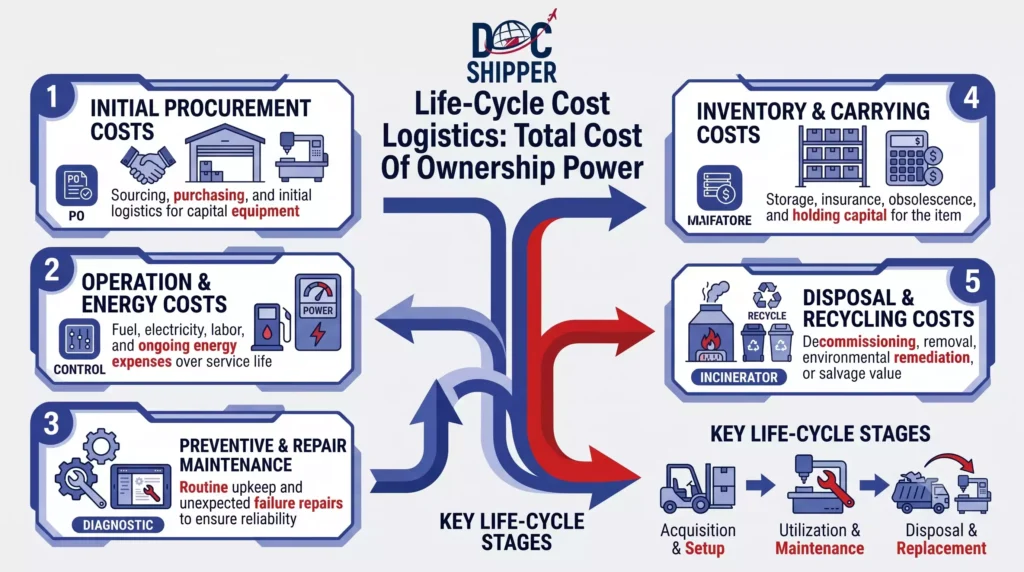
Life Cycle Cost analysis follows a structured methodology that accounts for every financial commitment associated with an asset. The fundamental formula encompasses acquisition costs (purchase price, installation, training), operating costs (energy, labor, consumables), maintenance costs (preventive and corrective), and disposal costs (decommissioning, environmental compliance).
In logistics operations, time-value of money becomes critical when projecting costs over 10-20 year periods. Net Present Value (NPV) calculations discount future expenses to today’s monetary value, providing accurate comparisons. For instance, a forklift requiring €3,000 annual maintenance in year five should be discounted at the company’s cost of capital rate.
The discount rate selection significantly impacts LCC outcomes. Most organizations use their Weighted Average Cost of Capital (WACC), typically ranging from 5% to 12% depending on market conditions and company-specific factors. According to ISO 15686-5 standard, this rate should reflect the organization’s opportunity cost of capital.
Residual value represents the asset’s worth at end-of-life, either through resale or scrap value. Container handling equipment, for example, may retain 15-20% of original value after 15 years if properly maintained. This residual amount reduces total LCC when properly accounted for.
At DocShipper, we systematically apply LCC analysis when recommending warehouse automation solutions or transport fleet upgrades. Our clients benefit from comprehensive cost projections that prevent unexpected financial exposure. This approach has helped partners avoid equipment choices that appeared economical initially but generated excessive maintenance costs over time.
Practical Examples & Cost Breakdowns
Consider two forklift options for a distribution center handling containerized cargo. Model A costs €35,000 with annual operating expenses of €4,200. Model B costs €42,000 but requires only €2,800 yearly for operation due to superior fuel efficiency and reliability.
Over a 10-year operational period with 6% discount rate:
| Cost Component | Model A | Model B |
|---|---|---|
| Initial Purchase | €35,000 | €42,000 |
| Operating Costs (NPV) | €30,912 | €20,608 |
| Maintenance (NPV) | €14,200 | €9,800 |
| Residual Value | -€3,200 | -€5,800 |
| Total LCC | €76,912 | €66,608 |
Despite the €7,000 higher purchase price, Model B delivers €10,304 in total savings over the lifecycle. This represents a 13.4% cost reduction compared to the apparently cheaper alternative.
Real-world container terminal case: A European port authority evaluated automated guided vehicles (AGVs) versus traditional terminal tractors. Initial AGV investment was €2.8 million compared to €1.2 million for conventional equipment. However, LCC analysis over 15 years revealed:
- Labor costs: AGVs eliminated 12 full-time positions, saving €6.4 million in personnel expenses
- Energy efficiency: Electric AGVs consumed 40% less energy, worth €890,000 in savings
- Maintenance: Predictive maintenance systems reduced unplanned downtime by 65%, avoiding €420,000 in operational disruptions
- Residual value: Advanced AGV technology retained 22% resale value versus 8% for conventional tractors
- Total LCC advantage: AGVs achieved €4.2 million lower lifecycle cost despite higher initial investment
This methodology applies equally to warehouse management systems, refrigerated containers, or fleet vehicles. The principle remains consistent: evaluate total ownership economics rather than purchase price alone.
Conclusion
Life Cycle Cost analysis transforms asset procurement from transactional purchasing into strategic investment management. By quantifying total ownership economics, logistics professionals make informed decisions that optimize long-term financial performance.
Need expert guidance on LCC analysis for your logistics assets? Contact DocShipper for comprehensive procurement consulting that maximizes your operational efficiency and ROI.
📚 Quiz
Test Your Knowledge: Life Cycle Cost
Life Cycle Cost (LCC) primarily measures:
When comparing two forklifts, the model with the lower purchase price will always result in:
A port authority is evaluating automated guided vehicles (AGVs) at €2.8M versus traditional tractors at €1.2M. The correct LCC approach is to:
🎯 Your Result
📞 Free Quote in 24hFAQ | Life Cycle Cost: Definition, Calculation & Concrete Examples
A comprehensive LCC includes acquisition costs (purchase, delivery, installation, training), operating costs (energy, labor, materials), maintenance costs (scheduled and unscheduled repairs, spare parts), downtime costs (lost productivity), and disposal costs (decommissioning, environmental remediation). Interest rates and inflation should also be factored into long-term projections for accurate financial modeling.
While often used interchangeably, LCC typically emphasizes physical assets with defined lifespans and includes time-value calculations through NPV. Total Cost of Ownership (TCO) may encompass broader organizational impacts including training, support services, and opportunity costs. Both methodologies aim to capture expenses beyond initial purchase price, but LCC applies more rigorous financial discounting for long-term capital assets.
Most organizations use their Weighted Average Cost of Capital (WACC), typically 5-12% depending on industry and financial structure. Government entities may use lower rates (3-5%) reflecting public sector borrowing costs. The discount rate should reflect the organization's opportunity cost of capital—what returns could be achieved if funds were invested elsewhere. Sensitivity analysis testing multiple rates provides robust decision support.
Analysis periods should match the asset's expected useful life. Forklifts typically operate 10-12 years, warehouse automation systems 15-20 years, and building infrastructure 25-40 years. Shorter periods may be appropriate for rapidly evolving technologies where obsolescence occurs before physical deterioration. Industry benchmarks and manufacturer specifications provide guidance on realistic operational timelines.
Absolutely. LCC for leased assets includes lease payments, operating costs borne by the lessee, maintenance responsibilities, and end-of-lease options. This enables comparison between purchasing, operating leases, and finance leases. Leasing may reduce upfront capital but increase total lifecycle costs due to financing charges. The analysis should account for tax implications and balance sheet treatment differences between ownership models.
Preventive maintenance reduces unexpected failures and extends asset life but increases scheduled maintenance costs. Reactive maintenance minimizes upfront maintenance investment but risks expensive emergency repairs and operational disruptions. Predictive maintenance using sensors and analytics optimizes the balance, performing interventions precisely when needed. Studies show predictive approaches can reduce maintenance costs by 25-30% while improving equipment availability.
Energy costs represent 15-40% of total operating expenses for material handling equipment and warehouse facilities. Efficient LED lighting, high-efficiency motors, and optimized HVAC systems require higher initial investment but generate substantial savings over 10-20 year periods. With electricity prices rising 3-5% annually in many markets, energy-efficient specifications become increasingly critical to favorable lifecycle economics.
Technological obsolescence occurs when newer solutions render existing assets economically inefficient despite remaining physically functional. This is addressed by selecting realistic analysis periods (shorter for IT systems, longer for mechanical equipment), incorporating residual values that reflect technological currency, and conducting scenario analysis. Some organizations include periodic technology refresh costs rather than assuming full asset life utilization.
Reliable LCC requires manufacturer specifications (purchase price, expected life, energy consumption), historical operating data from similar assets, industry benchmarks for maintenance costs, and financial parameters (discount rate, inflation projections). Equipment suppliers often provide lifecycle cost estimates. Third-party databases and industry associations publish comparative data. Internal fleet data from existing operations provides the most accurate inputs.
LCC naturally aligns with sustainability by favoring energy-efficient, durable assets with lower environmental impact. Extended asset life reduces resource consumption and waste generation. Carbon pricing and environmental compliance costs can be integrated into LCC models, making eco-friendly options more economically attractive. Many organizations now include externalities like carbon emissions in expanded lifecycle assessments.
Yes, LCC effectively compares outsourced services against internal capabilities. For warehousing, this includes comparing third-party logistics costs against operating your own facility (including capital investment, staffing, management overhead). The analysis should capture all relevant costs: service fees, transition costs, retained management burden, and flexibility/control considerations. Risk factors like service quality variability should also be quantified.
Sensitivity analysis tests how results change with varying assumptions. Key variables include discount rate (±2%), operating cost inflation (±1-2%), maintenance cost variation (±20%), and residual value estimates (±50%). This identifies which factors most influence outcomes and quantifies decision risk. Monte Carlo simulation using probability distributions for uncertain inputs provides sophisticated risk assessment for major capital investments.
Need Help with
Logistics or Sourcing ?
First, we secure the right products from the right suppliers at the right price by managing the sourcing process from start to finish. Then, we simplify your shipping experience - from pickup to final delivery - ensuring any product, anywhere, is delivered at highly competitive prices.


Fill the Form
Prefer email? Send us your inquiry, and we’ll get back to you as soon as possible.
Contact us




