


In short ⚡
Leverage is a financial and operational strategy that uses borrowed capital, debt, or fixed costs to amplify potential returns on investment. In international logistics, leverage multiplies purchasing power, enabling importers to scale operations, negotiate better freight rates, and optimize supply chain financing without mobilizing total capital upfront.
Introduction
Many import/export businesses struggle with capital constraints. They face a common dilemma: how to expand operations, increase order volumes, or negotiate favorable shipping contracts without tying up all available funds. Leverage solves this challenge by allowing companies to use external financing or credit facilities to multiply their operational capacity.
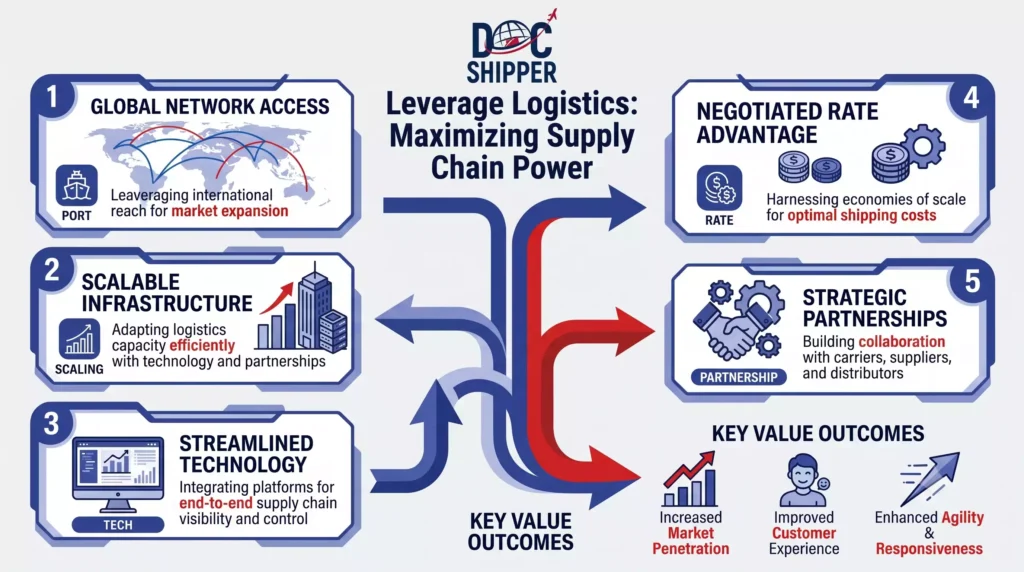
In international trade, leverage is not merely about borrowing money. It encompasses supplier credit terms, letters of credit, freight consolidation advantages, and volume-based discount negotiations. Understanding leverage mechanisms is crucial for optimizing cash flow, reducing per-unit logistics costs, and maintaining competitiveness in global markets.
Key characteristics of leverage in logistics include:
- Capital efficiency: Deploying less equity to achieve greater transaction volumes
- Risk amplification: Magnifying both potential gains and losses
- Negotiation power: Larger commitments unlock preferential freight rates and payment terms
- Cash flow management: Separating payment obligations from revenue realization timelines
- Scalability: Enabling rapid growth without proportional capital increases
Leverage Mechanics & Strategic Applications
Financial leverage operates through the debt-to-equity ratio, measuring how much borrowed capital a company uses relative to its own funds. In logistics, a ratio of 2:1 means for every dollar of equity, two dollars of debt finance operations. This amplifies return on equity when margins exceed borrowing costs, but increases vulnerability during market downturns.
The leverage formula in return analysis is: Return on Equity (ROE) = Return on Assets (ROA) × Leverage Multiplier. If an importer generates 8% ROA with 3x leverage, the theoretical ROE reaches 24% before interest deductions. However, borrowing costs typically reduce net gains to 15-18% in practice.
Operational leverage in freight logistics involves consolidating shipments to achieve volume discounts. A company shipping 10 containers monthly at $3,000 each might negotiate $2,400 per container by committing to 50 containers quarterly. This 20% cost reduction doesn’t require additional capital but leverages committed volume for better rates.
Trade finance instruments provide transactional leverage without traditional loans. Letters of credit allow importers to secure goods before payment, typically with 30-90 day credit terms. This timing gap enables selling imported products before settling supplier invoices, effectively using supplier capital to finance inventory. According to the World Trade Organization, 80-90% of global trade relies on some form of trade finance leverage.
Supplier payment terms represent another leverage form. Negotiating Net 60 instead of Net 30 terms effectively provides a 30-day interest-free loan. On a $100,000 shipment, this delays $100,000 in cash outflow, preserving working capital for other operations or investments yielding returns during that period.
At DocShipper, we structure financing solutions that optimize leverage ratios for our clients. By coordinating with freight forwarders and financial institutions, we help importers access credit facilities specifically designed for international logistics, ensuring capital efficiency without excessive risk exposure.
Practical Examples & Financial Data
Understanding leverage requires examining concrete scenarios with real numbers. The following cases illustrate how different leverage strategies impact profitability and risk in international trade operations.
Comparative Leverage Scenarios
| Scenario | Own Capital | Borrowed Capital | Leverage Ratio | ROE (10% ROA) |
|---|---|---|---|---|
| No Leverage | $100,000 | $0 | 1:1 | 10% |
| Moderate Leverage | $100,000 | $100,000 | 2:1 | 16% |
| High Leverage | $100,000 | $300,000 | 4:1 | 28% |
*Assumes 4% borrowing cost and 10% return on total assets
Use Case: Container Consolidation Leverage
A textile importer in New York orders $50,000 worth of fabric monthly from Vietnam. Standard LCL (Less than Container Load) shipping costs $8,500 per shipment. By leveraging a volume commitment strategy, the company negotiates with their freight forwarder:
- Baseline scenario: 12 monthly LCL shipments = $102,000 annual freight cost
- Leveraged scenario: Commit to 15 FCL containers annually at $4,200 each = $63,000 total
- Capital requirement: Increase inventory holding from 30 to 45 days (additional $25,000 tied up)
- Net savings: $39,000 freight reduction minus $1,500 inventory carrying cost = $37,500 annual benefit
- Leverage efficiency: $25,000 additional capital generates $37,500 savings = 150% return
Trade Finance Leverage Example
An electronics distributor uses a letter of credit facility to import $200,000 worth of smartphones from China with 60-day payment terms. They sell the inventory within 30 days at 25% markup:
- Revenue generated: $250,000 (30 days after receiving goods)
- Payment due to supplier: $200,000 (60 days after receiving goods)
- Cash availability window: 30 days with $250,000 liquid before settling invoice
- Opportunity value: Invest $250,000 at 5% annual rate for 30 days = $1,027 additional income
- LC facility cost: 1.5% of transaction value = $3,000
- Net leverage cost: $3,000 LC fee minus $1,027 opportunity gain = $1,973 for accessing $200,000 working capital
These examples demonstrate that strategic leverage deployment in logistics creates measurable financial advantages. The key is matching leverage instruments to specific operational needs while maintaining manageable risk exposure through diversified financing sources and conservative debt-to-equity ratios.
Conclusion
Leverage transforms capital constraints into competitive advantages when applied strategically. In international logistics, understanding leverage mechanics enables importers and exporters to scale operations, negotiate superior terms, and optimize cash flow without exhausting equity reserves. The balance between growth potential and financial risk defines successful leverage deployment.
Need expert guidance on structuring leverage strategies for your import/export operations? Contact DocShipper for tailored logistics financing solutions that align with your business objectives and risk tolerance.
📚 Quiz
Test Your Knowledge: Leverage in International Logistics
What is the primary function of leverage in international logistics?
A common misconception about leverage is that it only refers to traditional bank loans. Which statement correctly describes leverage in logistics?
An importer has $100,000 in equity and borrows $200,000 to finance operations, generating 10% return on total assets with 4% borrowing cost. What is the approximate return on equity (ROE)?
🎯 Your Result
📞 Free Personalized QuoteFAQ | Leverage: Definition, Calculation & Practical Examples
Most logistics experts recommend maintaining a debt-to-equity ratio between 1.5:1 and 2.5:1 for import/export operations. This range provides growth capital while preserving financial stability during market fluctuations. Companies with stable, predictable cash flows can safely operate at the higher end, while businesses facing volatile demand should remain conservative. The optimal ratio depends on industry margins, payment cycles, and access to emergency liquidity.
Leverage dramatically increases negotiation power by enabling volume commitments. Freight forwarders offer 15-30% discounts to clients guaranteeing minimum container quantities annually. Financial leverage allows importers to commit to larger volumes without proportional equity investment, securing preferential rates. This creates a compounding advantage: lower per-unit costs improve margins, which justifies further leverage deployment for additional volume commitments and even better pricing tiers.
Primary risks include currency fluctuations amplifying debt burdens, demand volatility preventing volume commitments from being met, and interest rate increases raising borrowing costs. Over-leverage can create cash flow crises if payment cycles misalign with revenue realization. Political instability or customs delays may freeze inventory while debt obligations continue. Effective risk management requires diversified financing sources, currency hedging strategies, and maintaining 20-30% reserve capacity in credit facilities.
Yes, multiple leverage options exist for small importers. Trade credit insurance enables access to letters of credit without extensive collateral. Supply chain financing platforms provide invoice factoring and purchase order financing specifically for SMEs. Freight forwarders often extend 30-60 day payment terms to established clients. Government-backed export credit agencies in many countries offer subsidized financing programs. Starting with supplier payment terms and gradually building credit history opens access to more sophisticated leverage instruments.
Financial leverage ratio equals total assets divided by shareholders' equity. For example, $500,000 in assets with $200,000 equity yields 2.5x leverage. Operating leverage in logistics measures fixed costs relative to variable costs; higher fixed commitments (warehouses, contracted freight capacity) amplify profit changes from volume fluctuations. The degree of operating leverage formula is: percentage change in operating income divided by percentage change in sales volume.
Financial leverage involves borrowing money to fund operations, measured by debt-to-equity ratios. It magnifies returns on equity but increases fixed interest obligations. Operational leverage relates to cost structure—specifically the proportion of fixed versus variable costs. High operational leverage means small sales increases generate disproportionate profit gains, but also amplifies losses during downturns. In logistics, using contracted warehouse space represents operational leverage, while financing that warehouse with loans represents financial leverage.
Letters of credit separate payment obligation from cash outflow timing. Importers commit to pay (creating liability) but actual cash transfer occurs 30-90 days later. This gap allows selling imported goods before settling supplier invoices, effectively using bank credit to finance inventory. The importer leverages the bank's creditworthiness to secure goods without immediate capital deployment. LC fees typically range 0.75-1.5% of transaction value, significantly cheaper than short-term working capital loans at 6-12% annual rates.
Seasonal importers should use flexible leverage instruments rather than fixed debt structures. Revolving credit facilities allow drawing funds during peak seasons and repaying during slow periods without penalty. Inventory financing secured by goods themselves adjusts automatically to stock levels. Extended supplier payment terms negotiated specifically for high-season orders preserve cash during critical periods. The key is matching leverage deployment timing to revenue generation cycles, ensuring debt service aligns with cash inflows.
Currency leverage occurs when borrowing in one currency to purchase goods priced in another. If an EU importer borrows USD to buy Chinese goods priced in USD, they eliminate currency risk between borrowing and payment. However, if their sales occur in EUR, exchange rate movements between USD and EUR affect effective debt burden. Favorable currency moves reduce real debt costs, while adverse movements increase them. This adds a speculative dimension requiring hedging strategies or natural currency matching between revenues and debt obligations.
Just-in-time systems require minimal inventory leverage but maximum supplier relationship leverage. Companies negotiate consignment arrangements where suppliers maintain ownership until goods are consumed, eliminating inventory financing needs. This shifts leverage from financial capital to negotiation power and supply chain reliability. Success depends on leveraging long-term partnerships and data-sharing agreements rather than borrowed funds. The trade-off is vulnerability to supply disruptions, requiring backup supplier leverage options as insurance.
DocShipper analyzes your specific supply chain to identify optimal leverage points across freight consolidation, supplier negotiations, and trade finance instruments. We coordinate with financial institutions to structure credit facilities tailored to logistics cycles, ensuring payment terms align with cash flow patterns. Our volume aggregation services enable smaller importers to access bulk pricing typically reserved for larger players. We also provide risk assessment to prevent over-leverage while maximizing capital efficiency across your international trade operations.
Moderate leverage enhances resilience by providing capital flexibility during disruptions, enabling rapid supplier switching or expedited shipping when needed. However, excessive leverage reduces resilience by creating fixed obligations that persist during revenue interruptions. The optimal balance maintains 20-30% unused credit capacity as a resilience buffer. Diversifying leverage sources across multiple banks, trade finance platforms, and supplier credit terms prevents single-point failures. Stress-testing leverage structures against scenarios like 30% demand drops or 60-day payment delays reveals vulnerability thresholds before crises occur.
Need Help with
Logistics or Sourcing ?
First, we secure the right products from the right suppliers at the right price by managing the sourcing process from start to finish. Then, we simplify your shipping experience - from pickup to final delivery - ensuring any product, anywhere, is delivered at highly competitive prices.


Fill the Form
Prefer email? Send us your inquiry, and we’ll get back to you as soon as possible.
Contact us




