


In short ⚡
A line item is an individual entry on a commercial document (invoice, purchase order, bill of lading) representing a specific product, service, or charge. Each line item includes a unique description, quantity, unit price, and total value, enabling precise tracking and verification throughout the supply chain.
Introduction
Confusion between total shipment values and individual product values causes over 30% of customs clearance delays worldwide. The distinction matters critically when calculating duties, verifying orders, or resolving disputes.
In international logistics, line items serve as the fundamental building blocks of commercial documentation. Each line represents a distinct transaction element that customs authorities, freight forwarders, and buyers must verify independently.
Understanding line items becomes essential for:
- Accurate customs valuation – Each item may carry different tariff classifications
- Order verification – Matching shipped goods against purchase agreements
- Financial reconciliation – Tracking costs at the SKU level for precise accounting
- Dispute resolution – Identifying specific items when damages or discrepancies occur
- Inventory management – Enabling precise stock tracking across multiple warehouses
Understanding Line Items in International Trade
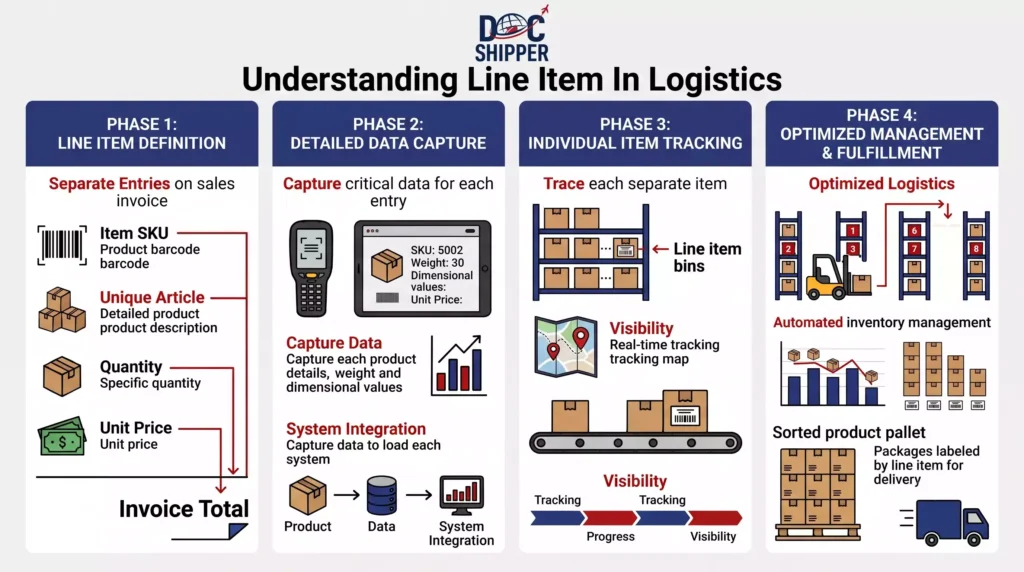
Every commercial document in logistics breaks down into discrete line items. This granularity enables stakeholders to trace individual products through complex supply chains.
The essential components of a line item include a sequential number, product description, HS code, quantity with unit of measure, unit price, and extended total. Additional fields often capture country of origin, manufacturer details, and specific markings.
From a customs perspective, each line item may trigger different duty rates and regulatory requirements. A shipment containing electronics and textiles requires separate tariff classifications. Customs authorities assess duties on a per-line basis, not on aggregate shipment value.
According to the World Customs Organization, proper line-item documentation reduces clearance times by 40% and minimizes examination risks. Each line must contain sufficient detail for classification without physical inspection.
The legal significance of line items extends beyond customs. Commercial disputes frequently hinge on specific line-level discrepancies. A buyer receiving 950 units instead of 1,000 needs clear line-item documentation to substantiate claims.
Electronic data interchange (EDI) systems depend on standardized line-item structures. Modern supply chains exchange millions of line items daily through automated systems. Consistency in formatting prevents transmission errors and system rejections.
At DocShipper, we verify every line item against purchase orders before shipment to prevent costly delays. Our systems flag inconsistencies in HS codes, quantities, or values that could trigger customs holds.
Practical Examples & Real-World Applications
Consider a furniture importer receiving a container from Vietnam. The commercial invoice contains twelve distinct line items, each representing different SKUs with unique HS codes and duty rates.
| Line | Description | HS Code | Qty | Unit Price | Total |
|---|---|---|---|---|---|
| 1 | Wooden dining table | 9403.60 | 50 | $120 | $6,000 |
| 2 | Upholstered chair | 9401.61 | 200 | $45 | $9,000 |
| 3 | Metal bookshelf | 9403.20 | 75 | $85 | $6,375 |
Each line item triggers different duty rates: wooden furniture at 3.2%, upholstered items at 4.5%, and metal furniture at 2.8%. Customs calculates duties per line, not on the $21,375 aggregate value.
Use Case: Electronics Shipment Discrepancy
A retailer orders 500 laptops and 300 monitors from China. The commercial invoice shows two line items. Upon arrival, the manifest reveals only 480 laptops but 320 monitors.
Line-item documentation enables the buyer to:
- Identify the exact shortage (20 laptops, line item 1)
- Calculate the precise financial impact ($18,000 at $900 per unit)
- File an insurance claim with specific item references
- Adjust inventory systems at the SKU level
- Negotiate partial payment with the supplier based on delivered quantities
Without proper line-item tracking, resolving this discrepancy would require physical recounts and extended dispute periods. Precise line documentation reduces claim resolution time from weeks to days.
Multi-Country Consolidation Scenario
A logistics provider consolidates shipments from three factories (Thailand, Malaysia, Indonesia) into one container. The master commercial invoice contains eighteen line items, grouped by origin country.
Each line item specifies country of manufacture, enabling customs to apply appropriate Free Trade Agreement benefits. Line items 1-6 from Thailand qualify for preferential rates under the US-Thailand trade agreement, while items 7-12 from Malaysia face standard MFN rates.
This granular approach saves the importer $3,200 in duty costs on a single $45,000 shipment by correctly applying trade preferences at the line level rather than treating the entire shipment as non-preferential.
Conclusion
Line items form the essential documentation framework that enables accurate valuation, customs clearance, and commercial verification in international logistics. Proper line-item management prevents delays and reduces duty costs through precise classification.
Need expert assistance with commercial documentation and line-item verification? Contact DocShipper for comprehensive logistics support.
📚 Quiz
Test Your Knowledge: Line Item
A line item is best defined as:
A shipment contains wooden tables, upholstered chairs, and metal bookshelves. How should customs calculate import duties?
Your commercial invoice shows 1,000 laptops on line item 1, but physical inspection reveals only 980 units. What is the correct course of action?
🎯 Your Result
📞 Free Quote in 24hFAQ | Line Item: Definition, Types & Practical Examples in Logistics
A line item represents an entry on a commercial document, while a SKU (Stock Keeping Unit) is an internal inventory code. One SKU may appear on multiple line items across different documents. The line item includes pricing and quantity specific to that transaction, whereas the SKU remains constant across all transactions for product identification purposes.
There is no legal maximum, though practical limits exist. Most customs systems handle invoices with 100-200 line items efficiently. Shipments exceeding 500 line items often require supplementary schedules or electronic submission formats. Consolidated shipments from multiple suppliers may contain thousands of line items, typically broken into multiple invoice documents.
Not necessarily. Multiple line items representing different quantities, sizes, or colors of the same product category may share an HS code. However, products with different materials, functions, or specifications typically require distinct classifications. Customs authorities focus on product characteristics, not line-item numbering, when assigning tariff codes.
This practice creates significant risks. Customs authorities require separate line items for products with different HS codes, values, or regulatory requirements. Combining items may trigger examinations, duty recalculations, or penalties. Some jurisdictions permit grouping identical items with different colors or sizes under one line if they share classification codes and unit values.
Discrepancies trigger customs examinations and potential shipment holds. If documentation shows 1,000 units but physical count reveals 950, customs may require amended documentation, impose penalties, or refuse clearance. Exporters must issue corrected invoices, and importers face delayed deliveries. Accurate line-item documentation prevents these costly situations.
Freight typically appears separately from product line items, either as a distinct section or as additional lines after product entries. International trade rules require clear separation between merchandise value and transportation costs for accurate duty calculation. Some jurisdictions assess duties on CIF values (including freight), while others use FOB values (excluding freight).
Customs assesses duties on each line item independently based on its HS code, value, and applicable rates. A shipment with ten line items may have ten different duty rates. Authorities multiply each line's value by its specific rate, then sum the results for total duties owed. This line-level calculation prevents averaging that could incorrectly reduce or increase duty obligations.
Customs requires sufficient detail for classification without physical examination. Generic descriptions like "parts" or coded references are typically insufficient. Each line item must identify the product clearly, including material composition, intended use, and distinguishing characteristics. Internal codes may supplement but not replace descriptive text.
Minimum requirements include sequential line number, product description, quantity, unit of measure, unit price, and extended total value. Most jurisdictions also require HS codes, country of origin, and manufacturer details. Additional elements may include weight, dimensions, part numbers, and regulatory certifications depending on product type and destination country requirements.
Consolidations combine goods from multiple shippers into one transport unit. Each shipper's products appear as separate line items on a master commercial invoice. The document typically groups line items by consignee or origin. Freight forwarders must maintain line-item integrity to ensure proper delivery splitting and customs clearance for individual consignees.
Yes, even samples require line-item documentation. Customs must verify that quantities and values align with sample classifications to prevent commercial shipments from falsely claiming sample status. Non-commercial goods like personal effects still need line items for inventory verification, though valuation may show zero commercial value. Proper documentation prevents misclassification penalties.
Post-submission modifications require formal amendment procedures. Most jurisdictions allow corrections before goods release, though some impose fees or require supervisory approval. After clearance, amendments become significantly more complex, potentially requiring duty recalculation and penalty assessments. Electronic systems often permit pre-arrival corrections without penalties if made before official acceptance.
Need Help with
Logistics or Sourcing ?
First, we secure the right products from the right suppliers at the right price by managing the sourcing process from start to finish. Then, we simplify your shipping experience - from pickup to final delivery - ensuring any product, anywhere, is delivered at highly competitive prices.


Fill the Form
Prefer email? Send us your inquiry, and we’ll get back to you as soon as possible.
Contact us




