


In short ⚡
Logistics Data Interchange (LDI) is a standardized electronic communication system enabling automated exchange of logistics information between supply chain partners. This digital framework facilitates real-time sharing of shipment data, inventory levels, and operational updates without manual intervention, significantly reducing errors and processing times in international trade operations.
Introduction
Supply chain visibility remains one of the most critical challenges facing logistics professionals today. Manual data entry, inconsistent formats, and communication delays create bottlenecks that cost businesses billions annually in inefficiencies.
Logistics Data Interchange addresses these pain points by establishing a common digital language between shippers, carriers, customs authorities, and warehouses. This standardization transforms fragmented information flows into seamless, automated processes.
The importance of LDI in modern supply chains includes:
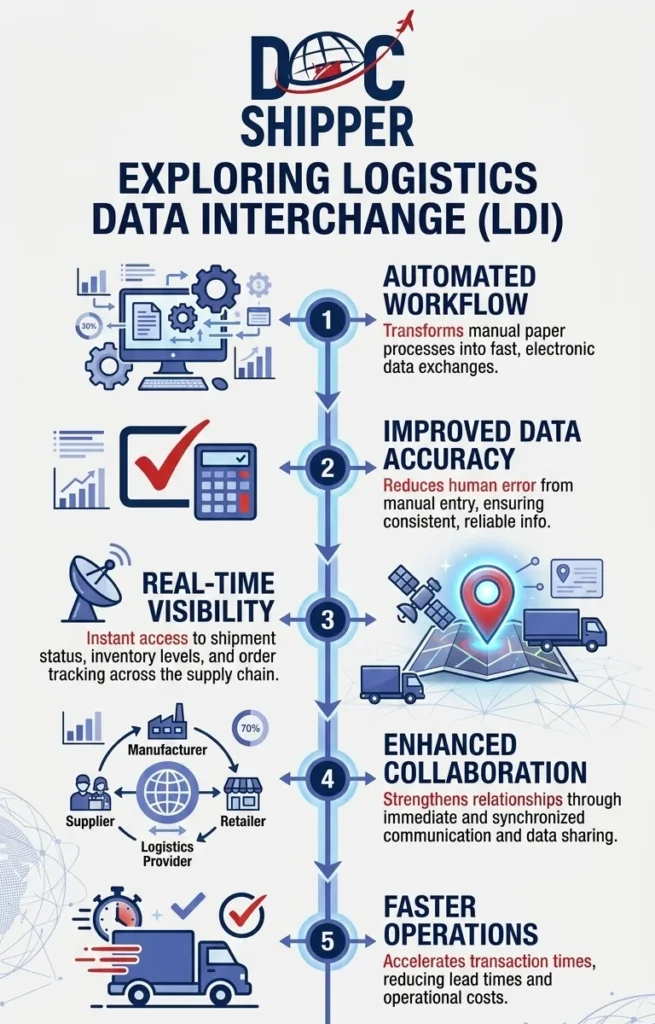
- Real-time visibility: Instant tracking updates across the entire logistics network
- Error reduction: Automated data transfer eliminates manual transcription mistakes
- Regulatory compliance: Standardized formats align with customs and trade requirements
- Cost optimization: Reduced administrative overhead and faster processing times
- Scalability: Seamless integration with multiple partners without customization
At DocShipper, we implement LDI protocols to ensure seamless communication between all stakeholders in your supply chain, from origin to final delivery.
Technical Framework & Standards
Logistics Data Interchange operates through standardized message formats that enable different software systems to communicate effectively. Understanding these technical foundations is essential for successful implementation.
The primary standards governing LDI include:
EDI (Electronic Data Interchange) remains the foundational protocol, with specific message types like DESADV (despatch advice), ORDERS (purchase order), and IFTMIN (freight booking). These standardized formats ensure consistent interpretation across global supply chains. The UN/EDIFACT standard governs international electronic business communication.
XML-based protocols provide modern alternatives with enhanced flexibility. Systems like GS1 XML enable detailed product information exchange, while SOAP and REST APIs facilitate cloud-based integration. These formats support complex data structures including nested shipment details and multi-party transactions.
API integration standards represent the latest evolution, enabling real-time data synchronization. RESTful APIs allow instant updates between transportation management systems, warehouse platforms, and customer portals without batch processing delays.
Blockchain-enabled LDI emerges as a secure alternative for high-value shipments. Distributed ledger technology creates immutable records of custody transfers and customs clearances, particularly valuable for pharmaceutical and luxury goods logistics.
IoT data streams integrate sensor information directly into LDI frameworks. Temperature monitors, GPS trackers, and shock sensors feed real-time condition data into the interchange system, triggering automated alerts when thresholds are exceeded.
DocShipper’s technical team configures these protocols to match your existing infrastructure, ensuring compatibility while maintaining data security and regulatory compliance throughout the integration process.
Implementation & Business Benefits
Transitioning to Logistics Data Interchange requires strategic planning but delivers measurable operational improvements across the supply chain. Real-world implementations demonstrate substantial ROI within the first operational year.
Comparative Analysis: Manual vs. LDI-Enabled Operations
| Operational Metric | Manual Processing | LDI Implementation | Improvement |
|---|---|---|---|
| Document Processing Time | 45-60 minutes | 2-5 minutes | 90% reduction |
| Data Entry Error Rate | 3-5% | 0.1-0.3% | 94% reduction |
| Shipment Visibility Updates | Daily/weekly batches | Real-time continuous | 24/7 transparency |
| Administrative Cost per Shipment | $25-35 | $5-8 | 75% cost reduction |
| Exception Resolution Time | 3-5 business days | 4-8 hours | 85% faster |
Use Case: Electronics Manufacturer Implementation
A European electronics manufacturer importing components from Southeast Asia implemented LDI across their supply chain network. Prior to implementation, they processed 2,400 shipments annually with manual documentation.
Challenge: Customs delays caused by documentation errors resulted in average detention periods of 72 hours, creating production bottlenecks and emergency air freight costs exceeding $180,000 annually.
LDI Solution: Integration of automated customs data transmission, carrier milestone updates, and warehouse receiving confirmations through standardized EDI messages. The system connected their ERP with freight forwarders, customs brokers, and port authorities.
Results after 12 months: Documentation error rate dropped from 4.2% to 0.3%. Average customs clearance time reduced to 18 hours. Emergency freight costs decreased by $156,000. Administrative staff reallocated from data entry to value-added supply chain optimization activities.
The manufacturer also gained predictive capabilities, using historical LDI data to forecast arrival times with 95% accuracy, enabling just-in-time production scheduling and inventory reduction.
At DocShipper, we’ve supported similar transformations across industries, configuring LDI systems tailored to specific operational requirements while ensuring compliance with international trade regulations. Need assistance implementing Logistics Data Interchange in your operations? Contact our technical team for a customized integration assessment.
Conclusion
Logistics Data Interchange represents the digital backbone of modern supply chain operations, transforming fragmented manual processes into seamless automated workflows. As global trade complexity increases, standardized data exchange becomes not just beneficial but essential for competitive advantage.
Ready to optimize your logistics communication infrastructure? Reach out to DocShipper for expert guidance on implementing LDI solutions tailored to your business requirements.
📚 Quiz
Test Your Knowledge: Logistics Data Interchange
What is the primary purpose of Logistics Data Interchange (LDI)?
Which statement correctly describes LDI's relationship to traditional EDI?
According to the case study, what was the primary outcome for the electronics manufacturer after implementing LDI?
🎯 Your Results
📞 Free Quote in 24hFAQ | Logistics Data Interchange (LDI): Definition, Implementation & Concrete Examples
Logistics Data Interchange is an evolution of traditional EDI specifically designed for supply chain operations. While EDI encompasses all electronic business document exchange, LDI focuses exclusively on logistics-specific messages like shipment tracking, customs declarations, and warehouse notifications. LDI typically incorporates newer technologies like APIs and IoT integration alongside classic EDI protocols, providing real-time capabilities that traditional batch-processed EDI cannot achieve.
Implementation timelines vary based on system complexity and partner network size. Small-scale deployments connecting 3-5 partners typically require 8-12 weeks for configuration, testing, and go-live. Enterprise-level implementations with multiple international partners and legacy system integration may require 6-9 months. Phased rollouts starting with high-volume lanes can deliver partial benefits within 4-6 weeks while the full system develops.
LDI costs include software licensing ($5,000-$50,000 annually depending on transaction volume), integration services ($15,000-$100,000 for initial setup), and per-transaction fees ($0.10-$0.50 per message). Cloud-based SaaS solutions offer lower entry points with subscription models starting around $500-$2,000 monthly. Most organizations achieve ROI within 12-18 months through reduced administrative costs and error-related expenses.
Yes, modern LDI platforms support integration with virtually all major WMS solutions through standardized APIs and middleware connectors. Common integrations include SAP, Oracle WMS, Manhattan Associates, and Blue Yonder systems. The integration typically involves mapping data fields between systems and establishing automated triggers for events like goods receipt, picking completion, and shipment dispatch notifications.
LDI systems employ multiple security layers including TLS/SSL encryption for data in transit, AS2/AS4 protocols for secure EDI transmission, and digital certificates for partner authentication. Data at rest utilizes AES-256 encryption standards. Enterprise implementations often include VPN tunnels, IP whitelisting, and multi-factor authentication. Blockchain-enabled LDI adds cryptographic verification ensuring data integrity throughout the supply chain.
LDI frameworks incorporate regional variations through configurable mapping tables that translate between local requirements and international standards. Systems maintain country-specific data dictionaries for customs declarations, addressing formats, and regulatory codes while preserving core message structure. UN/EDIFACT provides the international foundation, with regional subsets like EANCOM in Europe and VICS in North America addressing market-specific needs.
Several bridging solutions accommodate non-LDI partners. Web portals allow manual data entry that automatically converts to LDI formats. Email-to-EDI gateways extract information from structured emails and generate standardized messages. For critical partners, managed EDI services can act as intermediaries, handling translation between manual processes and automated systems. Gradually expanding LDI adoption across the network maximizes benefits over time.
LDI transmits regulatory data directly to customs authorities through standardized formats like CUSCAR (customs cargo reports) and CUSDEC (customs declarations). Systems validate data against regulatory requirements before transmission, reducing rejection rates. Integration with harmonized tariff databases ensures correct classification codes. Real-time status updates provide immediate notification of customs holds or additional documentation requests, accelerating clearance processes.
Yes, multimodal tracking represents a core LDI capability. Systems aggregate data from ocean carriers, airlines, trucking companies, and rail operators into unified shipment visibility. Standardized milestone codes enable consistent tracking regardless of transport mode. Container and trailer numbers serve as unique identifiers across mode changes, with automated handoff notifications at intermodal transfer points ensuring continuous visibility from origin to destination.
LDI platforms capture granular operational data enabling comprehensive analytics. Standard reports include on-time performance metrics, carrier reliability scorecards, customs clearance timeframes, and cost per shipment analyses. Advanced systems offer predictive analytics using historical patterns to forecast delays, identify optimization opportunities, and recommend routing alternatives. Dashboard visualizations provide real-time KPI monitoring for supply chain managers.
Exception management in LDI systems operates through automated workflows. When data validation fails or expected milestones don't occur within defined timeframes, the system generates alerts to designated personnel. Configurable business rules determine escalation paths based on severity. Transaction logs maintain complete audit trails for troubleshooting. Some advanced platforms incorporate machine learning to identify patterns in exceptions and suggest preventive measures.
Modern LDI implementations increasingly incorporate environmental data exchange. Systems capture fuel consumption, empty miles, mode selection efficiency, and route optimization metrics. Standardized carbon calculation methodologies enable consistent emissions reporting across carriers. This data supports regulatory compliance with environmental disclosures and helps organizations make informed decisions balancing cost, speed, and environmental impact in transportation planning.
Need Help with
Logistics or Sourcing ?
First, we secure the right products from the right suppliers at the right price by managing the sourcing process from start to finish. Then, we simplify your shipping experience - from pickup to final delivery - ensuring any product, anywhere, is delivered at highly competitive prices.


Fill the Form
Prefer email? Send us your inquiry, and we’ll get back to you as soon as possible.
Contact us




:%20Definition,%20Implementation%20&%20Concrete%20Examples)