


In short ⚡
Logistics is the systematic process of planning, implementing, and controlling the efficient flow and storage of goods, services, and information from point of origin to point of consumption. It encompasses transportation, warehousing, inventory management, packaging, and coordination across the entire supply chain to meet customer requirements cost-effectively.
Introduction
Many businesses treat logistics as a simple transportation problem. They discover too late that inefficient logistics can consume 15-20% of product value, eroding profit margins and damaging customer relationships. In today’s globalized economy, logistics determines whether companies compete successfully or fail to deliver.
Logistics functions as the circulatory system of international trade. Without coordinated movement of goods, raw materials never reach factories, finished products never reach customers, and business operations halt completely. Companies like DocShipper exist specifically to manage this complexity, transforming chaotic international shipments into predictable, cost-effective operations.
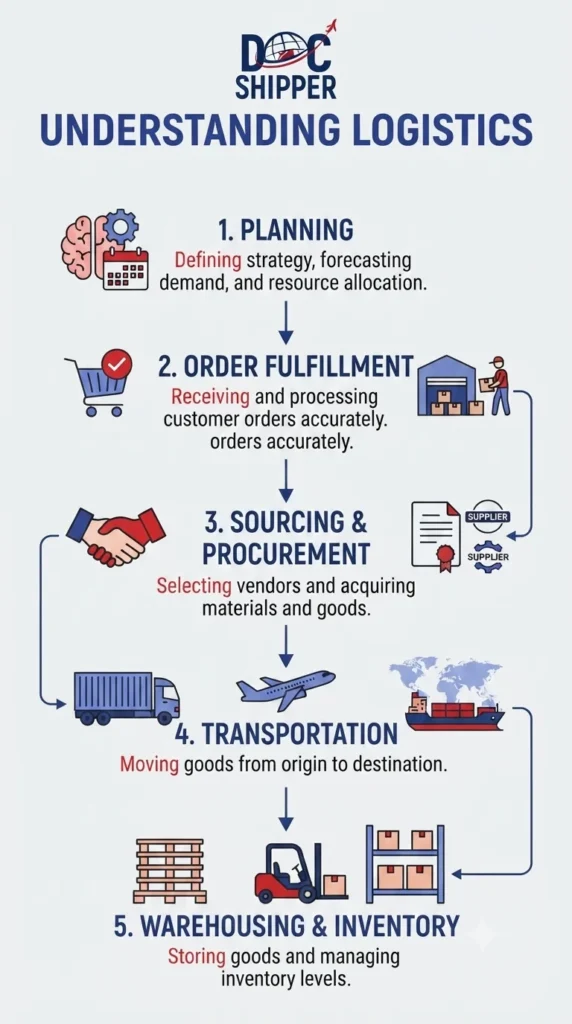
Understanding logistics requires grasping five fundamental elements:
- Transportation management: Selecting optimal carriers and routes across air, sea, rail, and road networks
- Warehouse operations: Strategic storage, handling, and distribution of inventory at multiple locations
- Inventory control: Balancing stock availability against carrying costs and obsolescence risks
- Order fulfillment: Processing customer demands accurately from initial order through final delivery
- Information systems: Tracking shipments, forecasting demand, and coordinating stakeholders in real-time
Fundamentals & Strategic Expertise
Logistics extends far beyond moving boxes from location A to location B. It represents a strategic discipline requiring coordination across procurement, production, distribution, and customer service. Companies treating logistics as mere transportation consistently underperform competitors who integrate it into core business strategy.
The field divides into distinct operational categories. Inbound logistics manages raw material flows from suppliers to production facilities, ensuring manufacturing never stops due to material shortages. Outbound logistics handles finished goods distribution from factories through distribution centers to end customers. Reverse logistics coordinates product returns, repairs, recycling, and disposal—increasingly critical as environmental regulations tighten globally.
International logistics introduces additional complexity layers. Cross-border regulations require navigating customs procedures, import/export documentation, duty calculations, and compliance with destination country standards. According to the World Customs Organization, improper documentation causes 30% of shipment delays worldwide, creating costly disruptions.
Modal selection significantly impacts cost and delivery performance. Air freight delivers quickly but costs 5-10 times more than ocean shipping. Sea freight offers economical rates for large volumes but requires 20-40 days for transoceanic routes. Rail provides middle-ground solutions, particularly across continental distances. Road transport offers flexibility and door-to-door service but faces distance limitations and regulatory variations.
At DocShipper, we implement multi-modal strategies combining transport methods based on urgency, cargo characteristics, and budget constraints. For example, we might ship bulk inventory by sea while expediting critical components by air, optimizing total landed costs while maintaining production schedules. Our customs brokerage services ensure regulatory compliance prevents shipment holds at borders.
Concrete Examples & Operational Data
Understanding logistics theory matters less than seeing how principles translate into measurable business outcomes. Consider three distinct scenarios demonstrating logistics impact on operational efficiency and profitability.
Use Case 1: E-commerce Electronics Distributor
A European electronics retailer sources smartphones from Shenzhen, China, for sale across EU markets. Initial logistics approach used air freight exclusively, costing €8.50 per unit with 5-day delivery. Annual volume reached 50,000 units, creating €425,000 in transportation costs alone.
Logistics optimization divided inventory into two streams. Predictable base demand (70% of volume) shipped via ocean freight at €1.20 per unit with 28-day transit. Variable demand and new product launches (30%) continued via air at premium rates. New blended cost: €176,400 annually—a 59% reduction. Additional warehouse holding costs of €35,000 were offset by transportation savings exceeding €213,600.
Use Case 2: Automotive Parts Manufacturer
A German automotive supplier faced production line shutdowns when Asian component shipments arrived late. Each shutdown cost €45,000 in lost production, occurring 3-4 times yearly. Total annual disruption cost: €157,500.
Implementation of logistics visibility systems provided real-time shipment tracking with predictive delay alerts. When potential delays appeared, expedited shipping activated automatically for critical components. Safety stock algorithms adjusted dynamically based on transit performance data. Result: Zero production shutdowns, 6% inventory carrying cost increase (€28,000), net savings of €129,500 annually.
Comparative Cost Analysis
| Transport Mode | Cost per Ton | Transit Time (China-EU) | Best Use Case |
|---|---|---|---|
| Ocean Freight (FCL) | €800-1,200 | 28-35 days | High-volume, non-urgent cargo |
| Air Freight | €4,500-6,500 | 3-5 days | Time-sensitive, high-value goods |
| Rail Freight | €2,000-2,800 | 18-22 days | Balanced cost-speed requirements |
| Express Courier | €8,000-12,000 | 1-2 days | Emergency shipments, samples |
These examples demonstrate that logistics optimization requires analyzing total cost of ownership, not just transportation rates. Inventory carrying costs, stockout penalties, customer satisfaction impacts, and operational disruptions all factor into optimal logistics design. Companies achieving supply chain excellence typically invest in professional logistics management rather than attempting ad-hoc solutions internally.
Conclusion
Logistics represents the competitive differentiator between thriving international businesses and struggling operations drowning in inefficiency. Mastering transportation modes, warehouse strategies, customs compliance, and information visibility transforms logistics from cost center into strategic advantage generating measurable ROI.
Need expert guidance optimizing your international logistics operations? Contact DocShipper for comprehensive supply chain solutions tailored to your specific business requirements.
📚 Quiz
Test Your Knowledge: Logistics
What is the primary scope of logistics as a business function?
According to the article, what percentage of product value can inefficient logistics consume?
A company ships 50,000 smartphone units annually from China to Europe. Currently using air freight exclusively at €8.50/unit, they're considering a mixed strategy: 70% ocean freight (€1.20/unit, 28 days) and 30% air freight. What would be the correct interpretation of this logistics optimization?
🎯 Your Result
📞 Free Quote in 24hFAQ | Logistics: Definition, Key Components & Concrete Examples
Logistics focuses specifically on the transportation, warehousing, and distribution of goods. Supply chain management encompasses broader activities including supplier relationships, procurement, production planning, demand forecasting, and customer service. Logistics operates as a critical component within the larger supply chain framework. Think of supply chain management as strategic planning while logistics handles tactical execution of moving products efficiently.
Total logistics costs include transportation fees, warehousing expenses, inventory carrying costs (typically 20-25% of inventory value annually), packaging materials, insurance, customs duties, documentation fees, and technology systems. Many businesses mistakenly track only freight charges while ignoring inventory costs, handling fees, and stockout penalties. Comprehensive cost analysis reveals that transportation typically represents only 40-50% of total logistics expenditure.
A 3PL is an external company managing logistics operations on behalf of other businesses. Services range from basic transportation and warehousing to comprehensive supply chain solutions including customs clearance, packaging, quality inspection, and inventory management. Companies engage 3PLs to access logistics expertise, reduce capital investment in warehouses and vehicles, gain operational flexibility, and focus internal resources on core business activities rather than logistics complexity.
Transit times vary dramatically by transport mode and route. Ocean freight from Asia to Europe requires 28-35 days, Asia to North America 18-25 days. Air freight delivers in 3-5 days globally. Rail freight between China and Europe takes 18-22 days. These are port-to-port times; add 5-10 days for customs clearance, inland transportation, and warehouse processing. Express courier services offer 1-3 day delivery at premium cost.
Essential documentation includes commercial invoices, packing lists, bills of lading (ocean) or air waybills (air freight), certificates of origin, and import/export licenses. Specific products require additional certificates: health certificates for food, phytosanitary certificates for plants, dangerous goods declarations for hazardous materials. Incomplete or inaccurate documentation causes 70% of customs delays, emphasizing why professional logistics providers verify all paperwork before shipment.
FCL (Full Container Load) means you rent an entire container exclusively, typically 20-foot or 40-foot sizes. LCL (Less than Container Load) consolidates multiple shippers' cargo into shared containers. FCL costs less per unit for large volumes, offers faster transit with no consolidation delays, and reduces damage risk. LCL suits smaller shipments, requires minimum 2-3 cubic meters to be cost-effective, and adds 3-7 days for consolidation/deconsolidation processes.
Cost reduction strategies include consolidating shipments to achieve volume discounts, optimizing packaging to reduce dimensional weight charges, negotiating long-term carrier contracts, implementing warehouse management systems to minimize handling errors, using multi-modal transportation combinations, forecasting demand accurately to prevent expedited shipping, and partnering with experienced logistics providers who leverage industry relationships and economies of scale.
Logistics visibility means real-time tracking of shipment location, status, and estimated delivery throughout the supply chain. Modern systems use GPS, RFID, IoT sensors, and API integrations providing minute-by-minute updates. Visibility enables proactive exception management, accurate customer delivery predictions, inventory optimization, and rapid problem resolution. Companies with advanced visibility systems report 25-40% fewer customer service inquiries and 50% faster issue resolution compared to those relying on manual tracking.
Incoterms (International Commercial Terms) are standardized trade terms defining responsibilities for shipping costs, insurance, customs clearance, and risk transfer between buyers and sellers. Common terms include FOB (Free on Board), CIF (Cost Insurance Freight), and DDP (Delivered Duty Paid). Selecting appropriate Incoterms determines who arranges transportation, who pays freight charges, and where liability transfers. Misunderstanding these terms creates disputes and unexpected costs.
Customs clearance involves submitting required documentation to government authorities, declaring cargo value and contents, paying applicable duties and taxes, and receiving authorization for goods to enter or exit a country. Licensed customs brokers navigate complex regulations, tariff classifications (HS codes), valuation rules, and compliance requirements. Clearance times range from 1-2 days for routine shipments to weeks for inspections or documentation issues. Professional brokers reduce clearance times by 60% compared to self-filing.
Technology enables warehouse management systems (WMS) optimizing storage and picking, transportation management systems (TMS) routing shipments efficiently, real-time GPS tracking providing visibility, automated customs documentation reducing errors, predictive analytics forecasting demand patterns, and blockchain securing supply chain transparency. Artificial intelligence optimizes routing, predicts delays, and automates routine decisions. Companies investing in logistics technology report 15-30% operational cost reductions and 40-60% improvement in delivery accuracy.
Reverse logistics manages product returns, repairs, refurbishment, recycling, and disposal. E-commerce growth increased return rates to 20-30% for online purchases versus 8-10% for traditional retail. Efficient reverse logistics recovers value from returned goods, maintains customer satisfaction through easy return processes, ensures environmental compliance with disposal regulations, and reduces waste. Companies with optimized reverse logistics recover 60-70% of returned product value compared to 30-40% for those treating returns as afterthoughts.
Need Help with
Logistics or Sourcing ?
First, we secure the right products from the right suppliers at the right price by managing the sourcing process from start to finish. Then, we simplify your shipping experience - from pickup to final delivery - ensuring any product, anywhere, is delivered at highly competitive prices.


Fill the Form
Prefer email? Send us your inquiry, and we’ll get back to you as soon as possible.
Contact us




