


In short ⚡
A logbook is a chronological record documenting all operational activities, inspections, and incidents related to a vehicle, vessel, aircraft, or equipment. In international logistics, it serves as legal proof of compliance, maintenance history, and operational integrity throughout the supply chain.
Introduction
Many logistics operators underestimate the critical role of proper logbook documentation until faced with customs delays, insurance claims, or regulatory audits. A missing or incomplete logbook can halt shipments, invalidate insurance coverage, or result in heavy fines.
In international trade, the logbook functions as the “black box” of logistics operations. It provides verifiable evidence of when, where, and how cargo was handled, transported, or stored.
Key characteristics of an effective logbook include:
- Chronological accuracy: Time-stamped entries without retroactive modifications
- Regulatory compliance: Adherence to IMO, ICAO, or national transport authority standards
- Maintenance tracking: Complete history of inspections, repairs, and certifications
- Incident documentation: Detailed records of damages, delays, or safety events
- Chain of custody proof: Evidence of cargo handling and transfer points
Regulatory Framework & Technical Requirements
Logbook requirements vary significantly across transportation modes and jurisdictions. For maritime shipping, the International Maritime Organization (IMO) mandates specific logbooks under SOLAS conventions.
The Official Logbook for vessels records all events affecting safety, crew changes, and cargo operations. Ship masters must maintain entries in indelible ink, with corrections countersigned. The IMO guidelines specify retention periods of three years after the last entry.
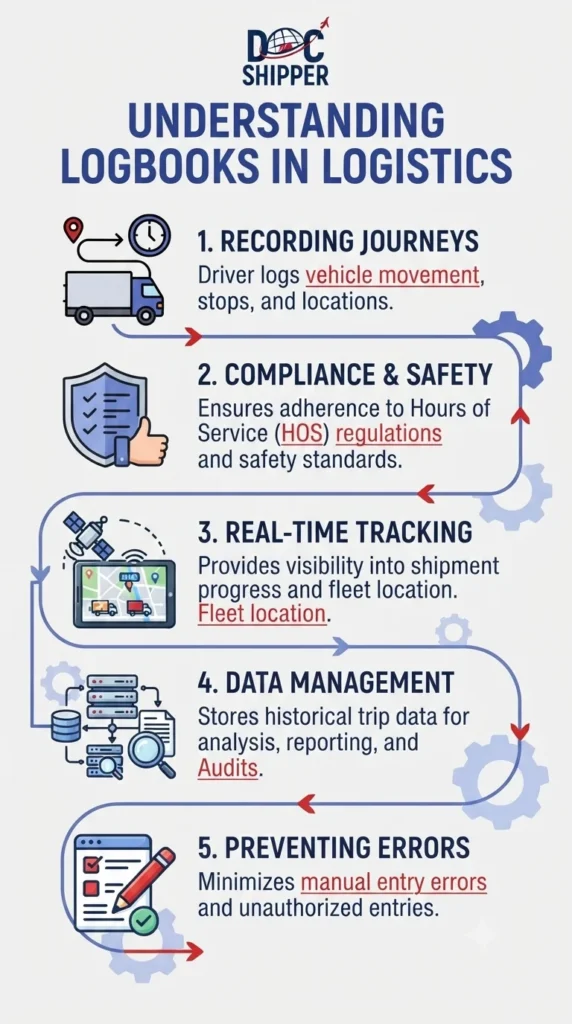
For road freight, the European Union enforces digital tachograph regulations as electronic logbooks. These devices automatically record driving hours, rest periods, and vehicle speed. Compliance prevents driver fatigue violations and ensures adherence to Regulation (EC) No 561/2006.
Aviation logbooks follow ICAO Annex 6 standards, requiring aircraft maintenance logs, flight records, and technical logbooks. Each entry must include aircraft identification, flight duration, and any defects discovered during operations.
In customs clearance, the cargo logbook documents container movements through free zones, warehouses, and inspection facilities. This chronological record proves compliance with bonded storage regulations and prevents accusations of smuggling or unauthorized cargo access.
At DocShipper, we systematically audit logbook completeness before shipment departure to prevent documentation-related delays at destination ports and ensure full regulatory compliance across all transport modes.
Practical Applications & Concrete Examples
Real-world implementation of logbook systems demonstrates their critical value in protecting logistics operators and cargo owners.
Use Case: Temperature-Controlled Pharmaceutical Shipment
A pharmaceutical company ships €2.5 million worth of vaccines from France to Nigeria via refrigerated container. The reefer logbook records:
- Temperature readings every 4 hours (required range: +2°C to +8°C)
- Compressor start/stop cycles and any alarm events
- Pre-trip inspection results and calibration certificates
- Port-to-port transfer timestamps with responsible parties
- Customs inspection access times and seal verifications
Upon arrival, customs authorities detected a 6-hour temperature excursion to +12°C. The logbook proved the deviation occurred during port handling, not during ocean transit. This documentation shifted liability to the terminal operator, protecting the carrier from a potential €2.5M claim.
Comparative Analysis: Manual vs. Digital Logbooks
| Criteria | Manual Logbook | Digital Logbook |
|---|---|---|
| Data Integrity | Vulnerable to alteration or loss | Blockchain-secured, tamper-proof |
| Real-Time Access | Physical retrieval required | Instant cloud-based access |
| Audit Efficiency | Manual review, time-consuming | Automated compliance checks |
| Integration | Standalone document | Linked to TMS/WMS/ERP systems |
| Cost (5 years) | €800-1,200 | €3,500-5,000 |
Industry data shows digital logbooks reduce compliance violations by 67% and cut insurance claim processing time from 45 days to 8 days on average. Major ocean carriers like Maersk and MSC now mandate electronic logbooks for all reefer equipment.
Key Logbook Best Practices
- Immediate entry recording: Document events within 30 minutes of occurrence
- Signature accountability: Every entry requires responsible party identification Backup protocols: Maintain duplicate copies in separate physical locations
- Translation preparedness: Have certified translations ready for international inspections
- Retention compliance: Store logbooks for minimum regulatory periods (typically 3-7 years)
Conclusion
The logbook remains the foundational document proving operational integrity and regulatory compliance across international logistics. Whether manual or digital, proper maintenance protects against liability, accelerates claims resolution, and ensures seamless customs clearance.
Need assistance implementing compliant logbook systems for your supply chain? Contact DocShipper for expert guidance on documentation standards across all transport modes.
📚 Quiz
Test Your Knowledge: Logbook
What is the primary function of a logbook in international logistics?
Which statement correctly describes logbook retention requirements?
A pharmaceutical shipment arrives with a 6-hour temperature excursion recorded in the reefer logbook. How does this documentation protect the carrier?
🎯 Your Result
📞 Free Quote in 24hFAQ | Logbook: Definition, Uses & Practical Examples in Logistics
Retention periods vary by jurisdiction and transport mode. Maritime logbooks typically require 3-5 years retention under IMO regulations. The EU mandates 1 year for road transport digital tachograph data. Aviation maintenance logbooks must be kept for the aircraft's operational lifetime plus 2 years. Always verify specific requirements with your flag state or national transport authority.
Yes, in most jurisdictions, provided the digital system meets specific criteria. The electronic logbook must include audit trails, tamper-proof timestamps, and secure authentication. IMO accepts electronic record books under MARPOL Annex VI when approved by flag administrations. EU road transport fully transitioned to mandatory digital tachographs in 2006. Always confirm acceptance with relevant authorities before implementation.
The ship's master holds primary responsibility for official logbook accuracy and completeness under SOLAS regulations. For specialized logs (engine room, oil record book), the chief engineer assumes responsibility. The shipowner remains ultimately liable for ensuring proper logbook systems exist and are maintained according to international conventions and flag state requirements.
Immediate notification to relevant authorities is mandatory. For vessels, report to the flag state administration and port authority. Recreate entries from memory and supporting documents (crew statements, automatic systems data). Mark reconstructed sections clearly as "Reconstituted." Insurance claims may require sworn declarations. Digital backup systems prevent this scenario by maintaining cloud-stored duplicates with automatic synchronization.
Logbooks provide critical evidence determining liability and claim validity. Insurers review temperature logs, handling records, and incident reports to assess whether damage resulted from insured perils. Incomplete or suspicious logbook entries can void coverage. Marine cargo policies often require "seaworthy vessel" proof, which logbooks demonstrate through maintenance records and safety compliance documentation.
Yes, IMDG Code requires detailed dangerous goods manifests and container packing certificates as logbook supplements. Air transport under ICAO Technical Instructions mandates Shipper's Declarations and Notoc (Notification to Captain) records. Road ADR regulations require transport documents with emergency response information. All entries must include UN numbers, proper shipping names, and emergency contact details for each hazardous material.
Absolutely. Customs officials have authority to inspect logbooks during cargo examinations, audits, or investigations. SOLAS regulation XI-2 allows port state control to review ship security logs. Refusal to present logbooks can result in detention, fines, or criminal charges. Maintain logbooks in accessible locations and ensure they're updated before entering ports or border crossings.
Mandatory entries include: pre-trip inspection results, continuous temperature readings (typically every 4 hours), alarm events with timestamps, compressor operating hours, defrost cycles, humidity levels if monitored, air exchange settings, power connection/disconnection times, and responsible party signatures at each transfer point. GPS coordinates may be required for high-value pharmaceutical shipments.
Blockchain logbooks create immutable, time-stamped records shared across all supply chain participants. Each entry becomes a cryptographically secured block, preventing retroactive alterations. Smart contracts automatically trigger alerts for out-of-specification conditions. TradeLens and IBM Food Trust platforms demonstrate how distributed ledger technology eliminates documentation disputes and accelerates customs clearance through verified, real-time data sharing.
Penalties range from administrative fines to criminal prosecution. Maritime logbook falsification can result in master's license suspension, company ISM Code violations, and vessel detention. The US Coast Guard imposes civil penalties up to $10,000 per violation. EU road transport tachograph manipulation carries fines up to €5,000 and potential imprisonment. Insurance fraud charges apply when falsified records support fraudulent claims.
Yes, each carrier maintains their own logbook per regulatory requirements. Ocean carriers keep vessel logs, trucking companies maintain driver logs or tachograph records, and warehouses document storage conditions. The freight forwarder should maintain a master shipment file compiling all segment logbooks. This comprehensive documentation proves continuous chain of custody and facilitates liability determination if damage occurs during intermodal transfers.
Implementation timelines vary based on fleet size and complexity. Small fleets (10-20 vehicles) typically require 3-6 months including hardware installation, software integration, and staff training. Large operations (200+ units) need 12-18 months for phased rollout. Critical factors include ERP system integration, regulatory approval processes, and driver acceptance. Budget approximately €500-800 per vehicle for equipment plus €50-100 monthly per unit for cloud services and support.
Need Help with
Logistics or Sourcing ?
First, we secure the right products from the right suppliers at the right price by managing the sourcing process from start to finish. Then, we simplify your shipping experience - from pickup to final delivery - ensuring any product, anywhere, is delivered at highly competitive prices.


Fill the Form
Prefer email? Send us your inquiry, and we’ll get back to you as soon as possible.
Contact us




