


In short ⚡
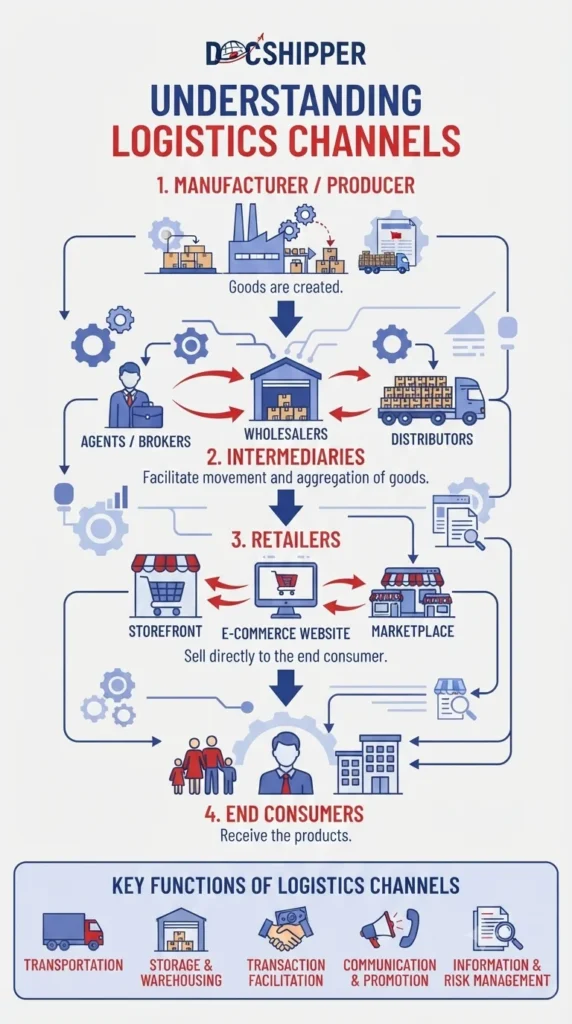
A logistics channel is the structured network of intermediaries, processes, and infrastructure through which goods move from origin to end-user. It encompasses transportation modes, warehousing facilities, distribution centers, and coordination mechanisms that optimize cost, speed, and service quality in supply chain operations.
Introduction
In international trade, confusion between “distribution channel” and “logistics channel” causes strategic misalignments. While distribution focuses on market reach, logistics channels determine operational efficiency and cost structures.
Companies shipping from Asia to Europe face critical decisions: direct shipment, cross-docking hubs, or multi-tier distribution? The wrong logistics channel inflates costs by 15-30% according to World Bank Logistics Performance Index studies.
Key characteristics of effective logistics channels:
- Modal integration: Seamless transitions between sea, air, rail, and road transport
- Node optimization: Strategic placement of warehouses and consolidation points
- Information flow: Real-time visibility across all channel partners
- Flexibility: Adaptability to demand fluctuations and disruptions
- Cost transparency: Clear attribution of expenses at each channel stage
Strategic Components & Architecture
Understanding logistics channel architecture requires analyzing three interdependent layers that determine performance outcomes.
The physical layer comprises tangible assets. Container terminals in Rotterdam handle 15 million TEUs annually, serving as pivotal nodes in European logistics channels. Warehouses function as buffers – regional distribution centers (RDCs) near major ports versus forward distribution centers (FDCs) closer to consumption markets. At DocShipper, we evaluate physical infrastructure capacity before designing channel strategies to avoid bottlenecks during peak seasons.
The informational layer orchestrates coordination. EDI systems, TMS platforms, and IoT sensors enable predictive routing. Maersk’s Remote Container Management transmits real-time temperature data for pharmaceutical shipments, exemplifying how information flow transforms channel reliability. Without digital integration, multi-party channels experience 40% higher delay incidents.
The relational layer governs partnerships. Third-party logistics providers (3PLs) versus fourth-party logistics (4PLs) present distinct governance models. 3PLs execute operations, while 4PLs design and orchestrate entire channels. Contractual frameworks like Incoterms define responsibility transitions at each node – critical when goods cross multiple jurisdictions.
Channel configuration patterns vary by product characteristics. High-value electronics favor air freight channels with minimal nodes (origin airport → destination airport → direct delivery). Bulk commodities utilize complex channels: factory → rail terminal → port → ocean freight → destination port → regional warehouse → last-mile delivery. Each additional node adds 2-5 days transit time but reduces per-unit transportation costs.
Regulatory compliance shapes channel design fundamentally. AEO (Authorized Economic Operator) certification in the EU grants expedited customs clearance, effectively shortening channel duration by 3-7 days. Non-compliant channels face random inspections that disrupt flow predictability. DocShipper systematically integrates compliance checkpoints into channel mapping to prevent costly delays at customs nodes.
Implementation Models & Performance Data
Translating logistics channel theory into operational reality requires evidence-based configuration decisions. Performance metrics vary dramatically across channel models.
| Channel Model | Transit Time | Cost Per Unit | Optimal Use Case |
|---|---|---|---|
| Direct Shipment | 12-18 days | $4.20/kg | High-value, time-sensitive goods |
| Hub-and-Spoke | 20-25 days | $2.80/kg | Medium-volume, multiple destinations |
| Cross-Docking | 15-20 days | $3.10/kg | Pre-sorted goods, high turnover |
| Multi-Tier Distribution | 28-35 days | $1.95/kg | Bulk commodities, cost-priority |
Case Study: Electronics Manufacturer (China to Germany)
A client imported 450 pallets of consumer electronics quarterly. Initial configuration used direct ocean freight to Hamburg with immediate trucking distribution – total channel cost €187,000. After analysis, DocShipper redesigned the channel: ocean freight to Rotterdam, consolidation at regional hub, synchronized truck deliveries matching retail restocking cycles. New configuration reduced costs to €159,000 (15% savings) while improving on-shelf availability by 22%.
Performance optimization factors:
- Load consolidation: Combining shipments increases container utilization from 68% to 94%, reducing per-unit costs proportionally
- Modal selection: Rail freight from China to Europe costs 50% less than air but takes 18 days versus 5 – channel design balances these trade-offs
- Inventory positioning: Holding 30 days stock at destination warehouses versus 60 days at origin reduces total logistics costs by 12-18%
- Technology integration: Automated routing systems decrease empty mile percentages from 28% to 11% in mature channels
- Partner reliability: Channels using ISO 28000-certified partners experience 67% fewer disruption incidents
The bullwhip effect amplifies demand variability through poorly coordinated channels. A 10% retail demand fluctuation becomes a 40% manufacturing variance without integrated channel planning. Collaborative forecasting between channel partners, facilitated by shared VMI (Vendor Managed Inventory) systems, dampens this amplification to 15-20%.
Conclusion
Logistics channel architecture directly determines supply chain competitiveness. Strategic configuration balances transit speed, cost efficiency, and service reliability through informed infrastructure and partnership decisions.
Need expert guidance on optimizing your logistics channel? Contact DocShipper for tailored supply chain solutions.
📚 Quiz
Test Your Knowledge: Logistics Channel
What is the primary focus of a logistics channel compared to a distribution channel?
A common misconception is that adding nodes to a logistics channel always increases costs. What is the correct understanding?
A manufacturer shipping electronics from China to Germany needs to optimize their logistics channel. Which configuration would be most appropriate for balancing cost and efficiency?
🎯 Your Result
📞 Free Quote in 24hFAQ | Logistics Channel: Definition, Types & Strategic Examples
A logistics channel is the operational pathway for physical goods movement, focusing on transportation and storage nodes. The supply chain encompasses broader activities including procurement, production, and demand planning. The logistics channel executes the distribution portion of supply chain strategy, typically representing 40-60% of total supply chain costs in international trade.
Digital logistics channels integrate IoT sensors, blockchain verification, and AI-powered routing algorithms. These technologies provide real-time visibility, automated exception management, and predictive optimization. Traditional channels rely on manual coordination and periodic updates. Digital transformation reduces administrative overhead by 30-45% and improves delivery precision by 25-35% according to industry benchmarks.
Channel length optimization depends on product value density, demand predictability, and service requirements. High-value pharmaceuticals justify short channels despite higher per-unit costs. Bulk textiles tolerate longer channels prioritizing cost minimization. Rule of thumb: each additional node adds 10-15% handling costs but reduces transportation expenses by 5-8% through consolidation economies. Mathematical modeling balances these opposing forces.
Customs procedures create mandatory channel nodes that significantly affect transit time. Pre-clearance programs like C-TPAT (USA) or AEO (EU) enable channel configurations bypassing intensive inspections. Without certification, 15-25% of shipments face detailed examination, adding 3-7 days. Strategic channel design positions customs clearance at nodes with fastest processing – major ports versus smaller border crossings.
Freight forwarders orchestrate multi-modal channel execution without owning transportation assets. They consolidate shipments, negotiate carrier contracts, manage documentation, and coordinate handoffs between channel nodes. For SMEs lacking logistics infrastructure, forwarders effectively become the channel architect and operator. They typically add 8-12% markup but provide access to bulk shipping rates reducing overall costs by 15-25%.
Reverse logistics channels manage returns, repairs, and recycling flows – moving goods from end-users back through the supply chain. They handle unpredictable volumes, mixed product conditions, and quality inspection requirements absent in forward channels. Costs typically run 20-35% higher per unit due to inefficient consolidation and specialized handling. Effective reverse channel design integrates collection points and refurbishment centers strategically.
Five key metrics dominate channel evaluation: (1) Total landed cost per unit, (2) Order cycle time from origin to delivery, (3) On-time delivery percentage, (4) Inventory turnover rate, and (5) Perfect order rate (complete, accurate, damage-free, on-time). Leading companies track these metrics at each channel node, identifying bottlenecks and improvement opportunities. Composite scores enable objective channel comparison.
Longer logistics channels with multiple inventory nodes tie up working capital. A 30-day channel with inventory stocked at origin, transit, and destination requires 90 days cash conversion cycle. Shortening to 18 days direct shipment reduces working capital needs by 40%. However, longer channels often enable bulk purchasing discounts offsetting carrying costs. Financial modeling must balance procurement savings against capital efficiency.
Carbon footprint varies dramatically by channel configuration. Ocean freight emits 10-40g CO2/ton-km versus 500-1500g for air freight. Channels optimizing container utilization and minimizing empty backhauls reduce emissions by 30-50%. EU regulations increasingly mandate Scope 3 emissions reporting covering entire logistics channels. Companies like DocShipper integrate carbon calculators into channel planning, helping clients balance environmental and cost objectives.
Trade tensions, tariffs, and regulatory changes force channel reconfiguration. US-China tariffs prompted many importers to establish alternative channels through Vietnam, Mexico, or Malaysia. Brexit created new customs nodes requiring channel redesign for UK-EU trade. Resilient channel strategies build optionality – maintaining qualified alternative routes and partners. This redundancy costs 5-10% more but prevents catastrophic disruptions during geopolitical shifts.
Autonomous vehicles, drone delivery, and hyperloop systems will radically alter channel economics within 10-15 years. Blockchain-enabled smart contracts automate handoffs and payments between channel partners. Digital twins simulate channel performance under various scenarios before physical implementation. Quantum computing will optimize multi-variable channel routing instantaneously. Early adopters gain 3-5 year competitive advantages by testing these technologies in controlled channel segments.
Omnichannel strategies merge B2C and B2B logistics channels, requiring unified inventory visibility and flexible fulfillment options. Ship-from-store, buy-online-pickup-in-store, and marketplace fulfillment create complex channel interdependencies. Successful integration deploys distributed order management systems allocating inventory across channels dynamically. Companies transitioning to omnichannel typically experience 18-month implementation periods and 20-30% initial cost increases before achieving efficiency gains.
Need Help with
Logistics or Sourcing ?
First, we secure the right products from the right suppliers at the right price by managing the sourcing process from start to finish. Then, we simplify your shipping experience - from pickup to final delivery - ensuring any product, anywhere, is delivered at highly competitive prices.


Fill the Form
Prefer email? Send us your inquiry, and we’ll get back to you as soon as possible.
Contact us




