


In short ⚡
Logistics costs represent all expenses incurred during the movement, storage, and management of goods throughout the supply chain. They typically account for 8-15% of a product's final price and include transportation, warehousing, inventory management, packaging, and customs clearance fees.
Introduction
Many businesses struggle to pinpoint exactly where their money goes in international shipping. Hidden fees, miscalculated volumes, and unexpected duties can transform a profitable shipment into a financial burden. Understanding logistics costs is not optional—it’s the foundation of competitive pricing in global trade.
In import-export operations, logistics costs determine whether your business remains viable. A single percentage point improvement in cost efficiency can translate into thousands of dollars saved annually. These expenses span the entire journey from factory gate to customer doorstep.
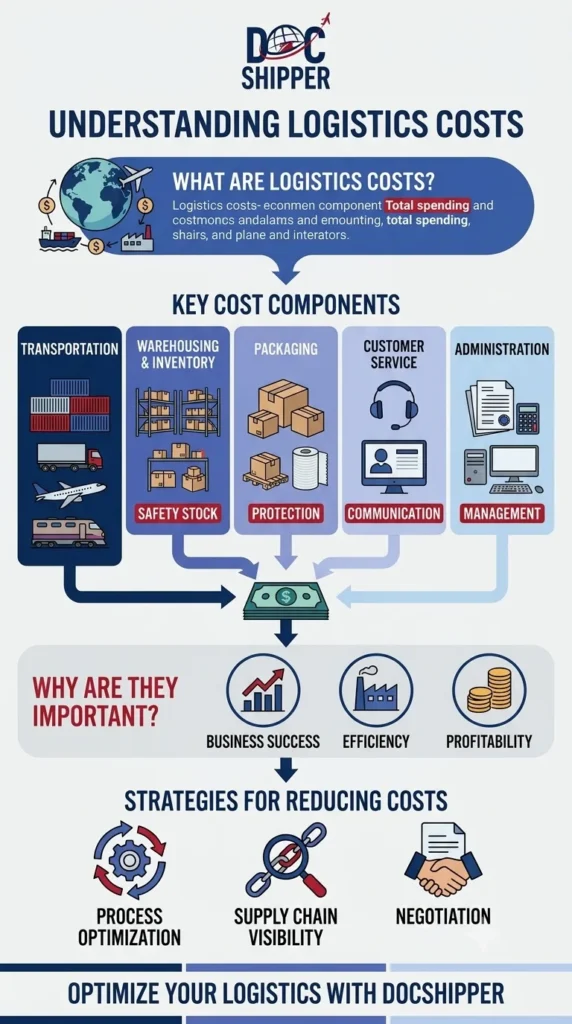
Key components of logistics costs include:
- Transportation costs: Freight charges for air, sea, road, or rail shipment
- Warehousing expenses: Storage fees, handling charges, and inventory holding costs
- Customs and duties: Tariffs, import taxes, and clearance processing fees
- Packaging and documentation: Materials, labels, certificates, and compliance paperwork
- Insurance and risk management: Coverage against damage, theft, or loss during transit
Understanding Logistics Costs Structure
Logistics costs divide into direct and indirect categories. Direct costs are immediately visible—freight invoices, warehouse receipts, customs declarations. Indirect costs hide in operational inefficiencies, inventory obsolescence, and opportunity costs from delayed shipments.
Transportation typically consumes the largest budget share. Ocean freight offers the lowest per-unit cost but demands longer lead times. Air freight provides speed at premium rates. Choosing the wrong mode can inflate costs by 200-400% without improving customer satisfaction.
Warehousing expenses follow a tiered structure. Storage fees charge per pallet or cubic meter per day. Handling charges apply to inbound receiving, inventory movement, and outbound preparation. Peak season surcharges can double standard rates during high-demand periods.
Customs duties and taxes vary dramatically by product classification. The Harmonized System (HS) code determines tariff rates, which range from 0% to 25%+ depending on origin and destination. Misclassification triggers penalties and shipment delays. According to World Customs Organization data, incorrect HS codes account for 30% of import-export disputes.
Inventory carrying costs represent another hidden expense. Holding products in storage incurs capital costs (money tied up in stock), depreciation, insurance, and obsolescence risk. Industry benchmarks suggest these costs average 20-30% of inventory value annually.
At DocShipper, we conduct comprehensive cost audits to identify optimization opportunities across all these categories, ensuring clients pay only for value-adding services.
Concrete Examples & Cost Breakdown
Consider a real-world scenario: importing 1,000 units of consumer electronics from Shenzhen to Hamburg. The logistics cost structure reveals where money flows and optimization opportunities exist.
| Cost Category | Ocean Freight | Air Freight |
|---|---|---|
| Transportation (per shipment) | $2,400 | $8,500 |
| Customs clearance | $350 | $350 |
| Import duties (8% tariff) | $1,600 | $1,600 |
| Insurance (0.5% of value) | $100 | $100 |
| Warehousing (2 weeks) | $280 | $140 |
| Documentation & compliance | $150 | $150 |
| Total Logistics Cost | $4,880 | $10,840 |
| Cost per Unit | $4.88 | $10.84 |
This comparison demonstrates why mode selection critically impacts profitability. Air freight costs 122% more in this scenario. However, ocean freight adds 25-30 days transit time, increasing inventory carrying costs and delaying revenue realization.
The break-even analysis depends on product margin. For a $50 retail item with 40% margin, the extra $5.96 air freight cost reduces profit from $20 to $14.04 per unit—a 30% margin erosion. But if faster delivery captures time-sensitive demand or avoids stockouts, air freight becomes economically justified.
Volume optimization offers another cost-reduction lever. Consolidating shipments to fill entire containers (FCL instead of LCL) can reduce per-unit costs by 35-50%. A 20-foot container accommodating 2,500 units drops ocean freight costs from $4.88 to approximately $2.80 per unit.
Route selection matters significantly. Direct routes cost more but reduce handling and transit damage risk. Multi-leg journeys with transshipments cut freight rates by 15-20% but add 7-10 days and increase loss probability.
DocShipper’s network allows us to compare multiple routing options and carrier rates simultaneously, ensuring clients always access the most cost-effective solution without compromising service quality.
Conclusion
Mastering logistics costs transforms them from an uncontrollable expense into a competitive advantage. Strategic planning, accurate forecasting, and continuous optimization separate profitable operations from struggling ones.
Need expert guidance on reducing your logistics expenses? Contact DocShipper for a comprehensive cost analysis and customized optimization strategy.
📚 Quiz
Test Your Knowledge: Logistics Costs
What do logistics costs primarily represent in international trade?
Which statement accurately describes inventory carrying costs?
A company imports 1,000 electronics units via ocean freight at $4.88 per unit total logistics cost versus $10.84 via air freight. When should they choose air freight despite the 122% cost increase?
🎯 Your Result
📞 Free Quote in 24hFAQ | Logistics Costs: Definition, Calculation & Real-World Examples
Industry benchmarks suggest logistics costs should comprise 8-15% of final product price for most manufactured goods. High-value, low-weight items (electronics, pharmaceuticals) typically fall toward the lower end. Bulky, low-value products (furniture, construction materials) often exceed 15%. Companies achieving below 8% usually benefit from economies of scale, strategic facility locations, or highly optimized supply chains.
Total landed cost includes product price plus all logistics expenses: international freight, customs duties, taxes, insurance, port fees, inland transportation, warehousing, and compliance costs. Add these components to your purchase price, then divide by unit quantity. Many businesses underestimate by 20-30% by overlooking indirect costs like inventory carrying charges or documentation fees. Comprehensive tracking systems are essential for accuracy.
Yes, through strategic approaches: consolidate shipments to maximize container utilization, negotiate volume contracts with carriers, optimize packaging to reduce dimensional weight, implement cross-docking to eliminate storage time, and use predictive analytics to avoid rush shipments. Some companies reduce costs 15-25% while maintaining service levels by combining these techniques. Technology investments in warehouse automation and route optimization also deliver long-term savings.
Common hidden costs include demurrage and detention fees for late container returns (averaging $75-150 per day), customs exam fees when authorities inspect shipments, address correction charges, residential delivery surcharges, fuel surcharges that fluctuate weekly, peak season premiums, and re-delivery fees for failed delivery attempts. These can add 10-20% to quoted rates. Always request all-inclusive pricing and review invoices carefully.
Warehouse positioning impacts both inbound and outbound expenses. Facilities near ports reduce drayage costs but increase last-mile delivery expenses to inland customers. Central locations balance these factors. Labor costs vary dramatically by region—coastal warehouses often cost 30-40% more than inland alternatives. Proximity to customers reduces transportation costs and improves delivery speed, potentially increasing sales while lowering freight expenses.
The decision depends on volume, complexity, and core competencies. Third-party logistics providers offer established networks, negotiated rates, and operational expertise. They typically become cost-effective above $500,000 annual logistics spend. Internal management provides control and direct customer relationships but requires infrastructure investment. Hybrid approaches—outsourcing international freight while managing domestic distribution—work well for mid-sized companies. Analyze total cost of ownership including capital requirements and opportunity costs.
Fuel surcharges (FSC) adjust weekly or monthly based on diesel or jet fuel prices. They typically add 15-30% to base freight rates. Carriers calculate FSC using formulas tied to government fuel price indexes. During price spikes, surcharges can exceed base rates. Some contracts include FSC caps to limit volatility. When budgeting, assume mid-range surcharges rather than historical lows. Hedging strategies exist for high-volume shippers to stabilize costs.
Incorrect commercial invoices, inaccurate HS codes, missing certificates of origin, and incomplete shipper/consignee details cause the majority of costly delays. Customs authorities may impose fines, require bond payments, or mandate physical inspections—each adding days and hundreds to thousands in fees. Inconsistencies between documents trigger red flags. Investing in compliance software and training reduces error rates by 60-80%, typically paying for itself within months through avoided penalties.
Industry associations publish benchmark studies segmented by sector and company size. Participate in confidential peer surveys to compare key metrics: cost per shipment, cost as percentage of revenue, cost per mile, and warehouse cost per order. Consultant firms offer proprietary benchmarking databases. Track your own metrics quarterly to identify trends. Performance gaps of 15-20% versus industry medians indicate significant optimization opportunities. Technology adoption rates and process automation levels correlate strongly with cost efficiency.
Transportation Management Systems (TMS) deliver 10-20% freight savings through rate shopping and route optimization. Warehouse Management Systems (WMS) improve labor productivity 25-35%. Real-time tracking reduces customer service inquiries and prevents lost shipments. Automated data capture (RFID, barcode scanning) eliminates manual errors costing businesses 1-3% of revenue. Cloud-based platforms require minimal upfront investment. ROI typically materializes within 12-18 months for companies shipping 100+ orders weekly.
Free trade agreements (FTAs) eliminate or reduce tariffs between member countries, potentially saving 5-25% on import duties. However, qualifying requires proper certificates of origin and compliance with rules of origin—specific requirements about where products are manufactured and how much value is added locally. USMCA, EU trade pacts, and RCEP offer significant savings for qualifying goods. Misunderstanding eligibility costs businesses millions in unclaimed duty savings annually. Professional compliance review identifies opportunities.
Essential KPIs include: cost per order, freight cost as percentage of sales, perfect order rate (delivered complete, on-time, damage-free), inventory carrying cost, warehouse cost per unit, transportation cost per mile, and claims ratio. Track these monthly with trend analysis. Segment by product category, customer type, and shipping lane to identify problem areas. Leading companies also measure carbon footprint per shipment as sustainability pressures increase. Dashboard visualization helps management spot issues requiring immediate attention.
Need Help with
Logistics or Sourcing ?
First, we secure the right products from the right suppliers at the right price by managing the sourcing process from start to finish. Then, we simplify your shipping experience - from pickup to final delivery - ensuring any product, anywhere, is delivered at highly competitive prices.


Fill the Form
Prefer email? Send us your inquiry, and we’ll get back to you as soon as possible.
Contact us




