


In short ⚡
Licenses are official authorizations issued by governmental bodies that permit businesses or individuals to engage in specific international trade activities. In logistics, licenses regulate the import/export of controlled goods, ensuring compliance with national security, public health, and regulatory standards across borders.Introduction
Many businesses underestimate the complexity of international trade licenses until their shipment gets detained at customs. A missing or incorrect license can trigger delays, penalties, or even criminal liability. In today’s interconnected supply chains, understanding licensing requirements is not optional—it’s mission-critical.
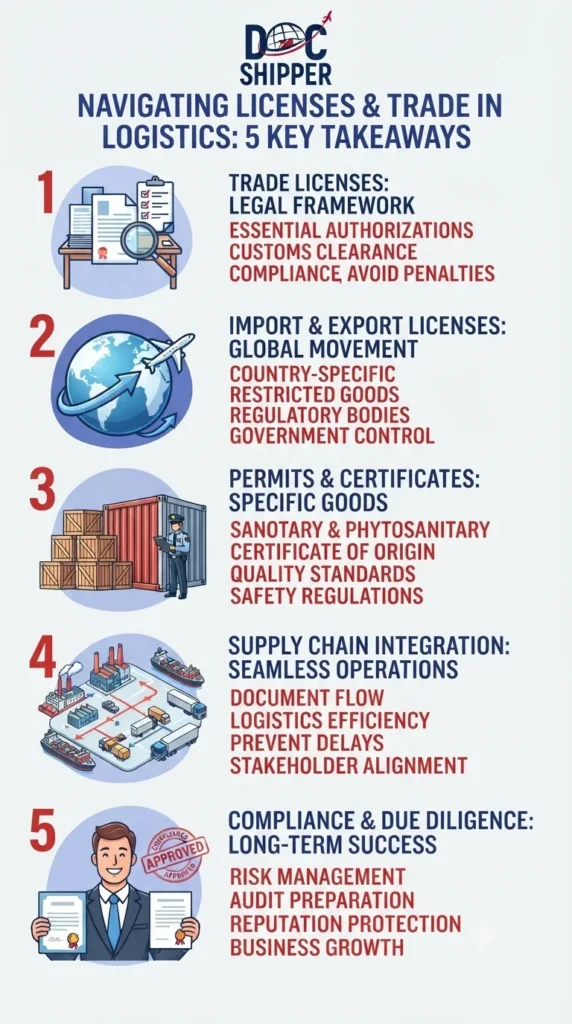
Licenses serve as gatekeepers for cross-border movements of sensitive goods. From pharmaceuticals to defense equipment, governments worldwide impose strict controls to protect national interests, public safety, and environmental standards.
Key characteristics of trade licenses include:
- Product-specific regulation: Controlled goods require dedicated permits (weapons, chemicals, medical devices)
- Destination-based restrictions: Certain countries face embargoes or enhanced scrutiny
- Temporary validity: Most licenses expire and require renewal or single-use application
- Multi-agency coordination: Different ministries oversee different product categories
- Legal accountability: Violators face fines, shipment seizures, or trade bans
Understanding Licensing Frameworks & Compliance
The global licensing landscape operates through three primary regulatory frameworks: export controls, import permits, and dual-use regulations. Each jurisdiction maintains its own classification system, but international harmonization efforts like the Wassenaar Arrangement provide coordination for strategic goods.
Export licenses are mandatory when shipping controlled items from your country of origin. The U.S. Department of Commerce administers the Export Administration Regulations (EAR), while the EU operates under a common framework requiring member states to screen dual-use items. Products receive classification codes (ECCN or similar) determining whether a license is required.
Import licenses work inversely, granting permission to bring regulated goods into a destination country. Agricultural products, pharmaceuticals, and telecommunications equipment commonly require advance authorization. Some nations maintain automatic licensing systems for statistical monitoring, even when no substantive restrictions apply.
Dual-use regulations cover items with both civilian and military applications—encryption software, high-performance computers, certain chemicals. These face enhanced scrutiny because of proliferation risks. The end-user certificate becomes critical here, documenting the final recipient and intended use.
Sanctions and embargoes represent the strictest form of licensing control. Entities on denied party lists (OFAC SDN, EU Consolidated List) cannot receive shipments without exceptional authorization. At DocShipper, we systematically screen all parties against these databases to prevent compliance violations before shipment preparation.
License Types & Real-World Applications
Understanding theoretical requirements means little without practical application. The following examples illustrate how different license types function in actual trade scenarios.
| License Type | Typical Products | Processing Time | Key Authority |
|---|---|---|---|
| Export Control License | Aerospace components, encryption technology, uranium | 30-180 days | Commerce/Defense Ministries |
| Phytosanitary Certificate | Plants, seeds, wooden packaging | 3-10 days | Agricultural Authorities |
| Pharmaceutical Import License | Prescription drugs, controlled substances | 60-120 days | Health/Drug Regulatory Bodies |
| Alcohol/Tobacco Permit | Wine, spirits, cigarettes | 15-45 days | Customs/Excise Departments |
| CITES Permit | Endangered species products (ivory, exotic leather) | 30-90 days | Environmental Agencies |
Case Study: Electronics Manufacturer Exporting to the Middle East
A German company needed to ship 5,000 smartphones containing advanced encryption to Dubai. Despite being commercial devices, the encryption capability triggered EU dual-use regulations. The process required:
- Product classification under EU Dual-Use Regulation 2021/821
- Individual export authorization from German authorities (6-week processing)
- End-user undertaking from the UAE distributor
- Import license from UAE Telecommunications Regulatory Authority
- Compliance statement regarding re-export controls
Total compliance timeline: 8 weeks. Without proper licensing, the shipment would have been blocked, resulting in storage fees and contract penalties.
Key data points for logistics professionals:
- License rejection rates: Average 12-18% for first-time applicants due to incomplete documentation
- Validity periods: Single Transaction License (one shipment) vs. Multi-Use License (2-4 years typically)
- Audit probability: Companies in controlled sectors face audits every 3-5 years
- Penalty structures: Non-compliance fines range from €5,000 to €500,000 depending on violation severity
- Processing acceleration: Pre-approved status (Authorized Economic Operator) can reduce timelines by 40%
Conclusion
Licenses represent the regulatory backbone of international trade, balancing commercial interests with national security and public welfare. Proper license management prevents costly delays and legal exposure. Mastering this domain requires staying current with evolving regulations and maintaining robust compliance systems.
Need expert guidance navigating licensing requirements for your shipments? Contact DocShipper for customized compliance support across all trade corridors.
📚 Quiz
Test Your Knowledge: Trade Licenses in International Logistics
What is the primary purpose of trade licenses in international logistics?
A company ships controlled goods without obtaining the required export license. What is the correct interpretation of this action?
Your client needs to export 3,000 smartphones with encryption technology from France to Saudi Arabia. Which licensing approach applies?
🎯 Your Results
📞 Free Compliance Quote in 24hFAQ | Licenses in Logistics: Definition, Types & Practical Examples
Controlled items include military equipment, dual-use technology (encryption, nuclear materials), certain chemicals, endangered species products, and cultural artifacts. Each country maintains its own control list. The U.S. Commerce Control List and EU Dual-Use Regulation provide comprehensive classification systems. Agricultural products and pharmaceuticals often require additional certifications beyond standard export documentation.
Processing times vary significantly by license type and jurisdiction. Simple agricultural certificates may process within 5-7 business days, while complex defense export licenses can require 120-180 days. Factors affecting timeline include application completeness, security reviews, inter-agency coordination, and destination country risk assessment. Expedited processing exists for established exporters with compliance track records.
Absolutely not. Shipping controlled goods without proper authorization constitutes a serious legal violation. Penalties include shipment seizure, substantial fines, criminal prosecution, and permanent trade bans. Goods must remain in your possession until all required licenses are issued and validated. Even preparing goods for shipment before authorization can trigger regulatory scrutiny in some jurisdictions.
A license grants permission to perform a specific trade activity (export/import of controlled goods). A certificate attests that goods meet certain standards (quality, origin, health). Licenses are regulatory permissions; certificates are documentary proof. Both may be required simultaneously. For example, exporting pharmaceuticals requires an export license (permission) and a Good Manufacturing Practice certificate (quality attestation).
Not for all products. Many countries permit free importation of non-restricted commercial goods with standard customs declaration. However, sensitive categories (pharmaceuticals, food products, electronics, chemicals) commonly require advance authorization. Some nations maintain automatic licensing for statistical purposes without substantive restrictions. Always verify requirements for your specific product and destination through official customs resources.
Denial reasons typically include incomplete documentation, security concerns, end-user risks, or destination embargoes. Most systems allow appeal or reapplication with corrected information. Review the denial explanation carefully, address deficiencies, and consider alternative destinations or product modifications. Persistent denials may indicate fundamental incompatibility with export control objectives. Consulting with trade compliance attorneys can help navigate complex denial situations.
Yes. License exceptions exist for low-risk scenarios: shipments below certain value thresholds, goods to trusted destinations, temporary exports for repair or demonstration, and items under de minimis thresholds. The U.S. system includes over 20 license exceptions (TMP for temporary exports, GOV for government end-users). EU Member States apply intra-community transfer exemptions. However, exceptions carry specific conditions and documentation requirements.
Start with product classification using your country's control list (ECCN in U.S., dual-use codes in EU). Consult the Harmonized System code and check if it appears on controlled lists. Government screening tools exist (SNAP-R in U.S., various EU member portals). When uncertain, request a classification ruling from authorities. Professional customs brokers or compliance consultants can provide definitive guidance for complex products.
Generally no. Licenses are issued to specific entities and cannot be transferred or sold. If business ownership changes through acquisition or merger, new applications are typically required. Some jurisdictions allow license transfer under exceptional circumstances with advance authorization. The license holder remains legally responsible for compliance even if logistics operations are outsourced to freight forwarders or customs brokers.
Licensed shipments require the license itself (original or certified copy), commercial invoice referencing license number, packing list, bill of lading/airway bill, end-user certificate if applicable, and destination-specific import permits. Many countries require electronic pre-departure notification. Maintain copies for your records for minimum 5-7 years as audit trail. DocShipper ensures all documentation is properly compiled and validated before shipment departure.
Authorized Economic Operator (AEO) certification demonstrates established compliance systems but does not eliminate licensing requirements. AEO holders benefit from simplified procedures: priority processing, reduced physical inspections, and in some cases, blanket authorizations replacing individual licenses for routine shipments. The certification reduces administrative burden and accelerates clearance, making it valuable for companies with frequent controlled goods shipments.
Penalties vary by severity and jurisdiction. Administrative violations may result in warnings or modest fines. Serious infractions trigger substantial financial penalties (often proportional to shipment value), license suspension, and denial of export privileges. Criminal prosecution applies to willful violations, especially involving weapons or dual-use technology. Companies may face debarment from government contracts. Compliance failures also damage business reputation and relationships with partners.
Need Help with
Logistics or Sourcing ?
First, we secure the right products from the right suppliers at the right price by managing the sourcing process from start to finish. Then, we simplify your shipping experience - from pickup to final delivery - ensuring any product, anywhere, is delivered at highly competitive prices.


Fill the Form
Prefer email? Send us your inquiry, and we’ll get back to you as soon as possible.
Contact us




