


In short ⚡
A Market-Positioned Warehouse is a strategically located storage facility positioned near key consumer markets or demand centers to minimize delivery times and transportation costs. This logistics approach prioritizes proximity to end customers over proximity to production sources, enabling faster order fulfillment and enhanced supply chain responsiveness in international trade operations.
Introduction
In global supply chain management, businesses constantly grapple with a fundamental dilemma: how to balance inventory costs against customer service expectations. Many companies lose competitive advantage by positioning warehouses solely near manufacturing hubs, forcing customers to endure extended delivery windows that modern e-commerce has rendered unacceptable.
The market-positioned warehouse concept revolutionizes this equation. Rather than storing goods at production origins, this strategy places inventory within or immediately adjacent to high-demand geographical zones. This positioning becomes particularly critical for international traders managing cross-border operations where customs clearance, last-mile delivery challenges, and customer expectations for rapid fulfillment intersect.
Understanding market-positioned warehousing is essential because it directly impacts:
- Delivery speed: Reduces transit time from days to hours in metropolitan areas
- Transportation expenses: Minimizes long-haul shipping costs through consolidated bulk shipments
- Customer satisfaction: Enables same-day or next-day delivery capabilities
- Market penetration: Facilitates entry into new geographical territories
- Competitive positioning: Provides service level advantages against slower competitors
Strategic Depth & Operational Mechanics
Market-positioned warehouses operate on a demand-proximity principle rather than supply-proximity logic. The fundamental mechanism involves transporting goods in consolidated bulk shipments to strategically selected locations, then distributing smaller quantities rapidly to end customers. This approach inverts traditional logistics hierarchies that prioritize manufacturing convenience over market access.
The strategic implementation requires analyzing demographic density patterns, purchasing behavior data, and transportation infrastructure connectivity. Companies typically select locations within major metropolitan statistical areas or logistics corridors that provide access to multiple population centers simultaneously. The European Union’s customs union framework and the United States’ interconnected highway system exemplify environments where this strategy thrives.
From a regulatory perspective, market-positioned warehouses must navigate customs bonded warehouse regulations when handling international goods. The Revised Kyoto Convention established international standards for customs procedures that enable businesses to store imported goods before final customs clearance, deferring duties until products enter local commerce. This mechanism proves particularly valuable for market-positioned facilities serving multiple import channels.
The financial architecture involves working capital optimization through inventory positioning. While holding stock closer to markets increases facility costs, it dramatically reduces expedited shipping expenses and enables companies to respond to demand fluctuations without maintaining excessive safety stock. Advanced forecasting algorithms and demand sensing technologies allow businesses to position optimal inventory quantities across multiple market-positioned locations.
Technology integration forms the operational backbone through warehouse management systems (WMS) synchronized with transportation management platforms. Real-time visibility across the network enables dynamic inventory allocation, ensuring high-velocity SKUs remain adequately stocked while slower-moving products concentrate at central distribution centers. At DocShipper, we implement integrated tracking solutions that connect market-positioned warehouses with customs documentation systems, eliminating common bottlenecks that delay final delivery to customers.
The concept extends beyond simple geography to encompass value-added services performed at market locations. Many market-positioned warehouses conduct final assembly, customization, labeling, or quality inspections immediately before distribution. This postponement strategy allows businesses to maintain generic inventory while tailoring products to local market requirements, regulatory standards, or customer specifications at the last possible moment.
Concrete Examples & Comparative Data
To illustrate the practical impact of market-positioned warehousing, consider a European electronics importer distributing products across France, Germany, and the Netherlands. The comparative analysis below demonstrates the operational and financial differences between centralized versus market-positioned approaches:
| Metric | Central Warehouse (Rotterdam) | Market-Positioned Network (Paris, Frankfurt, Amsterdam) |
|---|---|---|
| Average Delivery Time | 3-5 business days | 1-2 business days |
| Transportation Cost per Order | €8.50 | €4.20 |
| Warehouse Operating Costs | €120,000/month | €285,000/month |
| Customer Satisfaction Score | 78% | 93% |
| Carbon Footprint per Shipment | 12.3 kg CO₂ | 5.7 kg CO₂ |
This comparison reveals that while facility costs increase significantly with market-positioned strategies, the reduction in per-order transportation expenses and improved customer experience often justify the investment. The environmental benefits also align with increasingly stringent EU sustainability regulations.
Use Case: North American Pharmaceutical Distribution
A Canadian pharmaceutical importer implemented market-positioned warehouses in Toronto, Montreal, and Vancouver to serve temperature-controlled medication distribution. Previously operating from a single temperature-controlled facility in Calgary, the company faced challenges meeting 72-hour delivery requirements mandated by health authorities.
After establishing the market-positioned network:
- Regulatory compliance: Achieved 99.7% on-time delivery against previous 87% performance
- Product integrity: Reduced temperature excursion incidents by 68% through shorter transit times
- Emergency response: Enabled same-day critical medication delivery to 85% of population centers
- Inventory efficiency: Decreased overall inventory holding by 22% despite multiple locations through improved demand forecasting
- Revenue growth: Captured $4.2M additional annual revenue from previously inaccessible time-sensitive contracts
The pharmaceutical case demonstrates how market-positioned warehousing transcends simple speed advantages to enable entirely new business capabilities, particularly in regulated industries where delivery reliability directly impacts operational licenses and patient safety outcomes.
Asian E-Commerce Expansion Strategy
A Japanese consumer electronics brand entering Southeast Asian markets established market-positioned warehouses in Singapore, Bangkok, Jakarta, and Manila rather than distributing from Tokyo or Shanghai. This decision reflected analysis showing that 68% of potential customers abandoned online purchases when delivery exceeded five days.
The implementation generated measurable results within six months:
- Market share: Captured 12% market penetration versus 4% projected for centralized distribution
- Cart abandonment: Reduced from 71% to 34% through improved delivery promise visibility
- Returns rate: Decreased by 41% as faster delivery reduced buyer’s remorse and impulse cancellations
- Customs efficiency: Processed imports through local customs procedures rather than individual shipment clearances
At DocShipper, we’ve observed that businesses establishing market-positioned warehouses in new territories require comprehensive support navigating local customs regulations, real estate selection, and third-party logistics provider vetting. Our integrated service model connects import documentation management with warehouse establishment consulting, ensuring seamless operational transitions that preserve supply chain continuity during geographical expansion.
Conclusion
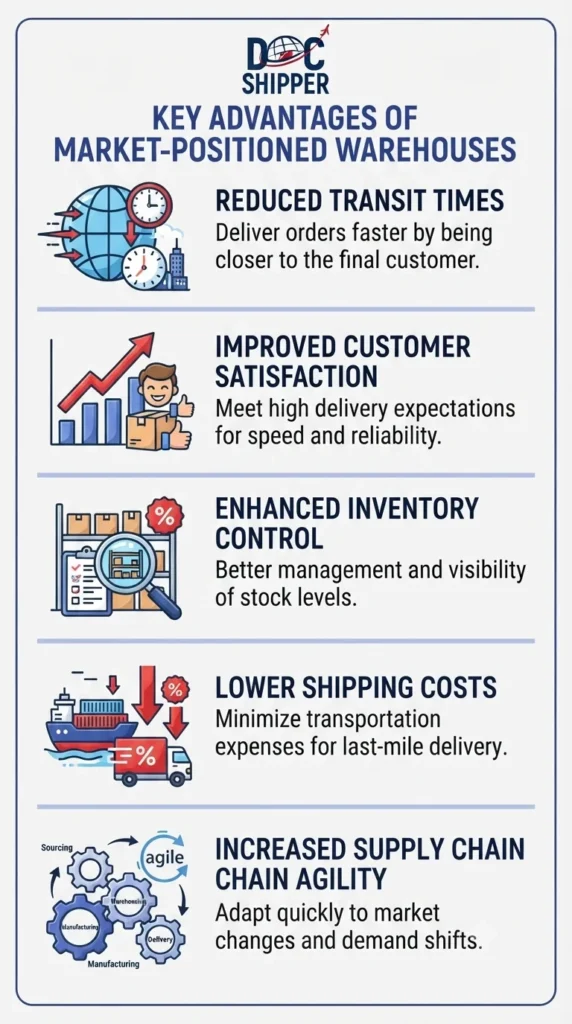
Market-positioned warehouses represent a fundamental strategic choice in modern international logistics, prioritizing customer proximity over traditional supply-side convenience. This approach delivers competitive advantages through reduced delivery times, lower transportation costs, and enhanced market responsiveness that increasingly define success in global commerce.
Need expert guidance on establishing market-positioned warehouses for your international operations? Contact DocShipper for comprehensive logistics consulting tailored to your specific market entry requirements.
📚 Quiz
Test Your Knowledge: Market-Positioned Warehouse
What is the primary strategic principle behind market-positioned warehouses?
A company claims market-positioned warehouses always reduce total inventory carrying costs. Is this statement accurate?
An electronics importer ships 800 monthly orders valued at $350,000 to a new geographical market. Which approach best applies market-positioned warehousing principles?
🎯 Your Results
📞 Free Quote in 24hFAQ | Market-Positioned Warehouse: Definition, Strategic Advantages & Real-World Examples
Market-positioned warehouses locate near consumer demand centers to minimize delivery times, while production-positioned warehouses sit near manufacturing facilities to reduce inbound logistics costs. The strategic choice depends on whether speed-to-customer or manufacturing efficiency takes priority in your business model. Market-positioned facilities excel when customer service and rapid fulfillment drive competitive advantage.
Market-positioned warehouses often operate as bonded facilities, allowing imported goods to remain in customs suspension until final distribution. This arrangement defers duty payments and enables consolidated customs processing rather than individual shipment clearances. Companies must comply with local bonded warehouse regulations and maintain detailed inventory tracking systems that customs authorities can audit.
Industry benchmarks suggest market-positioned warehouses become economically viable when monthly order volumes exceed 1,000 units or total monthly revenue surpasses $500,000 in a specific geographical region. However, the calculation depends heavily on product margins, transportation cost differentials, and competitive delivery expectations. High-value or time-sensitive products may justify market positioning at lower volumes.
Absolutely. Small businesses frequently leverage third-party logistics providers (3PLs) that operate shared market-positioned facilities, eliminating the need for dedicated warehouse investments. These arrangements allow businesses to access strategic locations while paying only for utilized space and services. Many 3PLs offer fulfillment-by-marketplace integration that positions inventory near major e-commerce customer concentrations.
Market-positioned strategies typically increase total inventory investment by 15-30% due to stock distribution across multiple locations. However, improved demand forecasting accuracy often reduces safety stock requirements, partially offsetting this increase. The net financial impact depends on the balance between additional carrying costs and savings from reduced expedited shipping, improved turnover rates, and decreased stockout penalties.
Effective management requires integrated warehouse management systems (WMS) with network-wide inventory visibility, transportation management systems (TMS) for optimal routing, and demand forecasting platforms that predict location-specific requirements. Cloud-based solutions enable real-time synchronization across facilities, while API integrations with e-commerce platforms and customs systems streamline order processing and compliance documentation.
Market-positioned facilities must accommodate seasonal inventory surges through flexible space arrangements, temporary labor scaling, and dynamic stock allocation algorithms. Many operators utilize seasonal overflow agreements with nearby 3PLs or implement pop-up distribution centers during peak periods. Advanced planning based on historical demand patterns ensures adequate capacity without maintaining costly excess infrastructure year-round.
Market-positioned strategies generally reduce carbon emissions by minimizing last-mile delivery distances and enabling consolidated bulk transportation to warehouses. Studies indicate average emissions reductions of 35-50% compared to centralized distribution with individual long-distance shipments. However, the environmental benefit depends on facility energy efficiency, local transportation infrastructure, and the proportion of orders consolidated before final delivery.
Establishing market-positioned warehouses in target countries signals market commitment to customers and partners while enabling compliance with local content requirements, faster customs clearance, and reduced cross-border shipping complexities. This physical presence often unlocks distribution partnerships, retail relationships, and government contracts unavailable to foreign shippers operating from distant locations.
Primary risks include demand forecasting errors leading to location-specific stockouts or excess inventory, higher fixed operating costs that reduce financial flexibility, and increased supply chain complexity requiring sophisticated management capabilities. Companies should conduct thorough market analysis, pilot programs in selected locations, and maintain contingency agreements with logistics partners before full network deployment.
Market-positioned facilities serve as fulfillment nodes for both online orders and retail store replenishment, enabling unified inventory visibility across channels. This positioning supports ship-from-store, buy-online-pickup-in-store (BOPIS), and same-day delivery programs that modern consumers expect. The warehouses effectively function as micro-fulfillment centers that blur traditional boundaries between distribution and retail operations.
Successful market-positioned facilities require access to qualified warehouse labor, particularly for specialized operations like temperature-controlled storage or hazardous materials handling. Site selection must evaluate local wage rates, labor availability, training infrastructure, and union presence. Urban locations offer abundant labor pools but higher costs, while suburban sites balance accessibility with affordability. Immigration policies and work authorization requirements also impact international operations significantly.
Need Help with
Logistics or Sourcing ?
First, we secure the right products from the right suppliers at the right price by managing the sourcing process from start to finish. Then, we simplify your shipping experience - from pickup to final delivery - ensuring any product, anywhere, is delivered at highly competitive prices.


Fill the Form
Prefer email? Send us your inquiry, and we’ll get back to you as soon as possible.
Contact us




