
Where a simple video call or a positive platform review once offered some reassurance, today these can be engineered, automated, and fabricated with alarming precision. The financial, legal, and reputational consequences of falling victim to a 2026 sourcing scams have never been more severe, and they are rising year after year
DocShipper info
Do you source products from Asia or beyond? DocShipper offers complete end-to-end logistics solutions: supplier sourcing, factory verification, freight forwarding by sea, air, road, or rail, customs clearance, and last-mile delivery. Whether you ship a single pallet or a full container, our experts manage every step so you can focus on growing your business. Get a Free Quote now
The Rise of 2026 Sourcing Scams and the “Ghost Factory” Phenomenon
The concept of the ghost factory is not entirely new, but its sophistication has reached an unprecedented level in 2026. A ghost factory is, at its core, a supplier that presents itself as a fully operational manufacturing entity while in reality owning zero machinery, employing no engineers, and controlling no production process whatsoever.
These entities exist purely in digital space, sustained by professionally designed websites, fabricated certification documents, and algorithmically generated reviews. What was once a clumsy impersonation has become a near-seamless fraud, made possible by the rapid democratisation of generative AI tools and immersive digital environments.
DocShipper Advice
Ghost factories are one of the biggest threats in today’s manufacturing landscape — fake suppliers with no real production capacity can cost you everything. Before committing to any supplier, always verify their facilities, audit their manufacturing process, and never skip physical or third-party inspections. DocShipper’s sourcing and verification experts are here to guide you at every step, from supplier vetting to on-site factory audits. Don’t leave it to chance — contact us and let us help you source safely.
According to asset verification specialists, between 23 and 30 % of assets listed on corporate registers — including production equipment catalogued by trading companies — may not physically exist at all. The same logic applies to the manufacturing capacity claimed by fraudulent suppliers: it is entered into systems, displayed on brochures, and communicated in pitch decks, but when examined physically, it simply is not there.
For importers and sourcing managers working at distance, this invisible gap between claimed capacity and actual production capability is the central vulnerability that ghost factory schemes exploit with devastating effectiveness.
How 2026 sourcing scams use AI and deepfakes to simulate production lines
The toolkit available to fraudulent suppliers in 2026 represents a dramatic acceleration of deception capabilities. AI-generated suppliers now use augmented reality-enhanced virtual tours to simulate bustling factory floors, presenting potential buyers with what appears to be a live, first-person walkthrough of operational production lines.
These tours can include real-time detail — workers moving, machines running, temperature gauges fluctuating — all of which can be manufactured using consumer-grade deepfake and rendering software. The barrier to creating a convincing fake digital presence has collapsed, and with it, the reliability of remote supplier verification tools that were considered best practice just three years ago.
Beyond video fabrication, AI document forensics have revealed a growing pattern of algorithmically generated maintenance logs, falsified electricity consumption records, and attendance sheets filled out in bulk rather than on a rolling, daily basis.
Platforms specialising in AI-powered document analysis can now detect these patterns by scanning thousands of pages for handwriting irregularities, metadata inconsistencies, and timestamp anomalies that indicate records were created all at once. Understanding this arms race is the first step toward defeating it: fraudsters are investing in technology, and buyers must invest in equally sophisticated countermeasures to maintain meaningful sourcing risk management.
Why “Gold Supplier” status is no longer enough for ghost factory verification
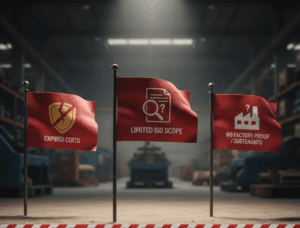
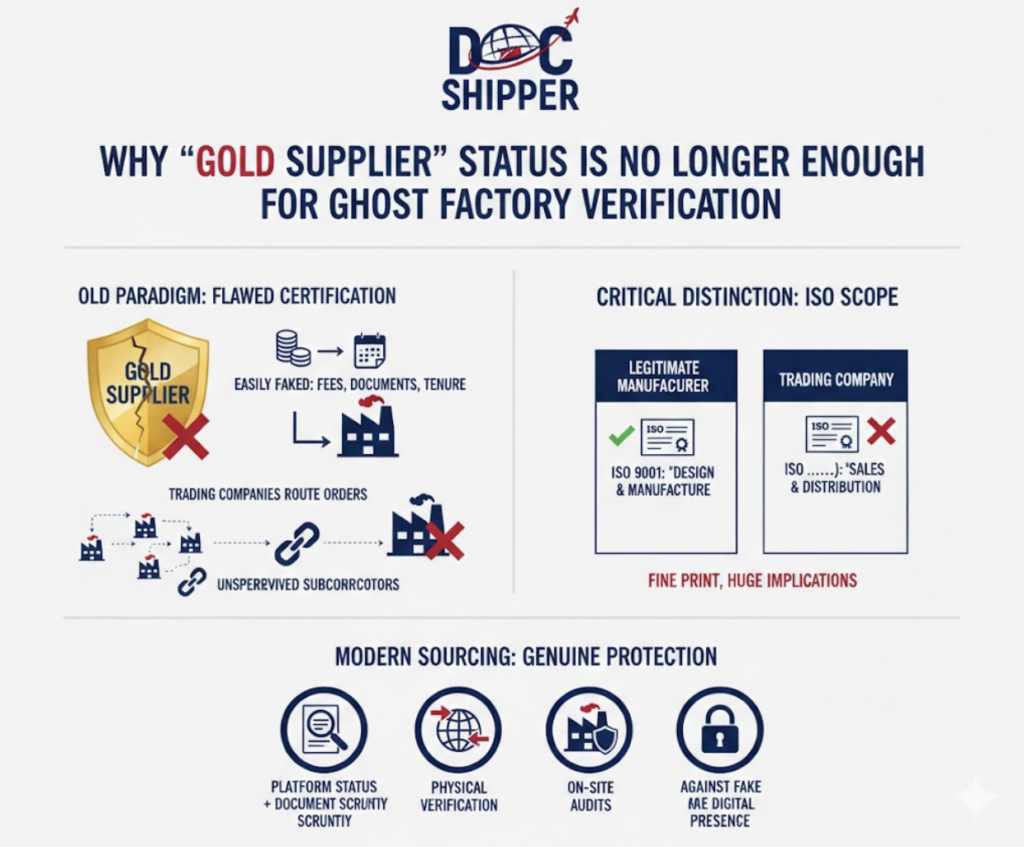
For years, platform certifications like “Gold Supplier” or “Verified Manufacturer” status served as a shorthand for legitimacy. In 2026, that shorthand has expired. These badges are granted based on criteria — registration fees, documentation submissions, platform tenure — that a well-resourced fraudulent operation can satisfy without ever owning a single piece of production equipment.
Trading companies and intermediaries have become expert at gaming these systems, presenting themselves as manufacturers while routing orders through a network of subcontractors they do not supervise and cannot vouch for. The result is a chain of supplier fraud 2026 risk that platform status does nothing to address.
A telling indicator is the scope of an ISO certification. Legitimate manufacturers carry ISO 9001 certification that explicitly covers “Design and Manufacture” within the audited scope. Trading companies, by contrast, often hold certificates limited to “Sales and Distribution” — a distinction that appears in fine print but has enormous implications.
Any sourcing professional who stops at the badge without reading the scope of certification is making procurement decisions on incomplete information. Combining platform status checks with document-level scrutiny and physical verification is the only approach that provides genuine protection against fake digital presence in the modern sourcing landscape.
DocShipper Alert
Fraudulent suppliers are more sophisticated than ever ans a simple “Gold Supplier” badge or a polished website is no longer proof of legitimacy. Before engaging with any manufacturer, here are two key red flags to watch for :
⚠ No verifiable physical address: If a supplier cannot provide a confirmed factory location that can be cross-checked via satellite or third-party audit, walk away.
⚠ Pressure to pay upfront via wire transfer: Legitimate manufacturers understand standard payment terms. Urgent requests for full payment before any inspection is a major warning sign.
Want to work only with verified, trustworthy suppliers? Get in touch with a DocShipper sourcing expert — we’ll handle the vetting so you don’t have to.
Red Flags: Spotting 2026 Sourcing Scams Before You Pay

The red flags that betray them are therefore often subtle:
- Inconsistencies in invoicing entities,
- Certifications that do not match the factory address,
- Product catalogues that defy the logic of manufacturing specialisation,
- And claimed capacity figures that are physically impossible given the infrastructure on display.
Developing the discipline to spot these signals, and to treat them as disqualifying rather than as minor concerns to be explained away, is foundational to protecting a sourcing operation.

Detecting manufacturing anomalies to avoid 2026 Sourcing Scams
Manufacturing anomalies in supplier documentation follow predictable patterns that experienced verification professionals learn to recognise quickly.One of the most reliable indicators is what anomaly detection specialists describe as the “drift“ principle: in genuine manufacturing environments, data accumulates incrementally and imperfectly, with small variations across daily logs, energy consumption records, and attendance sheets.
When these records appear suspiciously uniform — identical handwriting across a three-month period, energy bills that show implausibly flat consumption despite claimed production fluctuations — they betray the hallmark of documents created retrospectively. Manufacturing anomalies of this kind are not exceptional; they are systematic, and they demand investigation.
A factory audit checklist designed for 2026 conditions must include a cross-referencing protocol: production daily reports should be compared against attendance logs, and energy consumption data should be benchmarked against the capacity claimed by the supplier.
A factory claiming 500,000 units per month with only two active production lines represents a physical impossibility — industrial energy consumption is a constant that cannot be fabricated without leaving a paper trail. Requesting electricity bills for the last quarter is one of the most reliable and underutilised verification steps available to sourcing managers, and it costs nothing beyond the awareness to ask for it. When a supplier refuses or delays, that refusal is itself a data point of the highest significance.
Ghost factory verification: Identifying “phantom assets” and fake addresses

Research in asset management has shown that up to 30 % of assets listed on corporate registers across industries may not be physically present. Applied to the sourcing context, this means that a supplier’s stated machine inventory, its listed equipment roster, and its claimed production infrastructure may be entirely fictional entries rather than verifiable physical realities.
Ghost factory verification begins with challenging these entries directly, demanding purchase invoices for core equipment such as SMT lines, CNC machines, or testing chambers rather than accepting a list of assets at face value.
Fake factory addresses are another common element of supplier fraud 2026. It is not uncommon for trading companies to arrange site visits to “partner factories“ — facilities they do not own or control — and present them as their own.
The address on a supplier’s ISO certificate should match /
- the factory gate,
- the VAT registration address,
- and the export invoicing entity.
When these three elements diverge, the audit is effectively over: the divergence reveals a structure designed to obscure accountability rather than to facilitate it.
Systematic cross-referencing of these identifiers, before any commercial commitment is made, is a non-negotiable element of responsible sourcing risk management.
DocShipper Alert
Paying a supplier before conducting a physical factory verification is one of the most costly mistakes an importer can make in 2026. Ghost factories count on your urgency — a single unverified wire transfer can result in total financial loss with no legal recourse. Do not take that risk. Let our experts verify your supplier on the ground before you commit a single dollar. Contact us here — our team will get in touch with you within 24 hours.
Ghost Factory Verification: The Only 2026 Safety Net
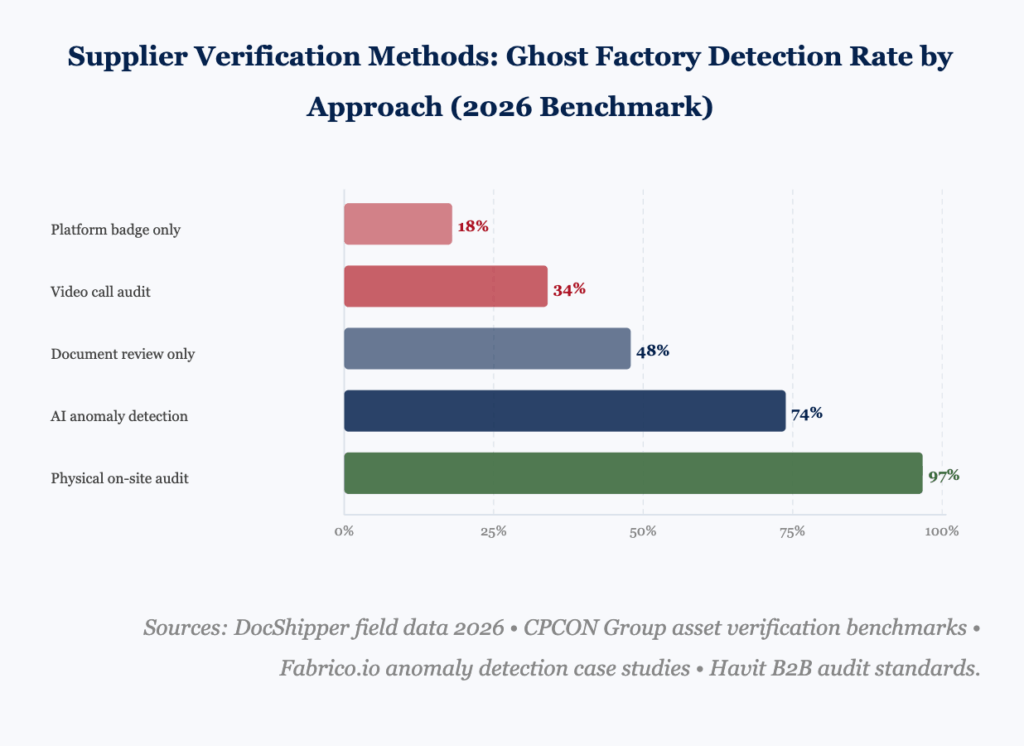
In a sourcing environment where digital tools — video calls, platform ratings, certification databases — have all been demonstrated to be susceptible to manipulation, physical verification stands as the last reliable line of defence.
No algorithm, no remote documentation review, and no certification badge can substitute for the irreducible reality of a human being standing on a factory floor, observing what machinery is actually present, speaking directly to engineers, and checking whether the production output claimed by the supplier is physically plausible. This is not a counsel of old-fashioned caution — it is the logical conclusion of a technological arms race that fraudsters are currently winning at the digital level.
Why on-site ghost factory verification is mandatory for 2026 imports
On-site factory inspection has moved from best practice to categorical necessity for any serious import operation in 2026. The legal context reinforces this: with due diligence legislation in major markets placing liability upstream in the supply chain, a buyer who cannot demonstrate that they took reasonable steps to verify a supplier’s legitimacy is exposed to both regulatory and commercial consequences.
A comprehensive factory audit checklist in 2026 must cover five pillars:
- quality management system readiness,
- technical and production competence,
- social compliance, supply chain resilience,
- and environmental footprint.
Each of these pillars requires evidence that can only be gathered reliably in person, by someone who knows what they are looking for and who is empowered to ask uncomfortable questions.
Lorem ipsum dolor sit amet, consectetur adipiscing elit. Ut elit tellus, luctus nec ullamcorper mattis, pulvinar dapibus leo.

Auditors must ensure the following steps :
- examine the actual production floor,
- verify that machinery listed on the equipment roster is present and operational,
- cross-check the capacity declarations against observable evidence such as line speeds and shift structures,
- and interview workers directly without management supervision.
Any supplier that restricts access to areas of the facility, provides only a guided tour along a predetermined route, or is unable to produce original equipment purchase invoices on demand should be treated as a high-risk partner.
The factory verification service that DocShipper provides is precisely designed to close this gap for importers who cannot conduct these inspections themselves.
DocShipper Advice
Before placing any order with a new supplier, always commission a professional on-site factory audit. DocShipper’s local inspection teams operate across asia , Europe , Africa and other major sourcing hubs — checking production capacity, equipment ownership, ISO certification scope, and social compliance standards on your behalf. A verified supplier is your strongest commercial asset. Do not skip this step — it costs far less than a failed shipment. Request a Factory Audit from our sourcing experts now
Video calls vs. physical visits: Beating “deepfake” tours with ghost factory verification
The emergence of deepfake video technology and augmented reality virtual tours has made remote supplier verification through video calls a fundamentally unreliable method in 2026.
A buyer who accepts a polished, pre-recorded or algorithmically enhanced factory tour as a substitute for physical presence is accepting a simulation rather than reality.
The tells are subtle:
- cameras that never quite reveal the full depth of a production area,
- workers who appear in slightly too-regular intervals, ambient sound that does not synchronise with visual activity, and an absence of the ordinary disorder that characterises real manufacturing environments. Training sourcing teams to look for these markers is worthwhile, but it is ultimately an inferior substitute for physical presence.
When physical visits are temporarily unavailable — due : to geopolitical restrictions, logistical constraints, or time pressures — hybrid digital audit approaches offer a meaningful intermediate level of assurance. Industrial smart glasses used by on-the-ground representatives can provide first-person, live-streamed walkthroughs that are harder to fake than pre-produced content.
Critically, the sourcing team should be able to direct the walkthrough in real time:
– asking to see specific stations,
– requesting a close-up of a machine serial number,
– or demanding that a randomly selected unit be tested on camera.
This interactivity is precisely what deepfake tours cannot replicate. Even so, hybrid digital audits should be understood as a complement to, not a replacement for, periodic physical visits that constitute the gold standard of ghost factory verification. Lorem ipsum dolor sit amet, consectetur adipiscing elit. Ut elit tellus, luctus nec ullamcorper mattis, pulvinar dapibus leo.
Advanced Tools to Prevent 2026 Sourcing Scams
The verification ecosystem available to sourcing professionals in 2026 has expanded significantly, offering powerful new instruments for detecting fraud that would have been inaccessible or prohibitively expensive just a few years ago.
- Anomaly detection software,
- AI-powered document forensics,
- RFID asset tracking,
- and drone-assisted verification are all now deployable at commercially viable costs.
These tools do not replace human judgement — they enhance it, providing data-driven signals that direct attention to the most suspicious elements of a supplier’s profile and reduce the likelihood that a well-constructed deception goes undetected.
The most effective verification strategies combine these technological instruments with experienced human oversight and a willingness to act on what the data reveals.
Using Anomaly Detection Software to Verify Real Factory Capacity
Anomaly detection software has become a cornerstone of manufacturing quality management, and its principles translate directly to supplier verification.
These systems operate by :
- establishing baselines — what a legitimate production environment looks like in terms of speed,
- Fixing energy consumption,
- Determining maintenance intervals, and output consistency —
- Then flagging any deviation from those baselines as a signal requiring investigation.
In the context of sourcing verification, the same logic applies: a supplier’s documented history of production outputs, machine utilisation rates, and quality metrics should exhibit the kind of natural variation that reflects genuine manufacturing activity. When the data is suspiciously clean or aligned with targets, that smoothness is itself an anomaly.
Advanced manufacturing anomaly detection platforms now integrate multiple data streams simultaneously — performance metrics such as
- OEE (Overall Equipment Effectiveness),
- sensor readings from PLC-connected machinery,
- and visual evidence captured by computer vision cameras — to triangulate a facility’s true operational status.
In the verification context, requesting that a supplier’s anomaly detection data be shared as part of the pre-qualification process is an increasingly standard expectation among sophisticated buyers.
A factory that genuinely produces at the volumes it claims will have a continuous operational record that AI-powered analytics can validate or refute within hours. Factories that cannot or will not provide this data have, in effect, already failed the most important element of the factory audit checklist.
The role of local sourcing agents in stopping 2026 Sourcing Scams

A reputable factory verification service operating in proximity to a supplier’s declared location can conduct to :
- physical spot checks,
- interview local labour markets,
- cross-reference municipal business registrations,
- and verify whether a facility’s presence in the local industrial ecosystem is consistent with its claimed history and scale.
This ground-level intelligence is difficult to fabricate and impossible to simulate through digital channels. It represents the human complement to the technological verification tools described above, and the two work most effectively in combination.

DocShipper’s network of local sourcing risk management specialists operates precisely in these markets — providing the on-the-ground verification capacity that importers need but often lack access to — ensuring that every supplier relationship rests on a foundation of verified, physical reality rather than digital promise.
Never pay before a physical verification has been completed and confirmed by a trusted local partner: this is the non-negotiable principle of safe sourcing in 2026.

DocShipper info
By working with DocShipper, you will never need to manage a single stakeholder in your supply chain alone. From initial supplier sourcing and on-site factory verification to freight forwarding, customs clearance, and final delivery — your dedicated DocShipper consultant handles everything. We offer transparent pricing, real-time shipment tracking, and multilingual support across Asia, Europe, and the America. Fill out our contact form and our experts will get back to you within 24 hours. Contact Us Now
Conclusion: Secure Your Supply Chain to avoid 2026 Sourcing Scams
The sourcing landscape of 2026 demands a fundamental rethinking of what due diligence means.
Ghost factories, deepfake tours, AI-generated suppliers, and phantom asset registers have made digital verification alone insufficient — and in many cases, actively dangerous as a false source of confidence.
The only supply chain that is truly protected is one built on a foundation of physical verification: real audits conducted by credible professionals who can see, touch, and interrogate the production environment directly.
Regulatory pressure, financial risk, and reputational exposure all point in the same direction — toward greater rigour, not less.
DocShipper’s verification service combines AI detection, local intelligence, and on-site inspections to ensure every supplier meets the highest standards — before you commit a single dollar.
The rule is simple: never pay before a physical verification is completed. In 2026, that discipline alone is your most powerful protection against sourcing scams.
FAQ — Frequently Asked Questions
Read More
Looking for more? These articles might interest you:
FAQ | Stop 2026 Sourcing Scams: Ghost Factory Verification
A ghost factory is a supplier entity that claims to be a fully operational manufacturer but in reality owns no machinery, employs no production engineers, and controls no actual manufacturing process. In 2026, these fraudulent operations — a core component of what industry professionals now call 2026 sourcing scams — have become increasingly sophisticated, using AI-generated content, deepfake video, and fabricated certification documents to present a convincing digital facade. Research in asset management indicates that between 23 and 30 percent of assets listed on corporate registers may not physically exist — a figure that illustrates just how structural this problem has become. The risk is global and affects importers across all product categories.
No — not as a standalone verification measure. Platform certifications are granted based on criteria that a well-resourced fraudulent operation can satisfy without ever owning production equipment: registration fees, document submissions, and platform tenure. In 2026, these badges have been systematically gamed as part of broader 2026 sourcing scams, with trading companies presenting themselves as manufacturers. They provide a starting point for research but must be supplemented by rigorous document-level scrutiny — particularly examining the scope of ISO certifications — and ultimately by physical on-site verification before any commercial commitment is made.
The most reliable documentary red flags include: ISO 9001 certificates whose scope covers only "Sales and Distribution" rather than "Design and Manufacture"; invoicing entities that differ from the registered factory name; electricity bills that show implausibly flat energy consumption relative to claimed production volumes; and attendance and maintenance logs that appear to have been completed in bulk. 2026 sourcing scams increasingly rely on documents that follow a pattern of suspicious uniformity — too clean, too perfectly aligned with targets — that contrasts sharply with the natural variation found in genuine production records. Any combination of these signals warrants an immediate escalation to physical verification.
Anomaly detection software identifies deviations from established operational baselines — drops in production speed, unusual energy consumption patterns, or irregular maintenance intervals — that indicate something abnormal about a facility's operation. In the context of 2026 sourcing scams, these tools can analyse the documented production history provided by a supplier, checking whether the data exhibits the natural variation of genuine manufacturing activity or the suspicious smoothness of fabricated records. Platforms that integrate performance metrics, sensor data, and computer vision provide a triangulated view of a facility's true operational status. Legitimate factories running at their claimed capacity will have a verifiable, continuous operational record; fraudulent ones will not.
Digital tools — however sophisticated — operate on data that can be fabricated, curated, or selectively presented as part of a 2026 sourcing scam. On-site factory inspection remains the only verification method that is fundamentally resistant to digital manipulation, because physical reality cannot be edited. A human auditor standing on a factory floor can observe whether machines are operational, whether workers recognise the production process being claimed, and whether the facility's physical scale is consistent with its declared output. Beyond verification, on-site audits are increasingly required by regulators and major retail channels as a condition of supplier accreditation — precisely because 2026 sourcing scams have made digital-only due diligence insufficient. DocShipper's recommendation is unambiguous: never pay before physical verification has been confirmed by a trusted, independent professional.
Need Help with Logistics or Sourcing ?
First, we secure the right products from the right suppliers at the right price by managing the sourcing process from start to finish. Then, we simplify your shipping experience - from pickup to final delivery - ensuring any product, anywhere, is delivered at highly competitive prices.
Fill the Form
Prefer email? Send us your inquiry, and we’ll get back to you as soon as possible.
Contact us