


In short ⚡
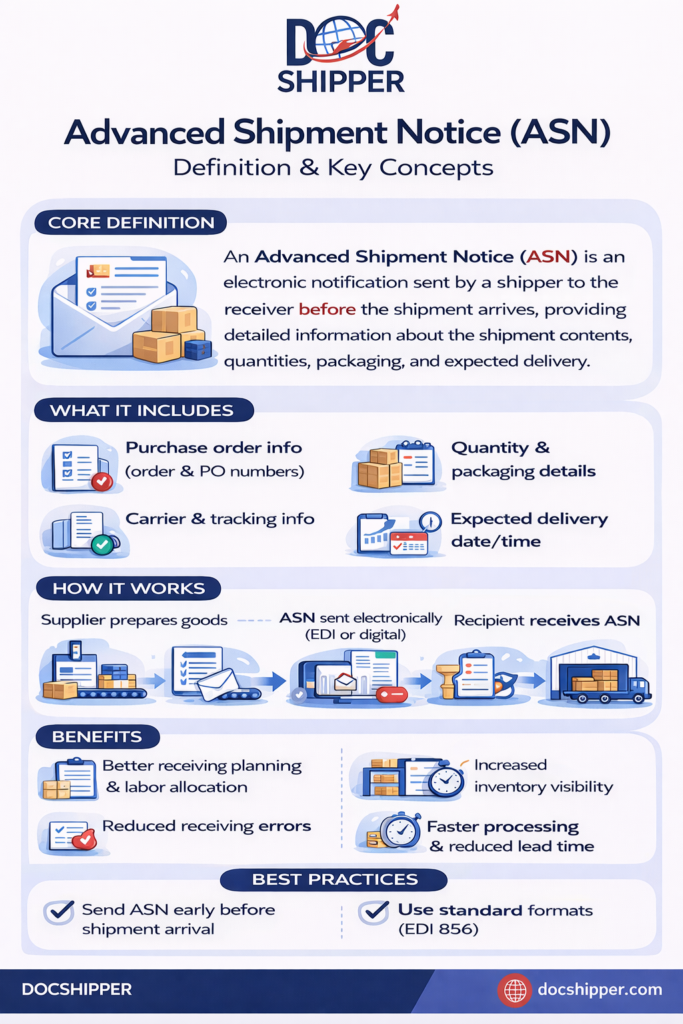
An Advanced Shipment Notice (ASN) is an electronic document sent by a supplier to a customer before goods are physically delivered, detailing shipment contents, quantities, packaging details, and expected arrival time. This EDI transaction (typically EDI 856) enables recipients to prepare receiving operations, optimize warehouse space, and improve supply chain visibility.
Introduction
In international logistics, delayed shipment information creates warehouse bottlenecks, labor inefficiencies, and inventory discrepancies. Many importers still rely on outdated phone calls or emails to track incoming freight, resulting in costly receiving errors.
The Advanced Shipment Notice solves this problem by providing structured, machine-readable shipment data before goods arrive. This pre-arrival intelligence is critical for just-in-time operations, cross-docking strategies, and compliance with retailer mandates.
Key characteristics of an effective ASN include:
- Standardized format: Typically EDI 856 or XML-based messages following ANSI X12 or EDIFACT standards
- Hierarchical structure: Shipment → order → pack → item level detail with serial numbers and batch codes
- Timing precision: Sent 24-72 hours before delivery to allow adequate preparation time
- Cross-referencing capability: Links purchase orders, packing lists, and bills of lading through unique identifiers
- Carrier integration: Includes tracking numbers, SCAC codes, and pro numbers for real-time visibility
Technical Components & Legal Framework
An ASN operates within a complex ecosystem of supply chain technologies and regulatory requirements. Understanding its technical architecture is essential for proper implementation.
The EDI 856 transaction set represents the industry standard for ASN transmission. This ANSI X12 format contains hierarchical loops organizing data from shipment level (HL01) down to individual item details (HL04). Each loop includes mandatory elements like shipment identification numbers, carrier details, and weight measurements, plus optional fields for hazardous materials classification or temperature control requirements.
Modern ASN systems integrate with Warehouse Management Systems (WMS) through API connections or middleware platforms. This integration enables automatic creation of receiving tasks, dock door assignments, and put-away instructions before trucks arrive. At DocShipper, we configure ASN workflows that trigger automated customs clearance processes when international shipments approach destination ports.
The GS1 standards provide global guidelines for ASN data structure, particularly the SSCC (Serial Shipping Container Code) used to identify logistics units. These 18-digit barcodes enable scan-based receiving that automatically matches physical goods against ASN data, reducing manual entry errors by up to 40%.
From a legal perspective, ASN accuracy requirements are often contractually mandated. Major retailers like Walmart and Amazon impose chargeback penalties for ASN discrepancies, typically $50-$500 per incident. The EU’s Customs Code (UCC) also recognizes electronic pre-arrival notifications as acceptable customs documentation when properly structured, as detailed in EU Customs regulations.
Data security protocols govern ASN transmission to protect sensitive commercial information. AS2 (Applicability Statement 2) encryption and VAN (Value-Added Network) services ensure secure EDI exchanges, while GDPR compliance requires careful handling of any personal data embedded in shipment notices for B2C deliveries.
Practical Examples & Performance Data
Real-world implementation reveals the tangible benefits of properly executed ASN processes across different logistics scenarios.
Comparative Analysis: ASN vs. No ASN Operations
| Metric | Without ASN | With ASN | Improvement |
|---|---|---|---|
| Receiving Time per Container | 4.5 hours | 2.1 hours | 53% faster |
| Data Entry Errors | 8.2 per 100 SKUs | 1.3 per 100 SKUs | 84% reduction |
| Dock Door Utilization | 62% | 89% | +27 points |
| Inventory Accuracy | 94.3% | 99.1% | +4.8 points |
| Labor Cost per Shipment | $127 | $68 | 46% savings |
Use Case: Automotive Parts Distribution
A European automotive supplier ships 15,000 SKUs monthly to North American assembly plants. Before ASN implementation, receiving teams required 8 hours to process each trailer, manually verifying part numbers against purchase orders.
After deploying EDI 856 ASN with SSCC labeling, the process transformed:
- Pre-arrival preparation: WMS generates receiving plans 48 hours before delivery, assigning specific dock doors and staging areas
- Scan-based receiving: Workers scan SSCC labels, automatically validating against ASN data with 99.7% accuracy
- Exception handling: System flags discrepancies in real-time, reducing post-receiving corrections by 91%
- Cross-docking optimization: 34% of parts bypass storage, moving directly to production lines based on ASN timing data
- Financial impact: Annual savings of $340,000 in labor costs plus $180,000 in reduced inventory carrying costs
DocShipper Platform
Cut logistics costs. Not corners.
See exactly where your logistics costs are bleeding — and how to fix it. Book your expert demo.

E-commerce Fulfillment Scenario
An online retailer receives 200+ inbound shipments daily from various suppliers. ASN implementation enabled:
- Dynamic slotting: System pre-assigns storage locations based on ASN velocity data, reducing travel time by 23%
- Appointment scheduling: Carriers book time slots through ASN-integrated portal, eliminating wait times
- Quality control triggers: ASN flags shipments requiring inspection, automatically routing them to QC stations
- Invoice matching: Finance system reconciles ASN quantities against supplier invoices, catching billing errors worth $47,000 annually
DocShipper integrates ASN data with customs brokerage systems for clients importing into the EU and US, enabling pre-clearance of shipments while goods are in transit. This approach reduces border dwell time by an average of 18 hours for ocean freight and 4 hours for air cargo.
Conclusion
The Advanced Shipment Notice transforms receiving operations from reactive chaos into predictable, data-driven processes. Organizations implementing ASN systems consistently achieve double-digit improvements in efficiency, accuracy, and cost control while meeting increasingly stringent retailer compliance requirements.
Need expert guidance on ASN implementation for your international supply chain? Contact DocShipper for customized logistics solutions that integrate seamlessly with your existing systems.
📚 Quiz
Test Your Knowledge: Advanced Shipment Notice (ASN)
Q1 — What is an Advanced Shipment Notice (ASN)?
Q2 — A logistics manager assumes that an ASN and a packing list are the same document. Is this correct?
Q3 — An automotive supplier wants to reduce receiving time and allow their warehouse to prepare dock assignments 48 hours before a trailer arrives. Which approach best leverages ASN capabilities?
🎯 Your Result
📞 Free Quote in 24hFAQ | Advanced Shipment Notice (ASN): Definition, Calculation & Practical Examples
A packing list is a static document listing shipment contents, while an ASN is an electronic, structured message sent before delivery that enables automated receiving processes and system integration. ASNs include carrier details, timing information, and hierarchical packaging data that packing lists typically lack.
No. While EDI 856 is the North American standard, EDIFACT DESADV serves European markets, and many companies use XML-based formats or API integrations. The key requirement is structured, machine-readable data that receiving systems can automatically process.
Best practice recommends 24-72 hours before delivery for domestic shipments and 3-5 days for international freight. This timing allows receiving teams to schedule labor, prepare dock space, and coordinate cross-docking operations without creating stale data issues.
Discrepancies trigger exception workflows in WMS systems. Receiving staff resolve variances through manual counts and system adjustments. Chronic ASN inaccuracies often result in supplier chargebacks (typically $50-$500 per incident) and damaged business relationships.
Yes. Many retailers and 3PLs offer web portals where suppliers manually enter ASN data, which the system converts to EDI format. Third-party EDI service providers also offer affordable cloud-based solutions for small-volume shippers.
Absolutely. ASNs are particularly valuable for LTL since they help consolidation centers and final destinations prepare for mixed-SKU deliveries. The hierarchical structure accommodates multiple purchase orders within a single shipment.
Core requirements include shipment ID, carrier SCAC code, expected delivery date, ship-to location, item numbers, quantities, and unit of measure. Optional but valuable fields include lot numbers, serial numbers, expiration dates, and country of origin for customs purposes.
By providing expected quantities before arrival, ASNs enable cycle counting during receiving rather than after storage. This immediate verification catches discrepancies when corrective action is easiest, preventing perpetual inventory errors that compound over time.
Not universally, but many customs authorities accept electronic ASN data as pre-arrival notifications. The EU's Import Control System (ICS) and US ACE (Automated Commercial Environment) can process ASN information to expedite clearance, though formal customs declarations remain separate requirements.
Most organizations achieve positive ROI within 6-12 months. Initial costs include EDI integration ($5,000-$50,000), staff training, and supplier onboarding. Savings from reduced labor, fewer errors, and improved space utilization typically exceed implementation costs within the first year.
Yes. EDI 856 supports hazardous materials segments that communicate UN numbers, hazard classes, packing groups, and emergency contact information. This data enables receiving facilities to prepare proper handling equipment and comply with OSHA and DOT regulations.
Modern TMS platforms consume ASN data to update shipment status, trigger carrier payment processes, and feed business intelligence dashboards. The ASN's carrier and tracking information creates a closed-loop visibility system from dispatch through final delivery confirmation.
Need Help with
Logistics or Sourcing ?
First, we secure the right products from the right suppliers at the right price by managing the sourcing process from start to finish. Then, we simplify your shipping experience - from pickup to final delivery - ensuring any product, anywhere, is delivered at highly competitive prices.


Fill the Form
Prefer email? Send us your inquiry, and we’ll get back to you as soon as possible.
Contact us




:%20Definition%20&%20Guide%20in%202026)