AQL (Acceptable Quality Limit): Definition & Guide for 2026

  • admin 8 Min
  • Published on March 3, 2026 Updated on March 5, 2026
img

In short ⚡

AQL (Acceptable Quality Limit) is a statistical sampling standard defining the maximum acceptable number of defective units in a production batch. Widely used in international trade, AQL determines inspection criteria and acceptance thresholds for quality control before shipment.

Introduction

Many importers face a recurring dilemma: how many defective products are acceptable before rejecting an entire shipment? Without clear quality standards, disputes multiply, costs explode, and supplier relationships deteriorate.

The AQL standard solves this problem by establishing precise statistical thresholds. Originally developed for military procurement, this methodology now governs quality inspections worldwide, particularly in textiles, electronics, and consumer goods.

  • Statistical foundation: Based on ISO 2859-1 (formerly MIL-STD-105E)
  • Risk management: Balances buyer protection against supplier constraints
  • Inspection flexibility: Adapts sample size to batch volume
  • Defect classification: Distinguishes critical, major, and minor defects
  • International acceptance: Recognized by customs and certification bodies globally

Understanding AQL: Technical Framework & Standards

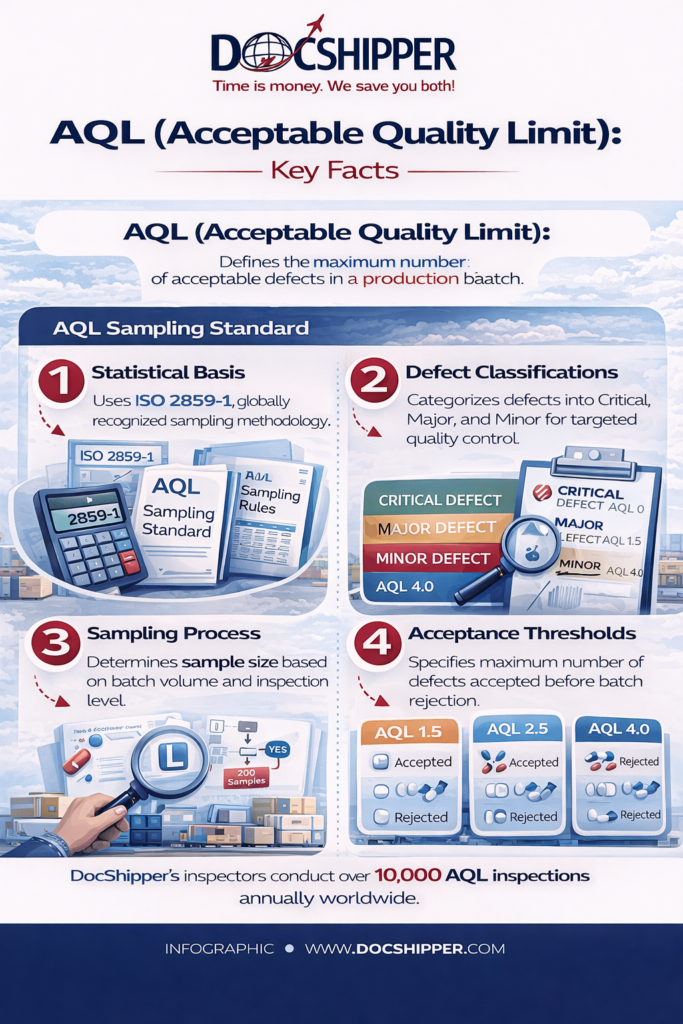
The AQL system operates through three fundamental components: defect severity classification, sample size determination, and acceptance/rejection criteria. Each element follows precise mathematical logic defined by international standards.

Defect severity levels form the cornerstone of AQL inspection. Critical defects (safety hazards, legal non-compliance) typically require AQL 0—zero tolerance. Major defects (functional failures, significant appearance issues) commonly use AQL 1.5 or 2.5. Minor defects (cosmetic flaws with no impact on use) generally accept AQL 4.0.

The inspection level determines sample size relative to batch quantity. General Inspection Level II represents the industry standard, balancing statistical confidence against inspection costs. Level I reduces sample size for low-risk products, while Level III increases scrutiny for high-stakes shipments.

Sample size codes translate batch quantities into inspection volumes through standardized tables. For example, a batch of 5,000 units under Level II generates code letter L, requiring 200 samples. The acceptance number then determines the maximum allowable defects—at AQL 2.5 for major defects, 10 defective units trigger rejection.

According to the ISO 2859-1 standard, switching rules allow inspectors to transition between normal, tightened, and reduced inspection based on supplier performance history. Consistent quality enables reduced sampling, while recurring failures mandate stricter protocols.

At DocShipper, we systematically apply AQL standards during pre-shipment inspections, ensuring your products meet contractual specifications before leaving the factory. This preventive approach eliminates costly post-delivery disputes.

AQL (Acceptable Quality Limit)

Practical Examples & Calculation Methods

Understanding AQL theory matters little without practical application. The following scenarios demonstrate how AQL thresholds translate into real-world inspection decisions across different product categories.

Use Case 1: Textile Garment Order

An importer orders 8,000 cotton shirts. Using General Inspection Level II, the sample size code becomes L (200 units). The buyer specifies AQL 0 for critical defects (exposed sharp objects), AQL 2.5 for major defects (stitching failures, wrong sizes), and AQL 4.0 for minor defects (loose threads, slight color variations).

Inspection outcome: Inspectors find 0 critical defects (pass), 8 major defects (pass—threshold is 10), and 18 minor defects (pass—threshold is 21). The shipment proceeds to export.

Use Case 2: Electronic Component Batch

A manufacturer receives 3,200 circuit boards. Code letter K applies (125 samples). The contract mandates AQL 1.0 for critical defects (electrical safety), AQL 1.5 for major defects (functionality), and AQL 2.5 for minor defects (cosmetic marks).

Inspection outcome: Testing reveals 0 critical defects (pass), 4 major defects (fail—threshold is 3), and 5 minor defects (pass—threshold is 7). The batch requires rework or replacement before acceptance.

Comparative AQL Table

Batch Size Code Letter (Level II) Sample Size AQL 1.5 (Accept/Reject) AQL 2.5 (Accept/Reject) AQL 4.0 (Accept/Reject)
500–1,200 J 80 2 / 3 3 / 4 5 / 6
1,201–3,200 K 125 3 / 4 5 / 6 7 / 8
3,201–10,000 L 200 5 / 6 10 / 11 14 / 15
10,001–35,000 M 315 7 / 8 14 / 15 21 / 22

These calculations demonstrate why AQL selection requires strategic thinking. Stricter thresholds protect brand reputation but increase rejection rates and supplier friction. Lenient standards accelerate shipments but risk customer complaints and returns.

DocShipper’s quality control teams conduct over 10,000 AQL inspections annually across Asia, Europe, and the Americas. Our inspectors follow ISO-certified protocols, providing detailed photographic reports within 24 hours of inspection completion.

Conclusion

The AQL standard transforms subjective quality judgments into objective, defensible decisions. Mastering its application protects your margins, strengthens supplier accountability, and ensures customer satisfaction.

Need expert guidance on implementing AQL standards for your imports? Contact DocShipper for customized quality control solutions tailored to your product category and risk tolerance.

📚 Quiz
Test Your Knowledge: AQL (Acceptable Quality Limit)

FAQ | AQL (Acceptable Quality Limit): Definition, Calculation & Practical Examples

AQL 1.5 means accepting a maximum of 1.5% defective units per 100 items inspected. For a 200-unit sample, this translates to 5 allowable defects before rejecting the batch.

Ask us anything!

Need Help with Logistics or Sourcing ?

First, we secure the right products from the right suppliers at the right price by managing the sourcing process from start to finish. Then, we simplify your shipping experience - from pickup to final delivery - ensuring any product, anywhere, is delivered at highly competitive prices.

Live Chat

Get instant assistance from our team—just click and start chatting!

Live Chat Now
image

Fill the Form

Prefer email? Send us your inquiry, and we’ll get back to you as soon as possible.

Contact us
image

Call us

Reach out to us on WhatsApp for quick, convenient, and personal support.

Call us
image