


In short ⚡
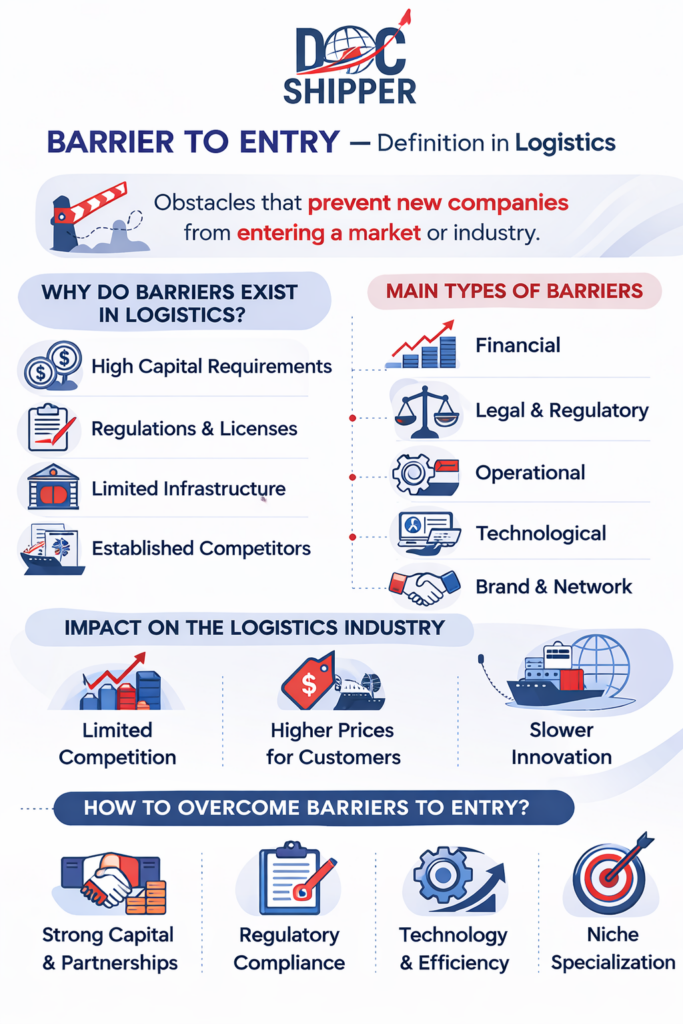
Barrier to entry refers to obstacles that prevent or hinder new competitors from entering a market or industry. In international logistics and trade, these barriers include regulatory requirements, capital costs, technical standards, and established supply chain networks that new market entrants must overcome to compete effectively.
Introduction
Why do some companies dominate international markets while newcomers struggle to gain a foothold? The answer often lies in barriers to entry—structural, financial, and regulatory obstacles that protect established players.
In import-export operations, understanding these barriers is essential for strategic planning. They determine market accessibility, competitive dynamics, and investment requirements across different countries and sectors.
Key characteristics of barriers to entry include:
- Regulatory compliance: Customs procedures, certifications, and licensing requirements that vary by jurisdiction
- Capital intensity: Significant upfront investment in infrastructure, inventory, or technology
- Economies of scale: Cost advantages enjoyed by established competitors with higher volumes
- Brand loyalty: Consumer preferences that favor existing market participants
- Distribution networks: Established supply chains and partnerships that are difficult to replicate
Understanding Barriers to Entry in Global Trade
Barriers to entry in international logistics manifest across multiple dimensions. Structural barriers include inherent market characteristics like high fixed costs for warehousing or transportation infrastructure. A company entering cross-border freight forwarding must invest in customs brokerage licenses, warehouse facilities, and technology platforms before generating revenue.
Strategic barriers are deliberately created by incumbent firms. Exclusive contracts with manufacturers, predatory pricing, or vertical integration can effectively block competitors. For example, established freight forwarders often secure preferential rates with carriers through volume commitments that newcomers cannot match.
Regulatory barriers constitute perhaps the most significant challenge in international trade. Each country maintains unique import regulations, product standards, and certification requirements. The European Union’s CE marking requirements exemplify how compliance standards can restrict market access for foreign manufacturers unfamiliar with technical directives.
Information asymmetry creates invisible barriers. Established players possess market knowledge, supplier relationships, and operational expertise accumulated over years. New entrants face steep learning curves regarding customs procedures, tariff classifications, and local business practices.
Network effects strengthen as platforms and ecosystems mature. Digital freight platforms with extensive user bases offer superior matching efficiency, making it difficult for new platforms to attract both shippers and carriers simultaneously. At DocShipper, we help clients navigate these complex barriers by leveraging our established network across 50+ countries, reducing the time and capital required to enter new markets.
Practical Examples & Market Analysis
Real-world barriers to entry vary significantly across industries and regions. Consider the pharmaceutical import sector, where regulatory barriers are exceptionally high.
| Barrier Type | Low-Barrier Market (Textiles) | High-Barrier Market (Pharmaceuticals) |
|---|---|---|
| Regulatory Approval | Basic import license (1-2 weeks) | FDA approval, GMP certification (12-24 months) |
| Initial Capital | $50,000 – $200,000 | $2M – $10M+ |
| Technical Standards | Labeling requirements, fiber content | Cold chain compliance, stability testing, batch tracking |
| Market Entry Time | 3-6 months | 18-36 months |
| Competitor Response | Price competition | Patent litigation, exclusive distribution agreements |
Case Study: E-commerce Cross-Border Logistics
A European retailer attempting to enter the Chinese e-commerce market faces multiple barriers. First, they must establish an ICP (Internet Content Provider) license, requiring a local entity. Second, they need partnerships with domestic payment processors like Alipay or WeChat Pay. Third, they must navigate complex customs procedures for bonded warehouses or cross-border e-commerce zones.
The capital requirement exceeds €500,000 before the first sale, including:
- Legal entity establishment and licensing: €80,000
- Warehouse setup in bonded zones: €200,000
- Technology platform localization: €150,000
- Marketing and brand establishment: €100,000
By contrast, established players like Alibaba’s Tmall Global already possess infrastructure, regulatory approvals, and consumer trust—creating formidable competitive advantages. DocShipper assists clients in overcoming such barriers through our turnkey solutions, including entity formation, customs clearance, and warehousing services that reduce both cost and complexity.
DocShipper Platform
One platform. Your entire supply chain
Sourcing, freight, customs & documents — all centralised, all visible, 24/7.
Conclusion
Barriers to entry fundamentally shape competitive dynamics in international trade. Understanding these obstacles—whether regulatory, financial, or strategic—enables businesses to make informed market entry decisions and allocate resources effectively.
Need expert guidance navigating market entry barriers? Contact DocShipper for comprehensive support across customs, logistics, and regulatory compliance.
📚 Quiz
Barrier to Entry
Q1 — What does "barrier to entry" mean in the context of international trade?
Q2 — A common misconception is that barriers to entry are always harmful to consumers. What does the article actually state?
Q3 — A European retailer wants to enter the Chinese e-commerce market. Which of the following best illustrates a barrier to entry they would face?
🎯 Your Result
📞 Free Quote in 24hFAQ | Barrier to Entry: Definition, Types & Real-World Examples in International Trade
The primary types include regulatory barriers (licenses, certifications), capital requirements (infrastructure, inventory), economies of scale enjoyed by incumbents, brand loyalty, established distribution networks, and technological advantages. Each market presents a unique combination of these obstacles.
Large established companies achieve lower per-unit costs through volume production and purchasing power. New entrants with smaller volumes face higher costs, making price competition difficult. In logistics, this manifests through preferential carrier rates and warehouse efficiencies that require significant throughput.
Not necessarily. Some barriers, particularly regulatory standards for safety and quality, protect consumers from substandard products. However, excessive barriers can reduce competition, leading to higher prices and less innovation. The optimal balance varies by industry and public policy objectives.
Strategies include partnering with established logistics providers, using third-party warehousing, leveraging digital platforms that reduce infrastructure needs, focusing on niche markets with lower entry costs, and seeking strategic investors or government export assistance programs.
Import quotas limit the quantity of goods that can enter a country, effectively restricting market access. Established importers with existing quota allocations maintain advantages over newcomers. Quota systems in textiles, agriculture, and steel have historically created significant entry barriers.
Different countries maintain unique product specifications, testing requirements, and certification processes. Compliance requires investment in redesign, testing, and documentation. The EU's REACH chemical regulations and varying electrical standards exemplify how technical requirements restrict market access.
Yes, digital freight platforms lower information asymmetry, reduce transaction costs, and provide access to carrier networks without significant capital investment. However, network effects can create new barriers as dominant platforms accumulate users and data advantages.
Natural barriers arise from market characteristics like high infrastructure costs or technological complexity. Artificial barriers are created through policy (tariffs, quotas) or strategic behavior (exclusive contracts, predatory pricing). Both types significantly impact competitive dynamics.
Patents, trademarks, and proprietary technology prevent competitors from copying innovations. In logistics, proprietary routing algorithms, customs software, or tracking systems provide competitive advantages that new entrants cannot easily replicate without significant R&D investment.
This varies by barrier type. Developed markets often have more stringent regulatory and technical standards, while developing markets may present infrastructure challenges and informal trade practices. Regulatory transparency and rule of law also significantly affect entry difficulty.
When customers face high costs to change suppliers—due to contractual commitments, integrated systems, or retraining requirements—new entrants struggle to attract clients. In freight forwarding, established relationships and customized IT integrations create substantial switching barriers.
Common tactics include securing exclusive supplier agreements, aggressive pricing to establish cost expectations, lobbying for favorable regulations, building proprietary technology, creating strong brand identity, and vertically integrating to control supply chains. These strategies reinforce competitive positions against potential entrants.
Need Help with
Logistics or Sourcing ?
First, we secure the right products from the right suppliers at the right price by managing the sourcing process from start to finish. Then, we simplify your shipping experience - from pickup to final delivery - ensuring any product, anywhere, is delivered at highly competitive prices.


Fill the Form
Prefer email? Send us your inquiry, and we’ll get back to you as soon as possible.
Contact us




