



In short ⚡
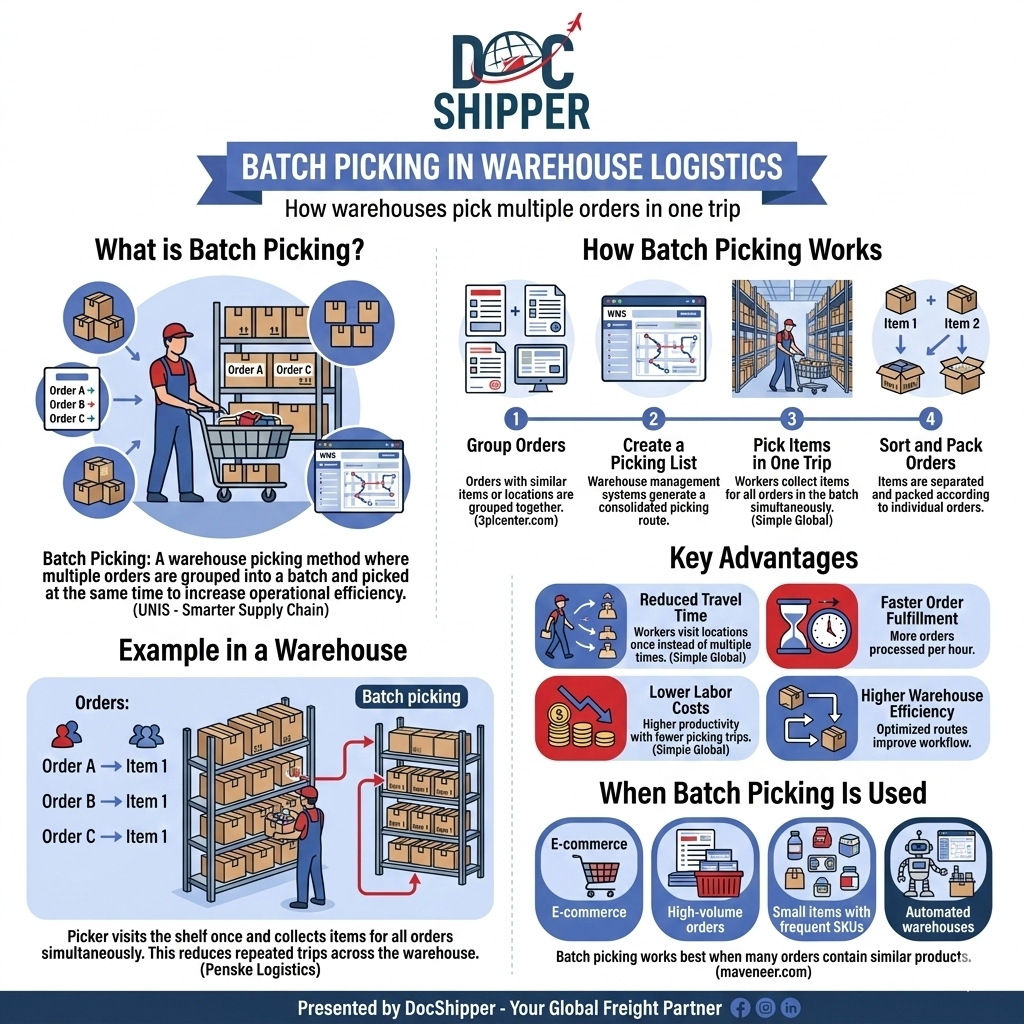
Batch picking is a warehouse order fulfillment strategy where multiple orders are picked simultaneously in a single trip through the warehouse. Instead of completing one order at a time, workers collect items for several orders together, significantly reducing travel time and increasing productivity in distribution centers and e-commerce operations.
Introduction
In modern warehousing, inefficient picking processes represent one of the costliest operational challenges. Workers spending excessive time walking between storage locations directly impacts order fulfillment speed and labor costs.
Batch picking addresses this critical bottleneck by consolidating multiple orders into coordinated picking routes. This methodology has become essential for businesses managing high-volume order fulfillment, particularly in e-commerce and third-party logistics environments.
Key characteristics of batch picking include:
- Multi-order consolidation: Grouping 5-20 orders per picking wave based on product location overlap
- Route optimization: Creating efficient paths through warehouse zones to minimize travel distance
- Sorting requirement: Post-picking separation of items into individual customer orders
- Productivity gains: Typical efficiency improvements of 30-50% compared to discrete picking
- Technology integration: Warehouse Management Systems (WMS) that automate batch creation and assignment
Batch Picking Methods & Operational Expertise
Implementing batch picking requires strategic selection among several proven methodologies. The zone batch picking approach divides the warehouse into designated areas, with workers assigned to specific zones collecting all items within their territory. This method works exceptionally well in large facilities exceeding 50,000 square feet.
The wave picking variation schedules batches at predetermined intervals throughout the day, allowing coordination with shipping schedules and carrier cutoff times. Organizations using wave picking typically align batch releases with outbound transportation windows.
Cluster picking represents the most advanced form, where workers simultaneously pick multiple orders using multi-compartment carts or totes. Each compartment corresponds to a specific order, eliminating post-picking sorting requirements. This method delivers maximum efficiency for operations handling 100+ daily orders with similar product profiles.
Critical success factors include inventory placement optimization, where fast-moving SKUs are positioned in accessible locations to minimize travel time. The order batching algorithm within your WMS must intelligently group orders based on product overlap, order priority, and delivery deadlines.
At DocShipper, we configure batch picking strategies aligned with client-specific warehouse layouts and order characteristics, ensuring optimal productivity from implementation day one. Regulatory compliance remains paramount—the Occupational Safety and Health Administration (OSHA) provides essential guidelines for warehouse picking operations to prevent worker injuries.
Concrete Examples & Performance Data
Real-world implementation data demonstrates the quantifiable impact of batch picking across various operational contexts. Consider these comparative scenarios:
| Picking Method | Orders/Hour | Travel Distance | Labor Cost/Order | Best Application |
|---|---|---|---|---|
| Discrete Picking | 25-35 | 1,200m/hour | $2.40 | Low volume, custom orders |
| Batch Picking | 60-80 | 450m/hour | $1.20 | E-commerce, retail distribution |
| Zone Batch Picking | 75-95 | 320m/hour | $0.95 | Large warehouses, diverse SKUs |
| Cluster Picking | 90-120 | 280m/hour | $0.75 | High-volume, similar products |
Case Study: A mid-sized e-commerce operation processing 800 daily orders transitioned from discrete to batch picking. Initial metrics showed workers completing 32 orders per hour with 1,150 meters average travel distance. After implementing zone batch picking with 8-order batches, productivity increased to 78 orders per hour while travel distance dropped to 340 meters—a 144% efficiency improvement.
The operation reduced picking labor costs from $19,200 monthly to $8,400, generating $129,600 annual savings. Implementation costs including WMS upgrades and worker training totaled $34,000, delivering ROI within 3.2 months.
Critical performance indicators for batch picking success:
- Pick rate: Target 60+ orders per labor hour for standard batch operations
- Accuracy rate: Maintain 99.5%+ picking accuracy through verification protocols
- Batch size optimization: 6-12 orders per batch balances efficiency with sorting complexity
- Order cycle time: Complete picking-to-packing within 45-90 minutes for same-day shipping
- Travel distance reduction: Achieve 60-70% decrease versus discrete picking methods
DocShipper Platform
One platform. Your entire supply chain
Sourcing, freight, customs & documents — all centralised, all visible, 24/7.
Conclusion
Batch picking transforms warehouse productivity by intelligently consolidating orders and minimizing unproductive travel time. Organizations implementing this methodology consistently achieve 40-150% efficiency gains while reducing per-order labor costs.
Need expert guidance optimizing your warehouse operations? Contact DocShipper for customized batch picking implementation strategies tailored to your specific operational requirements.
📚 Quiz
Test Your Knowledge: Batch Picking
Q1 — What best defines batch picking in a warehouse context?
Q2 — A warehouse manager claims that cluster picking still requires a post-picking sorting step to separate items into individual orders. Is this correct?
Q3 — A mid-sized e-commerce company processes 900 daily orders across a 60,000 sq ft warehouse. Which picking strategy would deliver the best efficiency?
🎯 Your Result
📞 Free Quote in 24hFAQ | Batch Picking: Definition, Methods & Concrete Examples
Batch picking groups multiple orders picked simultaneously, while wave picking schedules these batches at specific intervals throughout the day. Wave picking adds time-based coordination to the batch picking methodology, typically aligning with shipping schedules.
Optimal batch size ranges from 6-12 orders, balancing travel efficiency with post-picking sorting complexity. Smaller batches (4-6 orders) work better for diverse product catalogs, while larger batches (10-15 orders) suit operations with concentrated SKU overlap.
Facilities processing 100+ daily orders or warehouses exceeding 10,000 square feet typically benefit from batch picking. Smaller operations may not justify the WMS investment and sorting infrastructure required for effective implementation.
Manual batch picking is possible using paper-based systems, but efficiency gains remain limited to 20-30%. WMS automation enables intelligent order grouping, route optimization, and real-time inventory tracking that manual systems cannot replicate effectively.
Properly implemented batch picking maintains 99.5%+ accuracy rates through barcode scanning, verification checkpoints, and sorting validation. The risk of order mixing increases without proper technology controls and worker training protocols.
Cluster picking uses multi-compartment carts where each compartment represents one order, eliminating post-picking sorting. Standard batch picking collects all items together, requiring subsequent separation into individual orders before packing.
Complete implementation requires 4-8 weeks including WMS configuration, warehouse layout optimization, worker training, and process refinement. Organizations with existing WMS infrastructure can implement basic batch picking within 2-3 weeks.
Oversized items, temperature-controlled products requiring specialized handling, and high-value goods needing individual security protocols often perform better with discrete picking methods. Hazardous materials with regulatory separation requirements also present batch picking challenges.
Batch picking delivers both benefits simultaneously. Labor costs decrease 40-60% per order while individual worker productivity increases 50-100% through reduced travel time and optimized picking routes.
Batch picking complements goods-to-person systems, automated storage and retrieval systems (AS/RS), and robotic picking solutions. The methodology adapts to present multiple orders simultaneously to automated picking stations, maximizing equipment utilization.
Monitor orders per labor hour, picking accuracy rate, average travel distance per batch, order cycle time, and cost per order picked. These KPIs identify optimization opportunities and quantify operational improvements over time.
Advanced WMS platforms incorporate priority order handling within batch picking workflows. Rush orders either receive immediate discrete picking or join expedited batches with similar priority levels, maintaining both efficiency and service level commitments.
Need Help with
Logistics or Sourcing ?
First, we secure the right products from the right suppliers at the right price by managing the sourcing process from start to finish. Then, we simplify your shipping experience - from pickup to final delivery - ensuring any product, anywhere, is delivered at highly competitive prices.


Fill the Form
Prefer email? Send us your inquiry, and we’ll get back to you as soon as possible.
Contact us




