


In short ⚡
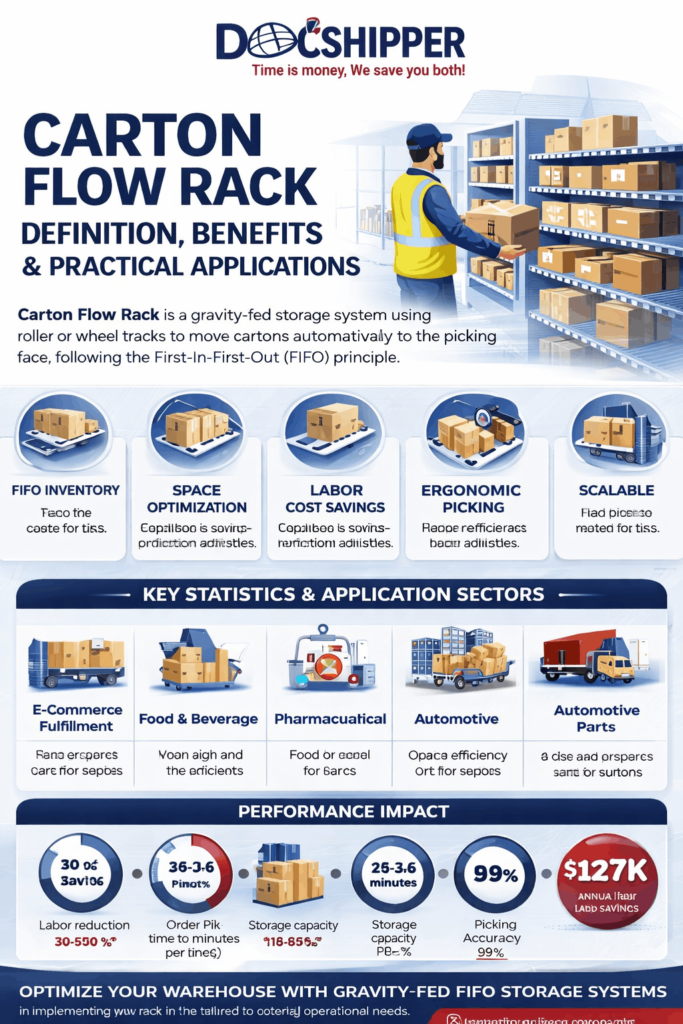
Carton Flow Rack is a gravity-fed storage system using inclined roller or wheel tracks to move cartons from loading to picking positions automatically. This FIFO (First-In-First-Out) solution optimizes warehouse space, reduces labor costs, and accelerates order fulfillment in distribution centers and manufacturing facilities.
Introduction
Warehouse managers constantly face the challenge of maximizing storage density while maintaining fast picking speeds. Traditional static shelving creates accessibility bottlenecks and inventory rotation problems.
Carton flow racks address these issues by combining dynamic storage with ergonomic design. These systems are essential for operations handling high-SKU volumes where inventory freshness and picking efficiency directly impact profitability.
- Gravity-powered operation eliminates energy costs for product movement
- FIFO inventory rotation prevents product expiration and obsolescence
- Space optimization increases storage density by 25-60% versus static shelving
- Ergonomic picking reduces worker fatigue through optimal product presentation
- Scalable configuration adapts to various carton sizes and throughput requirements
Technical Design & Operational Mechanisms
Carton flow racks utilize inclined roller lanes or wheel tracks positioned at 3-5 degree angles. Cartons slide forward under gravity as front units are removed, automatically replenishing the pick face without manual restocking.
The system architecture consists of structural frames supporting individual flow lanes. Each lane accommodates specific carton dimensions, with adjustable track spacing enabling multi-SKU configurations. Flow speed is controlled through brake mechanisms or speed controllers that prevent product damage from excessive velocity.
Load capacity varies by design, with standard systems handling 15-35 pounds per carton and heavy-duty versions supporting up to 75 pounds. Lane depth typically ranges from 4 to 20 cartons, balancing storage density with replenishment frequency requirements.
According to the Material Handling Industry (MHI), properly implemented carton flow systems reduce picking labor by 30-50% compared to traditional shelving. The elimination of travel time to multiple storage locations creates significant productivity gains.
At DocShipper, we design warehouse layouts incorporating carton flow racks to optimize our clients’ distribution operations. Our logistics engineers calculate precise lane configurations based on SKU velocity analysis and order profile data.
Installation considerations include structural load assessment, aisle width optimization, and integration with warehouse management systems. Modern implementations often feature pick-to-light technology and barcode scanning for enhanced accuracy.
Industry Applications & Performance Data
Carton flow racks deliver measurable improvements across diverse industries. E-commerce fulfillment centers achieve 40-60% faster pick rates, while food distribution operations ensure strict date code compliance through automated FIFO rotation.
Pharmaceutical warehouses utilize carton flow for temperature-sensitive products requiring rapid turnover. The reduced handling frequency minimizes exposure time outside controlled environments.
| Application Sector | Primary Benefit | Typical ROI Period | Space Efficiency Gain |
|---|---|---|---|
| E-commerce Fulfillment | Picking speed increase | 12-18 months | 35-50% |
| Food & Beverage Distribution | FIFO compliance | 18-24 months | 25-40% |
| Pharmaceutical Logistics | Temperature control | 15-20 months | 30-45% |
| Automotive Parts | Kitting efficiency | 20-30 months | 40-60% |
| Retail Replenishment | Labor reduction | 16-22 months | 30-50% |
Case Study: A mid-sized electronics distributor implemented carton flow racks across 12,000 square feet of warehouse space. Results after six months showed:
- Order picking time reduced from 4.2 to 2.6 minutes per line (38% improvement)
- Storage capacity increased by 42% without facility expansion
- Picking accuracy improved from 98.1% to 99.7%
- Labor costs decreased by $127,000 annually
- Product damage incidents reduced by 65%
The system paid for itself in 14 months through combined labor savings and space utilization gains. Maintenance requirements proved minimal, with quarterly roller inspections and annual bearing lubrication as primary needs.
Conclusion
Carton flow racks transform warehouse operations by combining gravity-powered efficiency with FIFO inventory management. The measurable improvements in picking speed, space utilization, and labor costs make these systems essential for competitive distribution operations.
Need expert guidance on implementing carton flow solutions in your logistics operations? Contact DocShipper for a customized warehouse optimization assessment.
📚 Quiz
Test Your Knowledge: Carton Flow Rack
1. What is the primary operating principle of a Carton Flow Rack system?
2. A food distributor needs to ensure that older stock is always picked before newer stock to avoid expiration. Which inventory rotation method does a Carton Flow Rack enforce by design?
3. An e-commerce warehouse manager wants to increase storage density without expanding the facility footprint. According to industry data, what space efficiency gain can Carton Flow Racks typically deliver compared to static shelving?
🎯 Your Result
📞 Free Quote in 24hFAQ | Carton Flow Rack: Definition, Benefits & Practical Applications
Standard systems accommodate cartons from 8x6x4 inches to 24x18x12 inches. Custom configurations handle larger dimensions up to 36x24x18 inches with reinforced structural support and specialized roller tracks.
Standard-duty lanes handle 15-35 pounds per carton with total lane capacities of 200-500 pounds. Heavy-duty systems support up to 75 pounds per carton and 1,000+ pounds per lane.
Yes, carton flow modules install directly into standard pallet rack beams. This hybrid approach maximizes vertical space by placing flow picking below pallet storage levels.
Quarterly visual inspections of rollers and tracks, annual bearing lubrication, and occasional brake adjustment. Well-maintained systems operate reliably for 15-20 years with minimal intervention.
Carton flow provides FIFO rotation and faster picking speeds, while push-back offers LIFO storage with higher density. Choose carton flow for date-sensitive products and high-pick operations.
A 50-lane system typically requires 3-5 days for installation by experienced technicians. Complex configurations with pick-to-light integration may extend to 7-10 days including system testing.
Most systems feature adjustable track spacing allowing lane width changes in 1-2 inch increments. Complete reconfiguration for significantly different carton sizes requires 2-4 hours per lane.
Compare current labor hours for picking and restocking against projected reductions (typically 30-50%). Factor space utilization gains and reduced product damage. Most operations achieve positive ROI within 12-24 months.
Speed controllers prevent carton collision, end stops secure products at pick face, and structural capacity ratings ensure load safety. Optional features include lane dividers and anti-tip mechanisms.
Specialized cold-storage versions use stainless steel construction and low-temperature lubricants. These systems operate reliably in temperatures down to -20°F while maintaining smooth flow characteristics.
A 100-lane system accommodates 100-300 SKUs depending on lane depth and replenishment frequency. High-velocity operations often dedicate multiple lanes to fast-moving SKUs for continuous availability.
Standard concrete floors supporting 250 PSF accommodate most configurations. Heavy-duty systems or multi-level structures may require 400+ PSF capacity. Professional structural assessment ensures compliance with building codes.
Need Help with
Logistics or Sourcing ?
First, we secure the right products from the right suppliers at the right price by managing the sourcing process from start to finish. Then, we simplify your shipping experience - from pickup to final delivery - ensuring any product, anywhere, is delivered at highly competitive prices.


Fill the Form
Prefer email? Send us your inquiry, and we’ll get back to you as soon as possible.
Contact us




