


In short ⚡
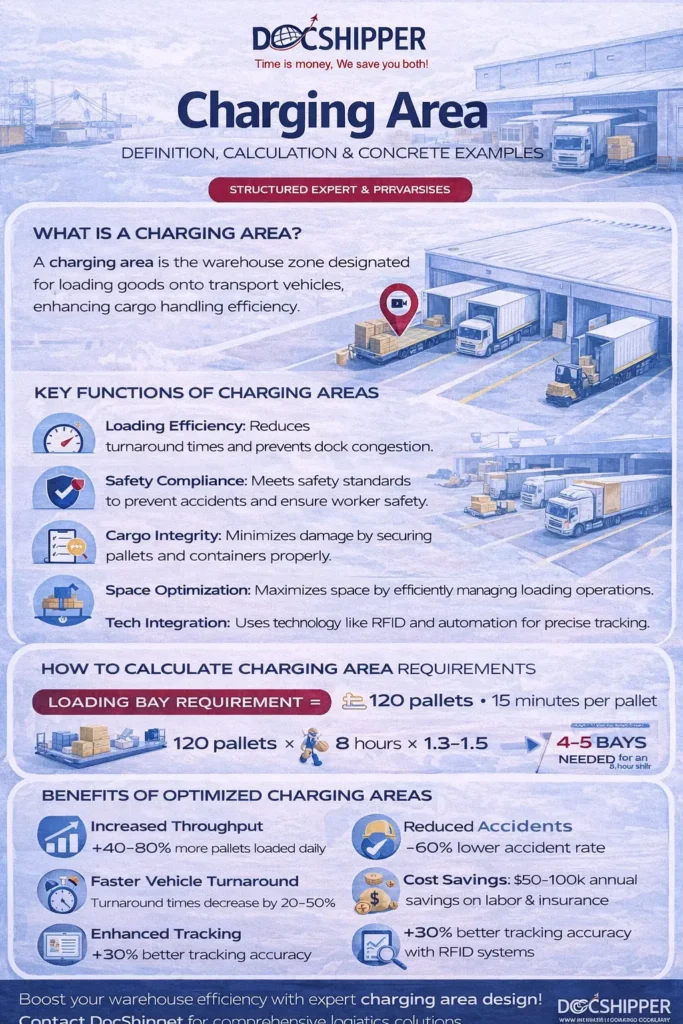
The charging area refers to the designated zone within a warehouse, distribution center, or terminal where goods are loaded onto transport vehicles. This critical operational space ensures efficient cargo handling, optimizes loading times, and maintains safety standards during the dispatch phase of the supply chain.
Introduction
Many logistics operators underestimate the strategic importance of charging areas, treating them merely as parking zones for trucks. This oversight leads to costly bottlenecks, damaged goods, and regulatory compliance issues. In international trade, where timing directly impacts profitability, the charging area serves as the final checkpoint before goods enter the transportation network.
Within the global supply chain, this zone bridges warehousing and distribution. Its efficiency determines whether shipments meet delivery windows, comply with safety regulations, and arrive intact. Understanding charging area optimization is essential for businesses managing import/export operations.
- Loading efficiency: Directly impacts vehicle turnaround times and fleet utilization rates
- Safety compliance: Must meet OSHA, EU, and local workplace safety standards
- Cargo integrity: Proper design prevents damage during the critical loading phase
- Space optimization: Maximizes warehouse throughput without expanding physical footprint
- Technology integration: Enables real-time tracking and automated loading systems
In-Depth Analysis & Operational Expertise
A properly designed charging area incorporates multiple functional zones. The staging zone holds palletized or containerized goods awaiting loading. The vehicle docking area provides secure access points with levelers and bumpers. The inspection corridor allows quality control before dispatch. The buffer zone separates pedestrian and vehicle traffic to prevent accidents.
Space calculation follows industry formulas based on throughput volume. The basic equation considers: daily shipment volume × average loading time ÷ operational hours × safety factor (typically 1.3–1.5). For example, a facility processing 120 pallets daily with 15-minute average loading times requires approximately 4–5 dedicated bays during an 8-hour shift.
Regulatory frameworks govern charging area design. The International Labour Organization (ILO) mandates minimum clearances between vehicles and structures. EU directive 89/391/EEC requires risk assessments for loading operations. The U.S. Department of Transportation enforces weight distribution standards affecting how charging areas accommodate different vehicle types. Compliance documentation is available through official channels like OSHA.gov.
Technology integration transforms traditional charging areas into smart logistics hubs. Dock scheduling systems eliminate wait times by coordinating arrivals. Automated guided vehicles (AGVs) move goods from storage to loading points. IoT sensors monitor weight distribution and cargo placement. RFID gates verify shipment accuracy before departure. These systems reduce human error and accelerate throughput.
At DocShipper, we conduct charging area audits for clients establishing new distribution centers. Our assessments identify layout inefficiencies, recommend equipment upgrades, and ensure compliance with destination country regulations. This proactive approach prevents costly operational delays once facilities go live.
Concrete Examples & Performance Data
Comparative analysis reveals significant performance variations across charging area configurations. The following data demonstrates how design choices impact operational metrics:
| Configuration Type | Average Loading Time | Daily Throughput (pallets) | Accident Rate |
|---|---|---|---|
| Traditional Open Bay | 22 minutes | 85 pallets/bay | 4.2 incidents/year |
| Enclosed Dock with Levelers | 16 minutes | 120 pallets/bay | 1.8 incidents/year |
| Automated Smart Dock | 11 minutes | 165 pallets/bay | 0.3 incidents/year |
Use Case: A European electronics distributor reduced loading errors by 73% after redesigning their charging area. The facility implemented color-coded zones, installed overhead LED guidance systems, and separated inbound/outbound traffic flows. Vehicle dwell time dropped from 45 minutes to 18 minutes, increasing daily shipment capacity from 280 to 520 pallets without adding staff.
Climate considerations significantly affect charging area design. Facilities in tropical regions require covered loading bays to protect temperature-sensitive goods. Cold-chain operations need insulated transition zones maintaining 2–8°C. Desert climates demand dust suppression systems preventing contamination. These environmental adaptations add 15–30% to construction costs but prevent cargo damage worth multiples of that investment.
Cost-benefit analysis shows that optimized charging areas deliver measurable ROI. A mid-sized warehouse investing $180,000 in dock levelers, traffic management systems, and safety equipment typically recovers costs within 14 months through reduced labor hours, lower insurance premiums, and decreased damage claims. The efficiency gains compound over time as throughput increases without proportional staffing increases.
Real-world data from port terminals demonstrates seasonal variations. Peak periods (Q4 for retail, pre-harvest for agriculture) see charging area utilization rates exceeding 95%. Facilities without flexible expansion capacity experience 8–12 hour truck queues, generating detention fees averaging $75–$150 per hour. Strategic charging area design incorporates temporary expansion zones activated during predictable demand spikes.
Conclusion
The charging area represents far more than a loading zone—it’s a critical operational nexus where warehouse efficiency meets transportation logistics. Proper design, regulatory compliance, and technology integration directly determine supply chain velocity and cargo integrity.
Need expert guidance on optimizing your charging area or designing a new facility? Contact DocShipper for a comprehensive assessment tailored to your specific import/export requirements.
📚 Quiz
Test Your Knowledge: Charging Area
Q1 — What is the primary purpose of a charging area in a logistics facility?
Q2 — A warehouse manager wants to use the charging area for storing overflow inventory for several days. Is this an acceptable practice?
Q3 — A mid-sized facility ships 200 pallets per day with an average loading time of 15 minutes over an 8-hour shift. Which approach best estimates the number of bays required?
🎯 Your Result
📞 Free Quote in 24hFAQ | Charging Area: Definition, Calculation & Concrete Examples
Minimum dimensions depend on vehicle types served. Standard truck bays require 12×60 feet, while container loading needs 14×70 feet. Add 20% buffer space for safety compliance and maneuvering.
Charging areas focus on outbound shipments and loading operations, while receiving docks handle inbound goods and unloading. Many facilities separate these zones to prevent cross-contamination and optimize workflow.
Required equipment includes dock levelers, wheel chocks, high-visibility markings, emergency stop buttons, and adequate lighting (minimum 50 foot-candles). Specific requirements vary by jurisdiction and cargo type.
Temporary staging (under 4 hours) is acceptable, but prolonged storage blocks loading operations and violates fire codes in most jurisdictions. Dedicated buffer zones should handle overflow inventory.
Hot climates require ventilation and sun protection. Cold regions need heated docks and ice prevention systems. Humid environments demand moisture control to protect cargo. Design must match local climate extremes.
Most facilities see 12–18 month payback periods through reduced labor costs, fewer accidents, and increased throughput. Automated systems may extend to 24–30 months but deliver higher long-term efficiency gains.
Calculate using: (daily shipments × average load time) ÷ (operating hours × 60). Add 30% capacity buffer. A facility shipping 200 pallets daily typically needs 5–7 bays for smooth operations.
Yes. Hazmat loading requires segregated zones, specialized ventilation, emergency wash stations, and spill containment systems. Compliance follows DOT, IATA, and IMDG codes depending on transport mode.
Dock scheduling software, RFID verification systems, automated levelers, IoT weight sensors, and real-time tracking dashboards reduce errors and accelerate loading by 35–50% compared to manual processes.
Properly designed charging areas facilitate pre-departure inspections, reducing customs delays. Segregated zones for export documentation review and last-minute compliance checks prevent shipment rejections at borders.
Yes, though structural limitations may apply. Retrofits typically focus on leveler installation, traffic flow redesign, and technology integration. Costs range from $50,000–$200,000 per bay depending on existing infrastructure.
Frequent issues include inadequate staging space, poor vehicle scheduling, incompatible dock heights, insufficient equipment (forklifts, pallet jacks), and lack of real-time communication between warehouse and transportation teams.
Need Help with
Logistics or Sourcing ?
First, we secure the right products from the right suppliers at the right price by managing the sourcing process from start to finish. Then, we simplify your shipping experience - from pickup to final delivery - ensuring any product, anywhere, is delivered at highly competitive prices.


Fill the Form
Prefer email? Send us your inquiry, and we’ll get back to you as soon as possible.
Contact us




