


In short ⚡
Cargo Preference is a legislative framework requiring that a portion of government-financed cargo be transported on vessels flagged under the nation's registry. This protectionist policy ensures domestic maritime industry support while affecting shipping costs, routing decisions, and compliance obligations in international trade operations.Introduction
Many importers and exporters encounter unexpected shipping constraints when dealing with government-funded cargo. The confusion often arises when standard freight quotes suddenly become invalid due to Cargo Preference regulations.
This concept plays a critical role in international logistics, particularly for shipments involving public sector financing. Understanding these requirements prevents costly delays, contract violations, and compliance penalties in cross-border operations.
- Mandatory compliance: Applies to government-financed or subsidized cargo movements
- Flag requirements: Specifies minimum percentages for national-flagged vessels
- Cost implications: Typically increases freight rates by 15-40% compared to open market
- Documentation obligations: Requires specific certifications and reporting procedures
- Global variations: Different countries maintain distinct cargo preference frameworks
In-Depth Analysis & Expertise
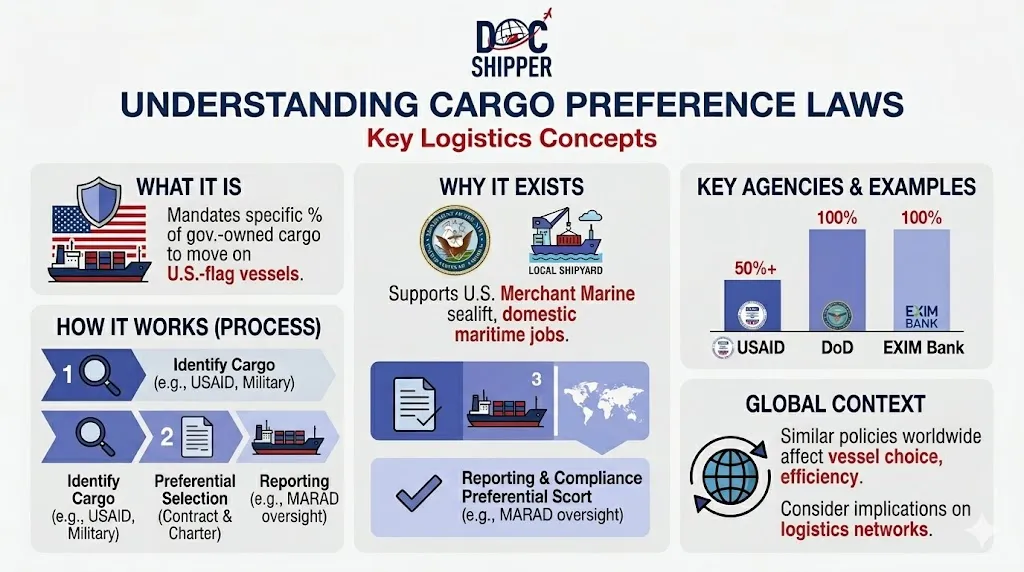
The U.S. Cargo Preference Act represents the most extensive implementation globally, mandating that at least 50% of certain government-impelled cargo travels on U.S.-flagged commercial vessels. This legislation affects military shipments, food aid programs, and Export-Import Bank financed goods.
Three primary categories define cargo preference applicability: military cargo (100% requirement under the Cargo Preference Act of 1904), civilian agency cargo (50% under the Cargo Preference Act of 1954), and food aid shipments (50% under the Food Security Act). Each category maintains distinct enforcement mechanisms and exemption procedures.
The Maritime Administration (MARAD) oversees compliance through the Transportation Institute’s reporting system. Shippers must submit detailed voyage data, cargo descriptions, and freight payment documentation within prescribed timeframes. Non-compliance triggers penalties ranging from contract termination to financial sanctions.
European Union regulations approach cargo preference differently through cabotage rules and state aid frameworks rather than explicit preference mandates. However, member states may implement national policies favoring domestic fleets for publicly funded projects, creating similar practical effects.
At DocShipper, we systematically verify cargo preference applicability during quotation stages, ensuring clients receive accurate cost projections and compliance guidance before contract execution. Our team coordinates directly with approved carriers to streamline documentation and avoid regulatory complications.
The financial impact stems from limited vessel availability, higher operating costs of flag-state fleets, and administrative overhead. A comprehensive analysis by the U.S. Maritime Administration indicates preference requirements add $50-150 million annually to federal shipping expenditures.
Concrete Examples & Data
Consider a practical scenario: A development agency finances $2 million in agricultural equipment destined for East Africa. Without cargo preference, ocean freight costs approximately $120,000 using open-market carriers. Under U.S. Cargo Preference requirements, the same shipment increases to $165,000-180,000 due to mandated flag-vessel usage.
| Cargo Type | Preference Requirement | Typical Cost Increase | Lead Time Impact |
|---|---|---|---|
| Military Equipment | 100% U.S. Flag | 35-50% | +7-14 days |
| Food Aid (P.L. 480) | 50% U.S. Flag | 25-40% | +5-10 days |
| EXIM Bank Financed | 50% U.S. Flag | 20-35% | +3-7 days |
| USAID Development | 50% U.S. Flag | 30-45% | +6-12 days |
| Commercial (No Gov. Funding) | None | Baseline | Standard |
Use Case Analysis: A renewable energy project receives $5 million in EXIM Bank financing for turbine components (total cargo value: $8 million). The cargo preference calculation applies to the financed portion: $5M ÷ $8M = 62.5% of cargo volume. Therefore, 50% of this 62.5% (31.25% of total shipment) must travel on U.S.-flagged vessels.
Key compliance factors impacting operational planning:
- Vessel availability: U.S.-flagged fleet comprises only 0.4% of global commercial vessels
- Route limitations: Flag carriers may not service all destination ports directly
- Documentation timeline: Preference waivers require 45-60 days for MARAD approval
- Insurance considerations: Flag requirements may affect coverage terms and premiums
- Multimodal complexity: Inland and last-mile segments remain unaffected by maritime preference
Recent data from the Transportation Institute shows that in fiscal year 2023, cargo preference laws generated approximately 12,000 U.S. maritime jobs and sustained $3.1 billion in economic activity, while adding $147 million to federal program costs.
Conclusion
Cargo Preference regulations fundamentally alter shipping economics and logistics planning for government-related cargo. Understanding these requirements early in the procurement process prevents budget overruns and ensures regulatory compliance.
Need expert guidance on cargo preference compliance for your shipments? Contact DocShipper for specialized support in navigating these complex requirements.
📚 Quizz
Test Your Knowledge: Cargo Preference
Q1 — What does Cargo Preference legislation primarily require?
Q2 — Under U.S. Cargo Preference law, what percentage of U.S.-flagged vessels must carry military equipment?
Q3 — A USAID-funded shipment of medical supplies is being arranged. Which statement correctly describes the cargo preference compliance situation?
🎯 Your Result
📞 Free Quote in 24hFAQ | Cargo Preference: Definition, Calculation & Concrete Examples
Cargo preference applies when U.S. government agencies finance, guarantee, insure, or subsidize ocean shipments. This includes direct purchases, grant programs, loan guarantees, and food aid initiatives administered by federal entities.
Yes, MARAD may grant waivers when insufficient U.S.-flagged vessels are available, when costs become prohibitive (typically exceeding 20% premium), or when national security interests require expedited delivery through alternative carriers.
The calculation uses cargo tonnage, not value. For mixed shipments, preference applies proportionally to the government-financed portion. Freight forwarders must document the calculation methodology in compliance filings.
No, current U.S. cargo preference statutes specifically address ocean transportation. Air cargo remains exempt, though separate regulations govern military air transport contracts through the Civil Reserve Air Fleet program.
Violations may result in contract termination, suspension from future government contracts, financial penalties up to three times the freight differential, and potential criminal charges for intentional misrepresentation of vessel eligibility.
Foreign vessels may carry the non-preference portion (remaining 50%) or the entire shipment if a valid waiver exists. However, vessels from certain countries face additional restrictions under bilateral trade agreements.
Preference-compliant vessels typically add 5-14 days to standard transit schedules due to limited sailing frequencies, indirect routing through hub ports, and fewer direct service options to secondary destinations.
Required records include vessel certifications, freight invoices, cargo manifests, government financing documentation, preference calculation worksheets, and proof of MARAD notification. Records must be retained for five years.
Generally no. The funding agency's budget must account for preference-related cost increases. Some grant programs provide supplemental allocations specifically for maritime compliance, but this varies by agency and program.
India's "Right of First Refusal" policy, Brazil's Merchant Marine Fund requirements, and various bilateral preference agreements create similar effects. Each jurisdiction maintains unique thresholds, vessel eligibility criteria, and enforcement mechanisms.
Yes, containerized cargo transported on U.S.-flagged container vessels fully satisfies preference obligations. The vessel's flag determines compliance, not the container ownership or leasing arrangements.
Forwarders must identify preference applicability, secure compliant vessel space, prepare required documentation, submit timely MARAD reports, and advise clients on cost implications. Non-compliance liability may extend to the forwarder depending on contractual terms.
Need Help with
Logistics or Sourcing ?
First, we secure the right products from the right suppliers at the right price by managing the sourcing process from start to finish. Then, we simplify your shipping experience - from pickup to final delivery - ensuring any product, anywhere, is delivered at highly competitive prices.


Fill the Form
Prefer email? Send us your inquiry, and we’ll get back to you as soon as possible.
Contact us




