


In short ⚡
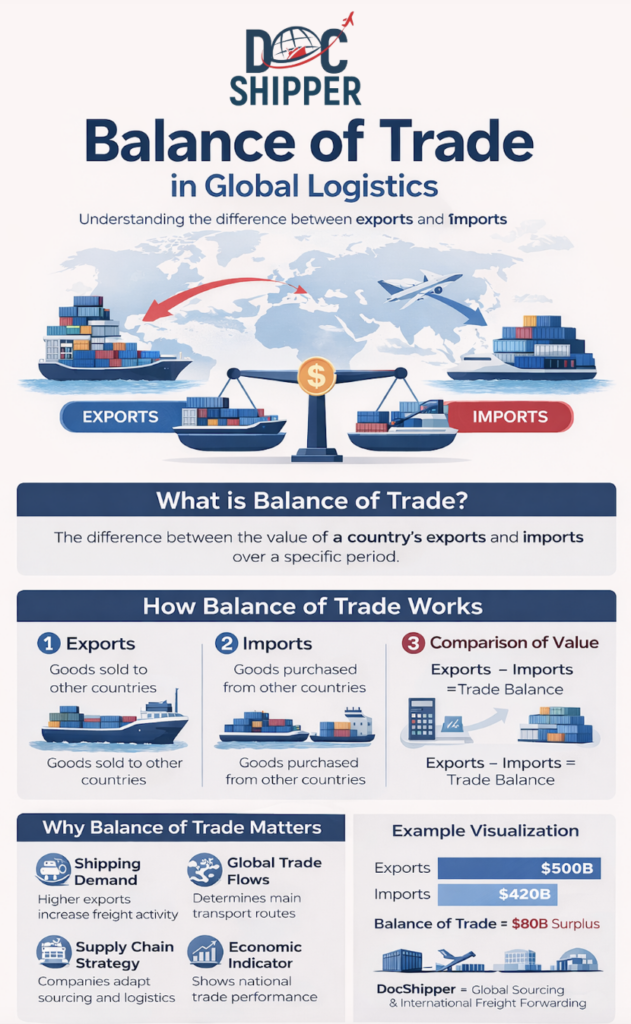
Balance of Trade is the difference between a country's total exports and imports of goods over a specific period. A positive balance (trade surplus) occurs when exports exceed imports, while a negative balance (trade deficit) indicates higher imports than exports. This metric serves as a fundamental indicator of economic competitiveness and international trade health.
Introduction
Many businesses misinterpret trade balances as simple win-lose scenarios. In reality, understanding your country’s balance of trade directly impacts sourcing strategies, currency risk management, and competitive positioning.
For companies engaged in international logistics, the balance of trade influences freight rates, customs regulations, and market access conditions. It shapes policy decisions that affect tariffs, quotas, and trade agreements.
Key characteristics of balance of trade include:
- Measurement scope: Covers only physical goods (merchandise), excluding services
- Time sensitivity: Calculated monthly, quarterly, or annually for trend analysis
- Currency impact: Persistent deficits or surpluses affect exchange rate stability
- Policy driver: Governments use this data to adjust trade and industrial policies
- Economic indicator: Reflects domestic production capacity versus consumption patterns
Mechanisms & Strategic Implications
The calculation formula is straightforward: Balance of Trade = Total Exports – Total Imports. However, interpretation requires understanding what drives these flows.
Structural factors determine long-term trade patterns. A country’s industrial base, natural resources, labor costs, and technological capabilities create comparative advantages. Germany maintains trade surpluses through advanced manufacturing, while resource-rich nations like Australia export raw materials.
Exchange rate dynamics create immediate effects. A weaker domestic currency makes exports cheaper for foreign buyers and imports more expensive domestically, potentially improving the trade balance. Conversely, a strong currency can worsen it by pricing exports out of competitive markets.
Regulatory frameworks shape trade flows significantly. Tariffs, quotas, and non-tariff barriers directly limit imports. Free trade agreements expand market access. According to World Trade Organization data, regional trade agreements have proliferated, creating preferential trading zones that alter traditional balance patterns.
Global supply chains complicate traditional interpretations. A smartphone “exported” from China contains components from dozens of countries. The full value counts as a Chinese export, even though China may add only 10-15% of the total value through assembly.
At DocShipper, we help clients navigate these complexities by analyzing how trade balance trends affect customs procedures, shipping routes, and regulatory requirements across different markets.
Concrete Examples & Data Analysis
Examining real-world trade balances reveals distinct patterns across economic models:
| Country | 2023 Trade Balance | Primary Drivers | Logistics Impact |
|---|---|---|---|
| China | +$823 billion surplus | Manufacturing dominance, electronics, machinery | High export container volumes, port congestion |
| United States | -$773 billion deficit | Consumer demand, energy imports (declining), manufacturing outsourcing | Import-focused infrastructure, return container imbalances |
| Germany | +$254 billion surplus | Automotive, machinery, chemical exports | Robust export logistics networks, Rhine River shipping |
| India | -$238 billion deficit | Energy imports, gold, electronics; offset by IT services (not in goods balance) | Growing import infrastructure, port modernization |
| Vietnam | +$28 billion surplus | Electronics assembly, textiles, FDI-driven manufacturing | Rapid port expansion, supply chain diversification hub |
Case Study: A European electronics retailer importing from Asia faces different scenarios based on trade balance conditions. When sourcing from China (surplus economy), they encounter competitive pricing but potential tariff risks as importing countries seek to protect domestic industries. Container availability favors exporters, but return logistics costs increase due to empty container repositioning.
Switching suppliers to Vietnam demonstrates how emerging surplus economies offer diversification. The retailer benefits from preferential trade agreements (EU-Vietnam FTA) while navigating less mature logistics infrastructure. DocShipper assists by coordinating multi-modal transport solutions that optimize cost despite infrastructure gaps.
Quantitative impact on logistics costs: Trade imbalances create container positioning inefficiencies. Routes from surplus to deficit countries see 30-40% higher freight rates during peak seasons compared to reverse routes. A 40ft container from Shanghai to Los Angeles costs $2,500-4,000, while the return journey drops to $800-1,200 due to equipment repositioning needs.
Currency risk illustration: A U.S. importer purchasing goods worth €100,000 from Germany faces exchange rate exposure. If the euro strengthens 5% against the dollar during the 90-day payment term, the effective cost increases by $5,000. Persistent trade deficits often correlate with currency depreciation, creating predictable hedging opportunities.
Policy response patterns: Countries with large deficits frequently impose anti-dumping duties or safeguard measures. Between 2018-2023, the U.S. implemented tariffs on $370 billion of Chinese imports, directly affecting landed costs and sourcing decisions for thousands of importers.
Conclusion
The balance of trade fundamentally shapes international logistics by influencing freight rates, regulatory environments, and currency stability. Understanding these dynamics enables strategic sourcing and risk management.
Need expert guidance navigating trade balance implications for your supply chain? Contact DocShipper for comprehensive logistics solutions tailored to your international trade requirements.
📚 Quiz
Test Your Knowledge: Balance of Trade
Q1 — What does the Balance of Trade specifically measure?
Q2 — India runs a large goods trade deficit, yet its IT and consulting exports are booming. Does this services revenue improve India's Balance of Trade figure?
Q3 — A freight forwarder notices that shipping a 40ft container from Shanghai to Los Angeles costs $3,500, while the return route costs only $1,000. What is the most likely explanation?
🎯 Your Result
📞 Free Quote in 24hFAQ | Balance of Trade: Definition, Calculation & Real-World Examples
Balance of trade measures only goods (merchandise) exports minus imports. Balance of payments is broader, including services, investment income, and financial transfers. Trade balance is one component of the current account within the balance of payments.
Not necessarily. Deficits can reflect strong consumer demand, capital investment in productivity, or currency strength attracting foreign goods. The U.S. has run deficits for decades while maintaining economic growth. Context and sustainability matter more than the sign.
Surplus countries export more containers than they import, creating equipment shortages for outbound shipments and surpluses at destination ports. This imbalance drives higher freight rates on export-heavy routes and requires repositioning of empty containers at carrier expense.
Yes, but services don't appear in the balance of trade calculation. The U.S. runs a substantial services surplus (financial, technology, consulting) that partially offsets its goods deficit in the broader current account. However, logistics professionals focus on goods trade since it drives physical shipping demand.
Monthly reports provide early signals of policy changes or market shifts. Quarterly data offers better trend analysis. Importers should track both their sourcing countries and destination markets to anticipate regulatory responses to persistent imbalances.
FTAs reduce tariffs and barriers, typically increasing bilateral trade volumes. They can shift trade balances by making partner countries more competitive. The USMCA, for example, altered North American trade flows by modifying automotive rules of origin and dairy access.
Tariffs aim to reduce imports and improve trade balances, but often trigger retaliation. The 2018-2019 U.S.-China trade war reduced bilateral trade volumes but shifted sourcing to third countries like Vietnam and Mexico rather than eliminating the U.S. deficit.
Commodity prices fluctuate dramatically. When oil prices drop, export revenues fall while import demand for consumer goods and machinery remains stable. Countries like Saudi Arabia experienced deficits during 2015-2016 when crude prices collapsed below $40/barrel.
Cross-border e-commerce creates millions of small-value shipments that customs agencies struggle to track accurately. De minimis thresholds (value limits exempt from duties) mean significant trade volumes bypass traditional reporting, potentially understating actual import values in official statistics.
Intentional devaluation makes exports cheaper and imports more expensive, theoretically improving the trade balance. However, the IMF and WTO monitor currency manipulation. Additionally, modern global supply chains mean devaluation increases costs for imported components, limiting effectiveness.
When a currency depreciates, the trade balance initially worsens (existing import contracts cost more) before improving as export volumes increase and import demand falls. This creates a J-shaped pattern over 12-18 months, complicating short-term policy assessments.
Countries with large deficits in specific product categories often increase inspection rates to combat undervaluation, mislabeling, or dumping. U.S. Customs intensified scrutiny of Chinese electronics and textiles during peak deficit periods, extending clearance times and increasing compliance costs for importers.
Need Help with Logistics or Sourcing ?
First, we secure the right products from the right suppliers at the right price by managing the sourcing process from start to finish. Then, we simplify your shipping experience - from pickup to final delivery - ensuring any product, anywhere, is delivered at highly competitive prices.


Fill the Form
Prefer email? Send us your inquiry, and we’ll get back to you as soon as possible.
Contact us


