


In short ⚡
Bonded Carrier Status is a U.S. Customs authorization allowing transportation companies to move goods under customs bond without immediate duty payment. This designation enables carriers to transport in-bond cargo between ports of entry, warehouses, and foreign trade zones while maintaining full accountability to CBP.
Introduction
Many importers face confusion when cargo arrives at one U.S. port but needs delivery to another location. Without proper authorization, this creates costly delays and compliance risks.
The Bonded Carrier Status solves this challenge by creating a secure transportation network. This designation is essential for efficient customs operations and multi-port logistics strategies.
- Legal authorization from U.S. Customs and Border Protection (CBP)
- Financial guarantee through surety bonds protecting government revenue
- Accountability system tracking cargo movements between customs-controlled locations
- Operational flexibility enabling cross-country in-bond transportation
- Compliance framework requiring strict record-keeping and reporting standards
Requirements & Regulatory Framework
Obtaining Bonded Carrier Status requires meeting stringent CBP criteria. The process involves financial, operational, and security qualifications that protect customs revenue.
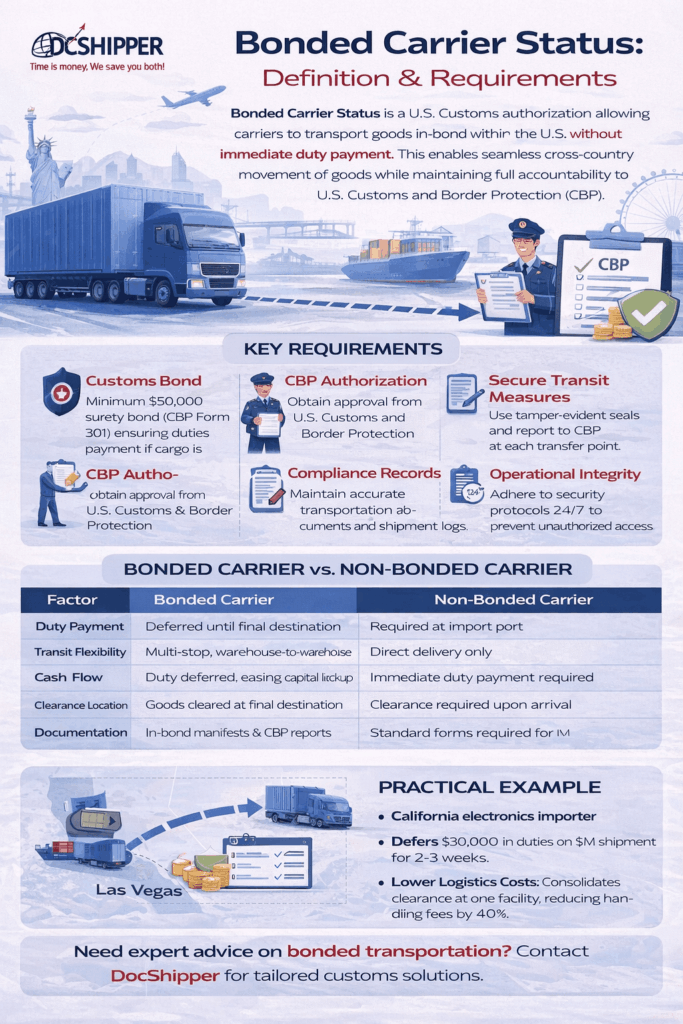
The primary requirement is a customs bond. Carriers must secure a continuous transportation bond (CBP Form 301) with minimum amounts determined by cargo volume. Standard bonds start at $50,000 but may reach millions for high-volume operators.
Application procedures demand submission of CBP Form 7512 (Transportation Entry and Manifest). Carriers must demonstrate established business operations, proper insurance coverage, and clean compliance history. Background checks verify corporate officers and key personnel.
Operational standards include maintaining approved routes, using sealed containers when required, and implementing tracking systems. Carriers must report to CBP at each transfer point and destination. At DocShipper, we work exclusively with bonded carriers to ensure seamless customs compliance throughout the transportation chain.
Security protocols mandate cargo integrity measures. This includes tamper-evident seals, GPS tracking for high-value shipments, and driver vetting procedures. Carriers must prevent unauthorized access during transit.
The regulatory framework falls under 19 CFR Part 18 and 19 CFR Part 113. These regulations define carrier responsibilities, bonding requirements, and penalty structures. Non-compliance can result in bond forfeiture, status revocation, or civil penalties. Additional information is available through the U.S. Customs and Border Protection official guidance.
Practical Applications & Case Studies
Understanding how Bonded Carrier Status functions in real scenarios clarifies its strategic value. These examples demonstrate cost savings and operational advantages.
Comparative Analysis: Bonded vs. Non-Bonded Transportation
| Factor | Bonded Carrier | Non-Bonded Carrier |
|---|---|---|
| Duty Payment | Deferred until final destination | Required at first port of entry |
| Transit Flexibility | Multiple stops, warehouse transfers | Direct delivery only |
| Cost Efficiency | Lower cash flow impact | Immediate duty payment burden |
| Customs Clearance | At optimal location | At arrival port |
| Documentation | In-bond paperwork required | Standard shipping documents |
Case Study: Electronics Importer
A California-based electronics distributor imports containers from Asia through the Port of Los Angeles. Their distribution center operates in Nevada, requiring inland transportation.
Scenario details: Monthly volume of 40 containers valued at $2 million total. Duty rate averages 3.5%, equating to $70,000 per month.
Bonded carrier advantage: Using bonded transportation defers the $70,000 duty payment until goods clear customs in Nevada. This preserves working capital for 15-30 days. Annual cash flow improvement exceeds $800,000.
Operational benefit: The company consolidates customs clearance at their Nevada facility, where specialized customs brokers handle electronics classifications efficiently. This reduces clearance time by 40% compared to port-side processing.
Key Operational Benefits
- Cash flow optimization — Duty deferral improves working capital management significantly
- Strategic clearance locations — Choose ports with favorable processing times or specialized expertise
- Consolidated operations — Clear multiple shipments simultaneously at distribution centers
- Foreign Trade Zone access — Bonded carriers enable FTZ transfers for additional duty benefits
- Supply chain flexibility — Adjust final destinations without customs complications
Conclusion
Bonded Carrier Status represents a critical infrastructure component for efficient U.S. import operations. This authorization enables cost-effective, flexible logistics while maintaining full customs compliance.
Need expert guidance on bonded transportation strategies? Contact DocShipper for comprehensive logistics support tailored to your import requirements.
📚 Quiz
Test Your Knowledge: Bonded Carrier Status
Q1 — What does Bonded Carrier Status primarily allow a transportation company to do?
Q2 — A common misconception is that any trucking company automatically qualifies as a bonded carrier. What does CBP actually require?
Q3 — A California electronics importer receives containers at the Port of Los Angeles but wants to clear customs at their Nevada distribution center. Which option correctly describes the bonded carrier advantage in this scenario?
🎯 Your Result
📞 Free Quote in 24hFAQ | Bonded Carrier Status: Definition, Requirements & Practical Examples
A bonded carrier transports goods under customs bond between locations. A customs broker handles import documentation and duty payments. Many importers use both services together for complete logistics solutions.
The application process typically requires 30-60 days after bond approval. CBP reviews business history, financial stability, and compliance records. Expedited processing may be available for established transportation companies.
Not automatically. Companies must meet CBP requirements including financial solvency, proper insurance, clean compliance history, and ability to post required bonds. Small carriers may find bonding costs prohibitive.
The bonded carrier remains liable under their customs bond. They must report incidents immediately to CBP and may face duty liability if cargo becomes unaccounted. Proper insurance coverage is essential.
Yes. Certain controlled substances, hazardous materials, and restricted goods require additional permits. Some high-risk commodities may be ineligible for in-bond transportation depending on CBP risk assessments.
In-bond transportation typically adds 1-3 days compared to direct delivery. However, strategic clearance location choices often reduce overall customs processing time, resulting in net time savings.
IT movements allow cargo to transfer from arrival port to another customs location without formal entry. This is the most common in-bond procedure, enabling efficient inland clearance operations.
Yes, through specific in-bond procedures called Transportation and Exportation (T&E) entries. These movements require additional documentation and coordination with destination country customs authorities.
Penalties range from monetary fines to bond forfeiture and status revocation. Serious violations may result in criminal charges. Typical fines start at $5,000 per incident and increase with severity.
Bonded carriers transport goods to bonded warehouses, where merchandise can be stored without duty payment. This combination enables sophisticated supply chain strategies including deferred duty programs.
Not universally mandated, but increasingly expected for high-value or sensitive cargo. CBP may require electronic tracking for specific shipments as part of risk management protocols.
Yes, if they obtain their own bonded carrier authorization. However, most importers find it more cost-effective to use established bonded carriers rather than managing compliance requirements internally.
Need Help with
Logistics or Sourcing ?
First, we secure the right products from the right suppliers at the right price by managing the sourcing process from start to finish. Then, we simplify your shipping experience - from pickup to final delivery - ensuring any product, anywhere, is delivered at highly competitive prices.


Fill the Form
Prefer email? Send us your inquiry, and we’ll get back to you as soon as possible.
Contact us




