


In short ⚡
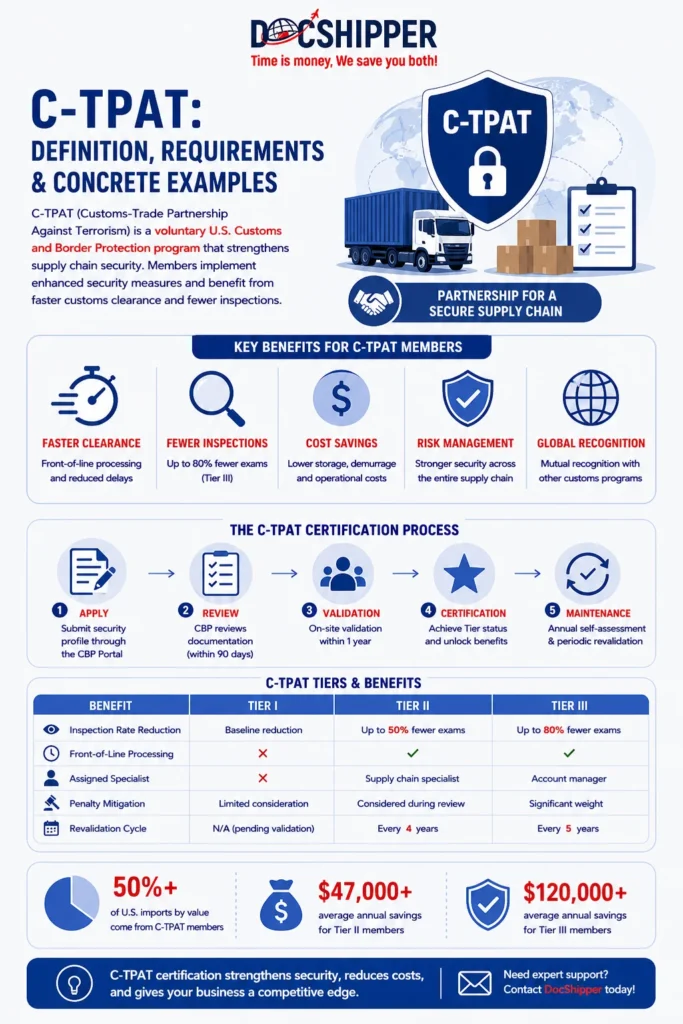
C-TPAT (Customs-Trade Partnership Against Terrorism) is a voluntary U.S. Customs and Border Protection program that strengthens supply chain security through partnership between CBP and private industry. Members commit to enhanced security measures in exchange for expedited customs processing and reduced inspections.Introduction
Many importers struggle with customs delays, unpredictable inspection rates, and mounting compliance costs. C-TPAT addresses these challenges by creating a trusted partnership framework between U.S. Customs and Border Protection and international trade stakeholders.
Launched in November 2001 following the 9/11 attacks, this program revolutionized supply chain security by shifting from reactive enforcement to proactive collaboration. Today, C-TPAT members account for over 50% of U.S. imports by value.
Key characteristics of C-TPAT include:
- Voluntary participation requiring documented security protocols across the entire supply chain
- Tiered certification levels (Tier I, II, III) based on validation depth and compliance history
- Risk-based approach focusing resources on high-risk shipments while expediting trusted traders
- Mutual recognition agreements with foreign customs administrations (EU AEO, Canada PIP, etc.)
- Continuous improvement requirement with periodic revalidation and self-assessment obligations
Program Structure & Requirements
C-TPAT operates through a structured certification process that evaluates companies across multiple security dimensions. The program divides participants into distinct categories including importers, carriers, brokers, consolidators, and manufacturers.
The application process begins with submission of a comprehensive security profile through the CBP Portal. Companies must document security procedures covering physical security, personnel security, procedural security, access controls, and information technology security. CBP reviews this documentation within 90 days of submission.
Upon acceptance, members enter Tier I status, receiving immediate benefits while awaiting validation. Within one year, CBP conducts an on-site validation to verify implementation of stated security measures. Successful validation elevates members to Tier II status, unlocking enhanced benefits and reduced examination rates.
The highest level, Tier III, requires three years of Tier II compliance, demonstrated supply chain security excellence, and validation of foreign business partners. These elite members receive maximum benefits including assignment of dedicated account managers and priority treatment during national emergencies.
According to U.S. Customs and Border Protection, members must conduct annual self-assessments and maintain documentation demonstrating continuous compliance. Revalidation occurs every four years for Tier II members and every five years for Tier III participants.
At DocShipper, we guide clients through the entire C-TPAT certification process, from initial security profile development to validation preparation, ensuring compliance while maximizing operational benefits.
Benefits & Data Analysis
C-TPAT membership delivers measurable advantages that directly impact bottom-line performance. CBP data demonstrates that certified members experience significantly lower examination rates compared to non-members, translating to faster cargo release and reduced demurrage costs.
| Benefit Category | Tier I | Tier II | Tier III |
|---|---|---|---|
| Inspection Rate Reduction | Baseline reduction | Up to 50% fewer exams | Up to 80% fewer exams |
| Front-of-Line Processing | Not available | Available | Priority access |
| Assigned Specialist | No | Supply chain specialist | Account manager |
| Penalty Mitigation | Limited consideration | Considered during review | Significant weight |
| Revalidation Cycle | N/A (pending validation) | Every 4 years | Every 5 years |
Quantifiable cost savings emerge from multiple sources. A 2023 industry survey revealed that Tier II members save an average of $47,000 annually through reduced examination-related costs, including storage fees, container repositioning, and delayed product launches. Tier III members report average annual savings exceeding $120,000.
Use Case Example: A mid-size electronics importer bringing 240 containers annually from Asia achieved Tier II certification in 2022. Prior to certification, they experienced a 12% examination rate, resulting in an average 4-day delay per inspected container and $1,850 in associated costs per incident. Post-certification, their examination rate dropped to 5%, saving approximately $29,600 annually in direct costs while improving inventory predictability.
Additional strategic advantages include enhanced corporate reputation, competitive differentiation in bid processes, and improved relationships with foreign suppliers who value partnership with certified importers. Many Fortune 500 companies now require C-TPAT certification from their logistics providers.
The program also offers mutual recognition benefits through agreements with equivalent programs in Canada, the European Union, Japan, South Korea, and other trading partners. These agreements enable streamlined processing across multiple jurisdictions, creating compounding efficiency gains for global supply chains.
Conclusion
C-TPAT represents a strategic investment in supply chain resilience, regulatory compliance, and operational efficiency. The program’s structured approach to security creates measurable value through reduced inspections, faster clearance times, and enhanced business credibility.
Need guidance on C-TPAT certification or supply chain security optimization? Contact DocShipper for expert support tailored to your international trade requirements.
📚 Quiz
Test Your Knowledge: C-TPAT
1. What is C-TPAT?
2. A logistics manager believes that achieving C-TPAT Tier III status is possible within the first year of joining the program. Is this correct?
3. A mid-size electronics importer achieves C-TPAT Tier II certification. Which of the following outcomes best reflects what they can realistically expect?
🎯 Your Result
📞 Free Quote in 24hFAQ | C-TPAT: Definition, Requirements & Concrete Examples
U.S. importers, carriers (sea, air, rail, highway), brokers, forwarders, consolidators, manufacturers, and foreign manufacturers shipping to the U.S. can apply. Companies must have a valid IRS number or CBP-assigned number and demonstrate adequate security measures.
Initial application review takes approximately 90 days. After acceptance into Tier I, on-site validation typically occurs within 12 months. Total time to achieve Tier II certification averages 15-18 months from initial application submission.
There is no application fee or annual membership cost charged by CBP. However, companies incur internal costs for security enhancements, documentation development, staff training, and compliance maintenance, typically ranging from $15,000 to $75,000 depending on company size and existing security infrastructure.
Yes. CBP may suspend or remove members for non-compliance, security breaches, criminal activity, or failure to complete revalidation. Members receive notification and opportunity to address deficiencies before final removal decisions are made.
C-TPAT is specific to U.S. Customs, while AEO is the European Union equivalent. Both programs share similar security principles and maintain mutual recognition agreements, allowing certified members to receive benefits in both jurisdictions under reciprocal arrangements.
Required documentation includes written security procedures, organizational charts, facility layouts, personnel screening protocols, access control measures, IT security policies, incident response plans, and business partner security requirements. All documents must demonstrate comprehensive supply chain security coverage.
Absolutely. Small importers often see proportionally greater benefits due to their limited ability to absorb delays and inspection costs. The program levels the playing field by providing the same reduced examination rates regardless of company size.
CBP Supply Chain Security Specialists conduct on-site reviews lasting 1-3 days, examining physical facilities, interviewing personnel, reviewing documentation, and assessing implementation of stated security measures. They provide a validation report identifying strengths and areas requiring improvement.
These agreements allow C-TPAT members to receive preferential treatment from foreign customs authorities without separate certification. For example, C-TPAT members may receive expedited processing in EU countries through the U.S.-EU mutual recognition arrangement established in 2012.
Members must conduct annual comprehensive reviews of their security programs, documenting compliance with C-TPAT minimum security criteria. Self-assessments must be completed using CBP's online portal and include updates on security incidents, procedural changes, and continuous improvement initiatives.
Yes, through the Foreign Manufacturer category. These companies must ship goods directly to U.S. importers and demonstrate security measures throughout their production and shipping processes. They receive certification but cannot sponsor other entities.
C-TPAT membership does not exempt companies from Importer Security Filing (ISF) requirements. However, certified members may receive more lenient treatment for minor ISF violations, and their overall compliance history carries weight in penalty mitigation considerations.
Need Help with
Logistics or Sourcing ?
First, we secure the right products from the right suppliers at the right price by managing the sourcing process from start to finish. Then, we simplify your shipping experience - from pickup to final delivery - ensuring any product, anywhere, is delivered at highly competitive prices.


Fill the Form
Prefer email? Send us your inquiry, and we’ll get back to you as soon as possible.
Contact us




