


In short ⚡
Demand Signal refers to any data point or indicator that reflects customer purchasing behavior, inventory movement, or market trends, enabling businesses to anticipate future product demand. These signals help optimize supply chain operations, reduce stockouts, and improve forecasting accuracy across international logistics networks.
Introduction
Many importers struggle with a common challenge: ordering too much inventory that sits unsold or too little that causes stockouts. This disconnect stems from poor interpretation of demand signals—the critical indicators that reveal what customers actually want to buy.
In international trade and logistics, understanding demand signals transforms reactive purchasing into strategic supply chain planning. These indicators bridge the gap between production facilities overseas and consumer markets, enabling businesses to synchronize global operations with real market needs.
Key characteristics of effective demand signal systems include:
- Real-time visibility into point-of-sale data and inventory levels
- Predictive analytics that identify emerging trends before competitors
- Cross-channel integration combining online, retail, and B2B signals
- Granular segmentation by product, region, and customer type
- Actionable insights that directly inform purchasing and shipping decisions
Understanding Demand Signals in Supply Chain Management
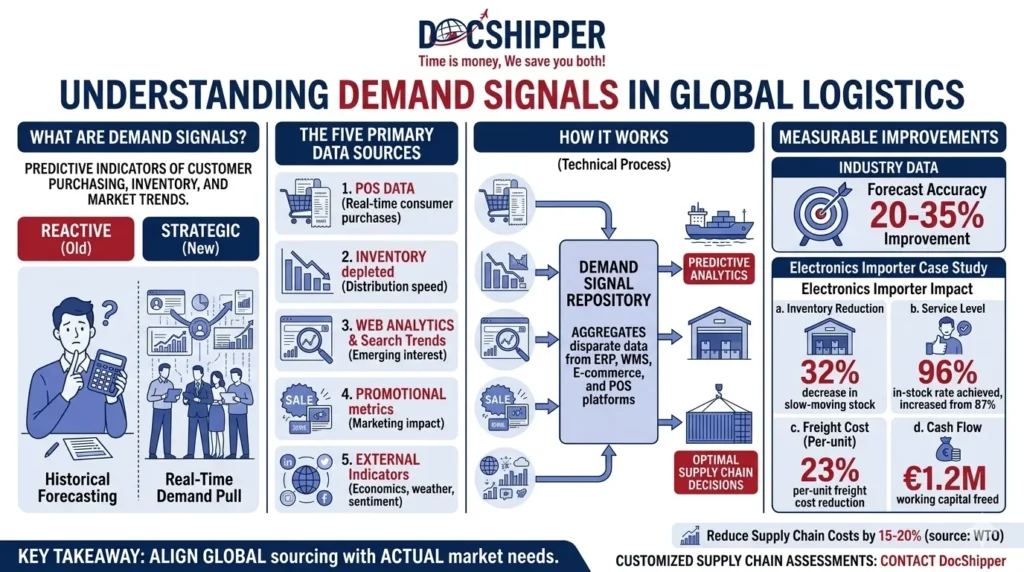
Demand signals operate as the nervous system of modern supply chains. Unlike traditional forecasting that relies on historical sales patterns, demand signal repositories aggregate multiple data streams to create a comprehensive view of market dynamics.
The most valuable demand signals originate from five primary sources. Point-of-sale data captures actual consumer purchases in real-time, providing the purest indicator of demand. Inventory depletion rates reveal how quickly products move through distribution channels. Web analytics and search trends expose emerging interest before purchases occur. Promotional response metrics measure how pricing and marketing affect buying behavior. Finally, external market indicators such as economic data, weather patterns, and social media sentiment add contextual depth.
The technical infrastructure supporting demand signal management involves data integration platforms that connect disparate systems—ERP, WMS, e-commerce platforms, and retail POS systems. Advanced implementations utilize machine learning algorithms to identify patterns humans might miss, such as correlations between seemingly unrelated products or seasonal shifts occurring earlier than historical norms.
From a regulatory and operational perspective, demand signal accuracy directly impacts customs compliance and documentation. Accurate forecasting ensures proper HS code classification volumes, reduces the risk of undervalued declarations, and optimizes duty drawback opportunities. According to the World Trade Organization, companies with sophisticated demand planning reduce supply chain costs by 15-20% while improving service levels.
At DocShipper, we integrate demand signal analysis into our freight forwarding services, helping clients optimize container utilization and shipping frequencies based on actual market pull rather than arbitrary schedules. This approach minimizes warehousing costs while ensuring product availability during peak demand periods.
Practical Applications & Data-Driven Insights
Understanding demand signals theoretically differs vastly from applying them operationally. The following comparative analysis demonstrates how different signal types influence international logistics decisions:
| Signal Type | Lead Time Impact | Accuracy Range | Best Application |
|---|---|---|---|
| POS Data | 1-2 weeks | 85-95% | Short-term replenishment |
| Search Trends | 4-8 weeks | 70-80% | New product launches |
| Seasonal Patterns | 12-16 weeks | 75-85% | Ocean freight planning |
| Economic Indicators | 20-26 weeks | 60-75% | Strategic capacity planning |
Use Case: Electronics Importer Optimization
A European electronics distributor importing from Southeast Asia faced chronic overstocking of certain SKUs while experiencing stockouts on others. By implementing a demand signal repository combining retailer POS data, Google Trends analysis, and social media sentiment tracking, they achieved measurable improvements:
- Inventory reduction: 32% decrease in slow-moving stock within six months
- Service level improvement: In-stock rate increased from 87% to 96%
- Shipping optimization: Consolidated weekly LCL shipments into bi-weekly FCL containers, reducing per-unit freight costs by 23%
- Cash flow impact: Working capital requirements dropped by €1.2M through better inventory turnover
- Customs efficiency: Pre-classification accuracy improved, reducing clearance delays by 40%
The implementation revealed that promotional signals required the shortest response time—air freight was justified for products showing sudden search volume spikes, while stable demand patterns suited economical ocean freight with 45-day lead times.
Industry data shows companies leveraging advanced demand signals achieve forecast accuracy improvements of 20-35% compared to traditional statistical methods. This translates directly to reduced safety stock requirements, fewer expedited shipments, and optimized container utilization—all critical factors in international logistics profitability.
Conclusion
Demand signals represent the fundamental intelligence layer that separates reactive logistics from strategic supply chain management. Mastering their interpretation enables importers to align global sourcing with actual market needs, reducing waste while improving customer satisfaction.
Need expert guidance on integrating demand signal analysis into your international logistics strategy? Contact DocShipper for a customized supply chain assessment.
📚 Quiz
Test Your Knowledge: Demand Signal
Q1 — What is a demand signal in supply chain management?
Q2 — A common misconception is that demand signals and demand forecasting are the same thing. What is the key difference?
Q3 — An importer notices a sudden spike in search volume for a product with no prior sales history. Based on demand signal best practices, what is the most appropriate logistics response?
🎯 Your Result
📞 Free Quote in 24hFAQ | Demand Signal: Definition, Analysis & Practical Examples
Demand signals are real-time data inputs (POS sales, web traffic, inventory levels), while demand forecasting uses these signals combined with algorithms to predict future demand. Signals are raw indicators; forecasting is the analytical output.
Response times vary by signal type. Point-of-sale data can trigger replenishment orders within 24-48 hours, while seasonal trend signals inform decisions 12-16 weeks in advance for ocean freight planning.
Retailer POS data and distributor inventory depletion rates offer 85-95% accuracy for short-term planning. For longer horizons, combining seasonal patterns with economic indicators provides the best predictive value.
Absolutely. Cloud-based platforms now offer affordable demand signal repositories accessible to SMEs. Even basic POS integration and Google Trends monitoring significantly improve forecasting accuracy without major IT investment.
Accurate demand forecasting ensures proper commercial invoice valuations, correct HS code quantities, and optimized duty payment timing. This reduces examination rates and speeds customs clearance processes.
Machine learning algorithms identify non-obvious correlations between signals, detect anomalies in real-time, and automatically adjust forecasts based on emerging patterns—capabilities impossible with manual analysis.
Critical signals like POS data require daily monitoring. Strategic signals such as economic indicators can be reviewed monthly. The key is establishing automated alerts for significant deviations from expected patterns.
Yes, though differently. Pre-launch signals focus on search trends, competitor product performance, and market research data rather than historical sales. Social media sentiment analysis becomes particularly valuable.
Relying on a single signal source. Effective demand planning requires triangulating multiple indicators—POS data, inventory levels, external trends—to filter noise and identify genuine demand shifts.
Strong, sustained signals justify economical ocean freight. Sudden spikes or time-sensitive trends warrant air freight despite higher costs. Signal strength and velocity determine the optimal logistics response.
They provide early warning systems. Unusual signal patterns—like sudden inventory accumulation or search volume drops—alert managers to potential issues before they cascade into major disruptions.
Retailers and suppliers must establish clear data-sharing agreements protecting competitive information while enabling collaborative planning. GDPR and similar regulations govern consumer-level data usage in demand signal systems.
Need Help with
Logistics or Sourcing ?
First, we secure the right products from the right suppliers at the right price by managing the sourcing process from start to finish. Then, we simplify your shipping experience - from pickup to final delivery - ensuring any product, anywhere, is delivered at highly competitive prices.


Fill the Form
Prefer email? Send us your inquiry, and we’ll get back to you as soon as possible.
Contact us




