


In short ⚡
Demand Supply Balancing is the strategic process of aligning production capacity, inventory levels, and procurement schedules with actual customer demand to minimize costs while maximizing service levels. This critical supply chain function prevents stockouts, reduces excess inventory, and optimizes working capital across global logistics networks.Introduction
Companies lose billions annually due to poor demand-supply alignment. Overstocking ties up capital, while understocking triggers lost sales and damaged customer relationships. In international trade, these imbalances amplify through longer lead times and complex customs procedures.
Demand Supply Balancing forms the backbone of efficient import/export operations. It determines when to order, how much to ship, and where to position inventory across borders. For businesses managing global supply chains, mastering this discipline directly impacts profitability and competitiveness.
- Forecast accuracy: Statistical models predict future demand patterns based on historical data and market signals
- Inventory optimization: Calculates safety stock levels considering lead time variability and service targets
- Production planning: Synchronizes manufacturing schedules with demand fluctuations and capacity constraints
- Distribution strategy: Positions stock geographically to minimize delivery times and transportation costs
- Supplier coordination: Aligns procurement cycles with consumption rates to maintain flow continuity
Mechanisms & Strategic Expertise
Effective Demand Supply Balancing requires integrating multiple data streams. Sales forecasting combines statistical algorithms with market intelligence to predict future requirements. Companies typically use time-series analysis, regression models, or machine learning to process historical patterns, seasonality, and external variables.
The S&OP process (Sales and Operations Planning) brings cross-functional teams together monthly to reconcile demand forecasts with supply capabilities. This collaborative framework ensures finance, sales, operations, and procurement work toward unified targets rather than conflicting departmental goals.
Safety stock calculation protects against uncertainty. The formula considers demand variability and lead time fluctuations: Safety Stock = Z × σ × √LT, where Z represents the desired service level, σ is demand standard deviation, and LT is lead time. International shipments require higher safety buffers due to customs delays and longer transit periods.
Advanced Planning Systems (APS) automate complex optimization scenarios. These platforms simulate thousands of supply chain configurations simultaneously, recommending optimal production schedules, inventory positions, and transportation modes. Integration with ERP systems ensures real-time data accuracy across the planning cycle.
At DocShipper, we help clients synchronize their international procurement with demand patterns by providing visibility across the entire logistics chain, from factory readiness to final delivery, enabling more accurate lead time planning.
Regulatory compliance adds complexity to international balancing. Customs regulations vary by country, affecting clearance times and inventory availability. The World Customs Organization provides frameworks for harmonized procedures, but importers must still navigate specific national requirements that impact supply timing.
Concrete Examples & Data Analysis
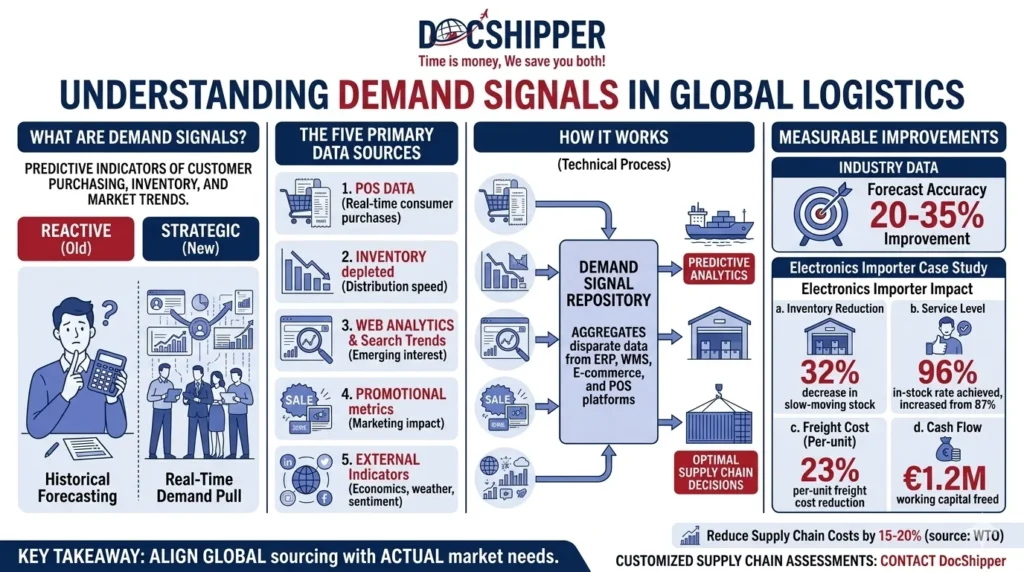
Consider an electronics importer sourcing from Asia to European markets. Historical data shows 15% demand variability and a 45-day ocean freight lead time. Using a 95% service level (Z=1.65), the safety stock calculation yields approximately 11 days of additional inventory coverage beyond average consumption.
| Balancing Approach | Inventory Days | Service Level | Working Capital | Stockout Risk |
|---|---|---|---|---|
| Reactive (No Forecasting) | 85 days | 78% | High | 22% |
| Basic Forecasting | 62 days | 89% | Medium | 11% |
| Advanced S&OP | 48 days | 96% | Optimized | 4% |
| AI-Powered Optimization | 41 days | 98% | Minimal | 2% |
Use Case: Fashion Retailer Seasonal Balancing
A clothing brand importing from Bangladesh faces pronounced seasonality. Summer collections require 60% higher inventory than winter lines. By implementing collaborative forecasting with suppliers and using air freight for late-season replenishments, they reduced inventory holding costs by 28% while improving in-stock rates from 84% to 97%.
Key performance metrics for effective balancing include:
- Forecast accuracy: Target 85%+ for stable products, 70%+ for new introductions
- Inventory turnover: Industry benchmarks range from 4× (industrial) to 12× (perishables) annually
- Fill rate: Percentage of orders fulfilled completely from available stock (target: 95%+)
- Cash-to-cash cycle: Days between paying suppliers and receiving customer payment (lower is better)
- Obsolescence rate: Percentage of inventory written off due to expiration or irrelevance (target: <2%)
DocShipper’s integrated logistics solutions provide real-time shipment tracking and predictive arrival dates, enabling clients to adjust inventory positions dynamically as goods move through the international supply chain.
Conclusion
Demand Supply Balancing transforms logistics from reactive firefighting to strategic advantage. Companies that master this discipline unlock working capital, improve customer satisfaction, and build resilient supply chains capable of absorbing market volatility.
Need expert guidance on optimizing your international supply chain balance? Contact DocShipper for tailored logistics solutions that synchronize your global operations.
📚 Quiz
Test Your Knowledge: Demand Supply Balancing
Q1 — What is the primary goal of Demand Supply Balancing in a global supply chain?
Q2 — Why do international supply chains require higher safety stock buffers compared to domestic ones?
Q3 — A fashion retailer importing seasonal clothing from Bangladesh notices it frequently runs out of stock during peak season while ending up with heavy markdowns post-season. Which Demand Supply Balancing approach would most directly address this problem?
🎯 Your Result
📞 Free Quote in 24hFAQ | Demand Supply Balancing: Definition, Calculation & Concrete Examples
The primary goal is to align inventory availability with customer demand while minimizing total supply chain costs, including holding, transportation, and stockout expenses, thereby optimizing working capital efficiency.
Higher lead time variability requires increased safety stock buffers to maintain service levels. International shipments typically experience greater variability due to customs delays, port congestion, and weather disruptions requiring larger inventory cushions.
Advanced Planning Systems, machine learning algorithms, and real-time tracking platforms enable dynamic demand sensing, automated replenishment triggers, and scenario modeling that dramatically improve forecast accuracy and response speed.
Leading organizations update tactical forecasts weekly or bi-weekly, strategic forecasts monthly through S&OP processes, and long-term forecasts quarterly. High-volatility markets may require daily adjustments using rolling forecast methodologies.
Push systems produce based on forecasts and push inventory to distribution points, while pull systems respond to actual customer orders. Most global supply chains use hybrid models, pushing base inventory while pulling for customization or final positioning.
Seasonal items require aggressive pre-season buildup based on uncertain forecasts, followed by rapid clearance strategies. Misalignment results in either stockouts during peak demand or heavy markdowns on excess inventory post-season.
Warning signs include inventory days exceeding industry benchmarks, frequent expedited shipments, declining fill rates, increasing obsolescence write-offs, and growing discrepancies between forecast and actual consumption patterns.
Introduction phase requires conservative stocking due to uncertain demand. Growth phase demands aggressive supply expansion. Maturity allows optimized balancing with stable patterns. Decline phase requires careful runout planning to avoid excess inventory.
Yes, through Excel-based statistical forecasting, collaborative planning with suppliers, and disciplined inventory review cycles. Cloud-based SaaS platforms now offer enterprise-grade capabilities at accessible price points for smaller operations.
Import duties, quotas, and clearance procedures affect total landed costs and timing. Tariff changes can shift optimal sourcing locations, while customs delays extend effective lead times, requiring larger safety stocks for cross-border supply chains.
The bullwhip effect describes demand amplification as orders move upstream through the supply chain. Small retail demand fluctuations create progressively larger swings at wholesale, manufacturing, and raw material levels, complicating accurate balancing.
Strategies include diversifying supplier bases, maintaining strategic inventory buffers, developing alternative transportation routes, implementing allocation rules for constrained supply, and transparent communication with customers about availability.
Need Help with
Logistics or Sourcing ?
First, we secure the right products from the right suppliers at the right price by managing the sourcing process from start to finish. Then, we simplify your shipping experience - from pickup to final delivery - ensuring any product, anywhere, is delivered at highly competitive prices.


Fill the Form
Prefer email? Send us your inquiry, and we’ll get back to you as soon as possible.
Contact us




