


In short ⚡
Demand Side Analysis is a strategic evaluation method that examines buyer behavior, market consumption patterns, and purchasing power to forecast product or service demand. This analytical approach enables businesses to optimize inventory, pricing strategies, and supply chain operations based on actual market requirements rather than production capabilities alone.Introduction
Many importers struggle with overstocking or stockouts because they focus exclusively on supplier capabilities rather than actual market demand. This disconnect creates costly inefficiencies throughout the international supply chain.
Demand Side Analysis addresses this challenge by providing a data-driven framework for understanding what customers actually want, when they want it, and how much they’re willing to pay. In global trade, this approach directly impacts procurement decisions, shipping volumes, and inventory positioning.
Key characteristics include:
- Consumer behavior tracking through sales data, market research, and trend analysis
- Price elasticity measurement to determine how demand shifts with pricing changes
- Seasonal pattern identification for optimized inventory cycles
- Geographic demand mapping to align distribution with regional consumption
- Competitive positioning analysis relative to market share and customer preferences
Methodology & Strategic Expertise
Effective demand side analysis combines quantitative metrics with qualitative market intelligence. The process begins with historical sales data aggregation, examining purchase patterns across multiple time periods to establish baseline consumption rates.
Market segmentation divides the customer base into distinct groups based on demographics, purchasing behavior, and geographic location. This granular approach reveals which segments drive volume versus which generate premium margins.
The demand forecasting model integrates statistical techniques such as regression analysis, moving averages, and exponential smoothing. These mathematical approaches predict future consumption based on identified trends and cyclical patterns.
Price sensitivity analysis measures elasticity coefficients to determine optimal pricing strategies. Products with high elasticity require careful price management, while inelastic goods offer more pricing flexibility without significant volume loss.
Finally, external factor integration accounts for macroeconomic indicators, regulatory changes, and competitive actions. According to the World Trade Organization, global trade volumes fluctuate based on GDP growth, exchange rates, and geopolitical stability—all critical inputs for demand forecasting.
At DocShipper, we integrate demand side analysis into our sourcing recommendations, ensuring clients import quantities aligned with actual market absorption capacity rather than arbitrary order minimums.
Practical Applications & Data Insights
Consider an electronics importer evaluating demand for wireless earbuds across three European markets. Demand side analysis reveals distinct patterns that directly impact logistics planning.
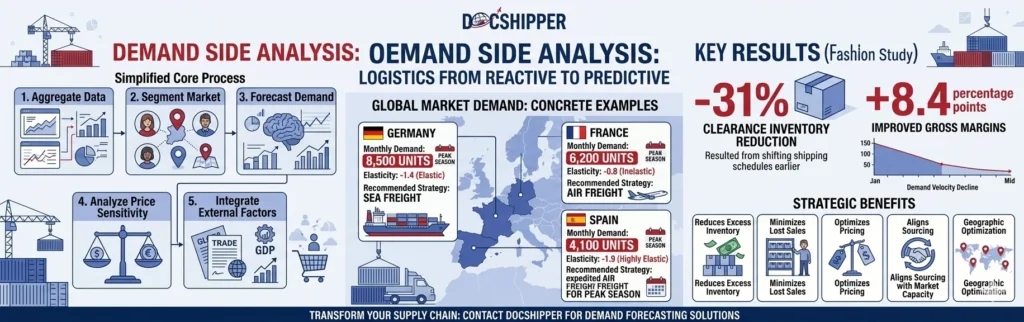
| Market | Monthly Demand (Units) | Price Elasticity | Peak Season | Recommended Strategy |
|---|---|---|---|---|
| Germany | 8,500 | -1.4 (Elastic) | Q4 (November-December) | Competitive pricing, volume shipments pre-Q4 |
| France | 6,200 | -0.8 (Inelastic) | Q1 (January-March) | Premium positioning, steady monthly imports |
| Spain | 4,100 | -1.9 (Highly Elastic) | Q3 (July-September) | Promotional pricing, air freight for peak season |
This analysis drives specific logistical decisions. For Germany, the importer consolidates larger sea freight shipments arriving in September to capture Q4 demand while maintaining competitive pricing. France’s inelastic demand supports smaller, more frequent air shipments with premium pricing that offsets higher freight costs.
Spain’s high elasticity requires aggressive promotional pricing during peak tourist season, justifying expedited air freight to capitalize on short demand windows. Without demand side analysis, the importer might apply uniform strategies across markets, missing these optimization opportunities.
Use Case: Fashion Apparel Seasonal Planning
A clothing importer analyzed five years of sales data, revealing that winter coat demand begins declining 23% week-over-week starting mid-January. This insight shifted their shipping schedule, moving the final container arrival from late December to early December. The adjustment reduced end-of-season clearance inventory by 31% and improved gross margins by 8.4 percentage points.
Key data points informing this decision:
- Demand velocity: Peak weekly sales of 1,240 units (Week 50) versus 180 units (Week 8)
- Inventory turnover: 4.2x during peak season versus 0.9x post-season
- Price realization: 92% of full price during weeks 48-52 versus 54% in weeks 1-8
- Customer acquisition cost: €12 during organic demand period versus €38 during clearance promotions
- Return rate: 8% for in-season purchases versus 23% for discounted clearance items
Conclusion
Demand side analysis transforms supply chain management from reactive to predictive, aligning import volumes and timing with actual market consumption. This strategic approach reduces working capital tied up in excess inventory while minimizing lost sales from stockouts.
Need expert guidance on demand forecasting for your import operations? Contact DocShipper for customized supply chain solutions.
📚 Quiz
Test Your Knowledge: Demand Side Analysis
Q1 — What does Demand Side Analysis primarily evaluate?
Q2 — A product has a price elasticity of -1.9. What does this mean for an importer's pricing strategy?
Q3 — A fashion importer discovers that winter coat demand drops 23% week-over-week from mid-January. What is the most effective action based on demand side analysis?
🎯 Your Result
📞 Free Quote in 24hFAQ | Demand Side Analysis: Definition, Methods & Practical Examples
Critical sources include point-of-sale transaction data, customer relationship management systems, web analytics, market research reports, competitor pricing intelligence, and macroeconomic indicators. Combining internal sales history with external market data provides the most accurate demand forecasts.
Demand side analysis focuses on customer behavior and market consumption patterns, while supply side analysis examines production capacity, input costs, and supplier capabilities. Effective supply chain strategy requires balancing both perspectives to match procurement with actual market requirements.
Price elasticity measures how quantity demanded changes when prices shift. An elasticity of -2.0 means a 10% price reduction increases demand by 20%. Products with elasticity below -1.0 are considered elastic (price-sensitive), while those above -1.0 are inelastic (less price-sensitive).
Rolling forecasts updated monthly provide optimal responsiveness for most product categories. Fast-moving consumer goods may require weekly updates, while industrial equipment with longer sales cycles can use quarterly revisions. Seasonal products need pre-season analysis with weekly adjustments during peak periods.
While historical analysis identifies patterns, sudden disruptions require supplementary monitoring. Leading indicators like consumer confidence indices, search trend data, and social media sentiment analysis can provide early warning signals of demand shifts before they appear in sales data.
Regional demand patterns often vary significantly due to cultural preferences, climate differences, economic conditions, and competitive landscapes. Geographic segmentation enables optimized inventory positioning, localized pricing strategies, and targeted marketing investments aligned with regional consumption patterns.
Cannibalization occurs when new product introductions reduce sales of existing items. Effective analysis tracks incremental demand (total category growth) versus substitution effects (shifts between products). This distinction prevents overestimating total import requirements when launching line extensions.
Most businesses use 80-95% confidence intervals depending on inventory cost versus stockout risk. High-margin products with low holding costs may accept 80% confidence, while products with significant obsolescence risk or tight margins require 95% confidence to minimize excess inventory exposure.
Promotions create temporary demand spikes that distort baseline consumption patterns. Effective forecasting separates promotional lift from organic demand by analyzing sales during non-promotional periods and calculating incremental volume attributable to specific promotional tactics. This prevents mistaking temporary spikes for sustained demand increases.
Frequent errors include over-relying on recent trends without accounting for cyclical patterns, ignoring competitive actions, failing to segment diverse customer groups, neglecting lead time requirements in forecast horizons, and applying domestic market assumptions to international markets with different consumption behaviors.
Extended lead times (typically 30-90 days for ocean freight) require forecasting further into the future, increasing uncertainty. Importers mitigate this through safety stock calculations, expedited air freight options for demand surges, and vendor-managed inventory agreements that shift forecasting responsibility to suppliers with better visibility.
Accurate demand forecasting enables better customs planning by predicting import volumes, allowing pre-clearance arrangements, optimized duty payment schedules, and compliance with quota systems. Aligning shipment timing with demand patterns also reduces warehouse dwell time, minimizing storage costs and demurrage fees at ports.
Need Help with
Logistics or Sourcing ?
First, we secure the right products from the right suppliers at the right price by managing the sourcing process from start to finish. Then, we simplify your shipping experience - from pickup to final delivery - ensuring any product, anywhere, is delivered at highly competitive prices.


Fill the Form
Prefer email? Send us your inquiry, and we’ll get back to you as soon as possible.
Contact us




