


In short ⚡
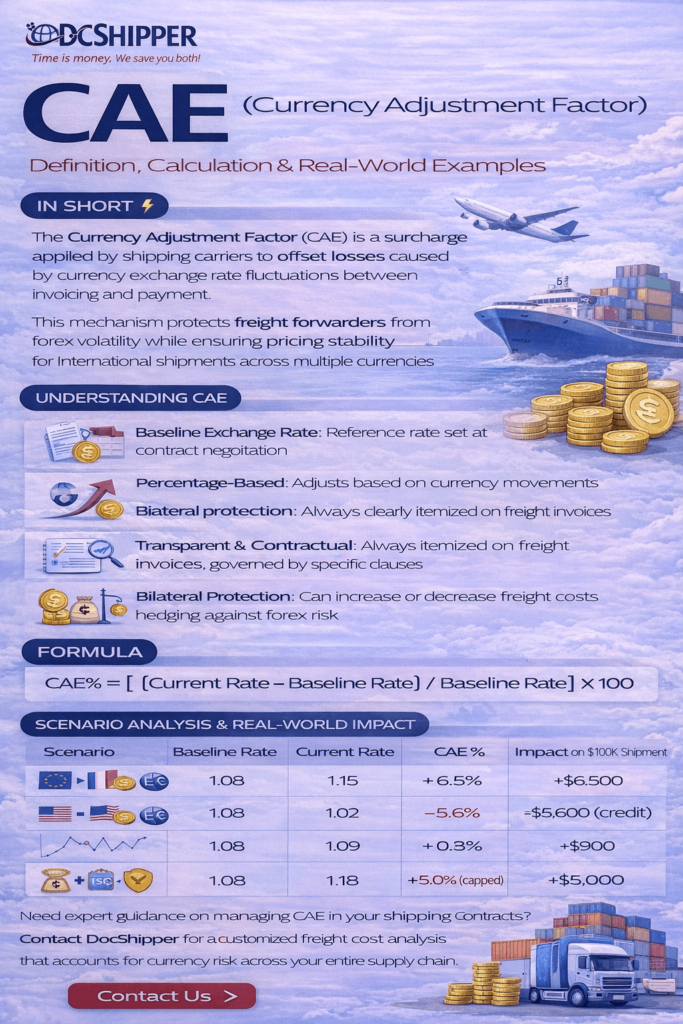
The Currency Adjustment Factor (CAE) is a surcharge applied by shipping carriers to offset losses caused by currency exchange rate fluctuations between invoicing and payment. This mechanism protects freight forwarders from forex volatility while ensuring pricing stability for international shipments across multiple currencies.
Introduction
International trade operates across dozens of currencies, creating constant exposure to exchange rate risk. When a shipping contract is signed in USD but the carrier operates primarily in EUR, a 5% currency swing can eliminate profit margins entirely. The CAE addresses this fundamental challenge.
This adjustment factor has become critical as global freight markets experience unprecedented volatility. For importers and exporters, understanding CAE calculations directly impacts budgeting accuracy and cost predictability.
Key characteristics of CAE include:
- Dynamic application: Recalculated monthly or quarterly based on market rates
- Bilateral protection: Can be positive or negative depending on currency movements
- Transparency requirement: Must be clearly itemized on freight invoices
- Contractual basis: Governed by specific clauses in shipping agreements
- Regional variations: Application rules differ across trade lanes and carrier alliances
Understanding CAE: Mechanisms & Strategic Implications
The CAE operates through a baseline exchange rate mechanism. Carriers establish a reference rate at the time of contract negotiation. When actual payment occurs, the prevailing exchange rate is compared against this baseline. The percentage difference becomes the adjustment factor.
From a legal standpoint, CAE clauses must comply with international commercial law. The ICC (International Chamber of Commerce) recognizes currency adjustment mechanisms as legitimate risk-sharing tools, provided they meet transparency standards outlined in Incoterms® 2020 guidelines.
The calculation methodology typically follows this formula: CAE% = [(Current Rate – Baseline Rate) / Baseline Rate] × 100. For instance, if a contract sets EUR/USD at 1.10 and payment occurs at 1.15, the CAE would be +4.5%. This percentage applies to the base freight charge.
Strategic implications extend beyond simple cost recovery. Forward-thinking shippers negotiate CAE caps (typically 3-5%) to limit exposure. Some contracts incorporate hedging clauses that neutralize CAE when currency movements fall within predetermined bands.
At DocShipper, we systematically review CAE clauses during contract negotiations to ensure our clients aren’t exposed to uncapped currency risk. Our procurement team monitors 27 currency pairs daily to anticipate CAE impacts on active shipments.
The regulatory framework varies significantly. EU regulations require CAE disclosure 30 days before application, while U.S. Federal Maritime Commission rules mandate quarterly filings. According to EU Customs procedures, CAE must be documented separately from base freight for duty calculation purposes.
Practical Examples & Data-Driven Scenarios
Consider a real-world case: A German manufacturer books 40 TEUs monthly from Shanghai to Hamburg. Contract rate: $2,000/TEU with EUR/USD baseline at 1.08. Three months later, EUR strengthens to 1.12 against USD.
CAE calculation: [(1.12 – 1.08) / 1.08] × 100 = +3.7%. Applied to monthly shipment: 40 TEU × $2,000 × 3.7% = $2,960 additional monthly cost. Annually, this represents $35,520 in unbudgeted expenses.
| Scenario | Baseline Rate | Current Rate | CAE % | Impact on $100K Shipment |
|---|---|---|---|---|
| EUR Strengthens | 1.08 | 1.15 | +6.5% | +$6,500 |
| USD Strengthens | 1.08 | 1.02 | -5.6% | -$5,600 (credit) |
| Minimal Fluctuation | 1.08 | 1.09 | +0.9% | +$900 |
| With 5% Cap | 1.08 | 1.18 | +5.0% (capped) | +$5,000 |
Industry data reveals significant variations across trade routes. Asia-Europe lanes averaged 2.3% CAE in 2023, while Trans-Pacific routes saw 4.1% due to JPY volatility. Carriers applying CAE recovered an estimated $1.2 billion globally in currency-related losses last year.
A comparative analysis of mitigation strategies shows:
- Fixed-rate contracts: Eliminate CAE but typically cost 8-12% premium upfront
- Quarterly adjustments: Reduce volatility by 40% versus monthly recalculations
- Multi-currency invoicing: Allows payment in carrier’s preferred currency, avoiding CAE entirely
- Hedging instruments: Forward contracts can lock rates for 6-12 months at 1.5-3% cost
- Volume commitments: High-volume shippers negotiate CAE waivers as part of annual tenders
Conclusion
The Currency Adjustment Factor represents a critical risk-sharing mechanism in modern logistics, balancing carrier exposure against shipper cost predictability. Mastering CAE dynamics enables strategic procurement decisions that protect margins in volatile forex markets.
Need expert guidance on managing CAE in your shipping contracts? Contact DocShipper for a customized freight cost analysis that accounts for currency risk across your entire supply chain.
📚 Quiz
Test Your Knowledge: Currency Adjustment Factor (CAE)
Q1 — What is the primary purpose of the Currency Adjustment Factor (CAE) in international shipping?
Q2 — A shipper's contract sets a EUR/USD baseline rate of 1.08. At payment time, the rate is 1.02. What happens to the CAE in this scenario?
Q3 — A high-volume importer wants to limit their exposure to CAE surcharges in a long-term shipping contract. Which strategy is most effective?
🎯 Your Result
📞 Free Quote in 24hFAQ | CAE (Currency Adjustment Factor): Definition, Calculation & Real-World Examples
No. Most jurisdictions require CAE clauses to be explicitly stated in the original service contract. Retroactive application without documented agreement is generally unenforceable under commercial law.
Recalculation frequency varies by carrier and contract. Monthly adjustments are standard for spot rates, while contract rates typically use quarterly reviews based on 90-day moving averages.
Yes. When the invoicing currency weakens against the baseline, CAE becomes negative, generating credits. However, some contracts include asymmetric clauses applying CAE only when unfavorable to the carrier.
Typically, CAE applies only to ocean freight charges, excluding terminal handling, documentation fees, and surcharges. Contract terms should specify which components are CAE-eligible.
CAF (Currency Adjustment Factor) and CAE are often used interchangeably, though some carriers distinguish CAF as applying to bunker-related costs and CAE to general currency fluctuations.
While no universal standard exists, most carriers reference central bank rates (ECB, Federal Reserve) or interbank rates (LIBOR successors). The specific source should be contractually defined.
Absolutely. Volume shippers frequently negotiate caps (3-5% typical) or trigger thresholds where CAE only applies beyond a certain percentage movement.
CAE is a carrier surcharge independent of Incoterms, but responsibility for payment follows the freight payment terms. Under CFR/CIF, sellers absorb CAE; under FOB/EXW, buyers typically do.
Carriers must provide baseline rate references, current rate sources, calculation methodology, and application dates. Invoices should itemize CAE separately from base freight.
Yes, though less commonly than ocean carriers. Air cargo CAE typically applies to long-term contracts rather than spot rates due to shorter transit times.
Use historical volatility data for relevant currency pairs, apply Monte Carlo simulations, or consult forex analysts. Conservative budgets add 2-3% buffer for CAE exposure on international freight.
Generally no, if properly documented as separate surcharges. However, customs authorities may include CAE in dutiable value if not clearly distinguished from base freight charges.
Need Help with
Logistics or Sourcing ?
First, we secure the right products from the right suppliers at the right price by managing the sourcing process from start to finish. Then, we simplify your shipping experience - from pickup to final delivery - ensuring any product, anywhere, is delivered at highly competitive prices.


Fill the Form
Prefer email? Send us your inquiry, and we’ll get back to you as soon as possible.
Contact us




