


In short ⚡
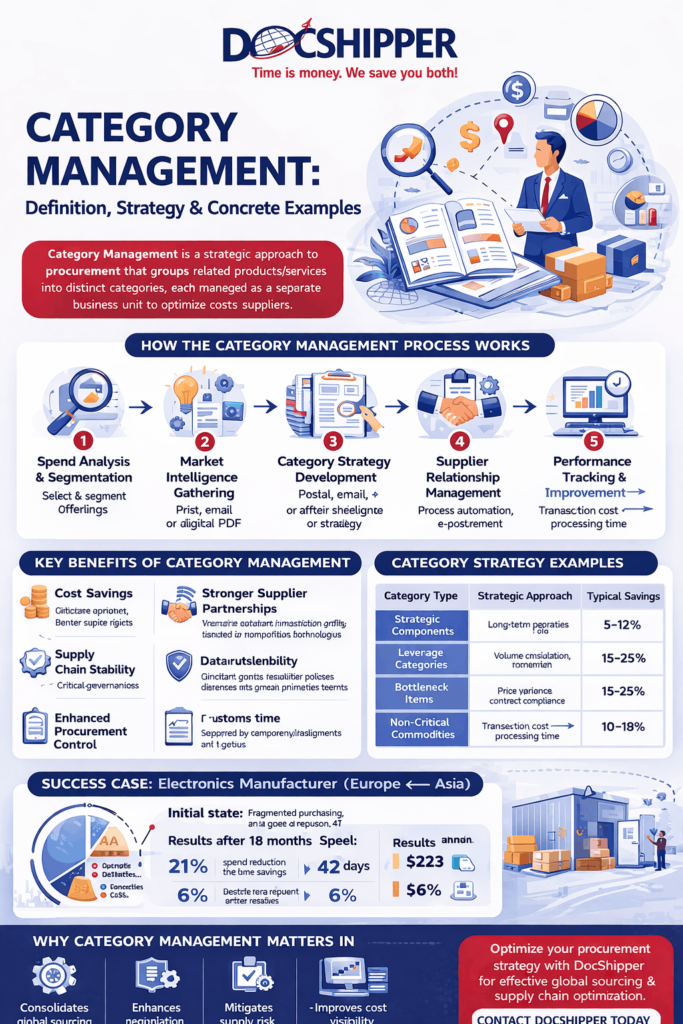
Category Management is a strategic approach to procurement and supply chain operations that groups products or services into distinct categories, each managed as a separate business unit to optimize costs, supplier relationships, and value delivery across the entire sourcing portfolio.Introduction
Many businesses treat procurement as a transactional function, purchasing items individually without strategic oversight. This fragmented approach leads to missed savings opportunities, supplier redundancy, and inconsistent quality standards across the supply chain.
Category Management transforms procurement from reactive buying to proactive value creation. By consolidating similar goods or services into managed categories, organizations gain leverage, visibility, and control over their international sourcing operations.
Key characteristics of effective Category Management include:
- Segmentation: Products grouped by function, supplier base, or strategic importance
- Dedicated ownership: Category managers responsible for end-to-end performance
- Data-driven decisions: Spend analysis and market intelligence guide strategy
- Supplier consolidation: Reduced vendor base improves negotiation power
- Cross-functional alignment: Collaboration between procurement, logistics, and operations teams
Strategic Framework & Expertise
Category Management operates through a structured methodology that aligns procurement activities with business objectives. The framework typically follows five core stages that transform how organizations approach international sourcing.
The first stage involves spend analysis and segmentation. Organizations analyze historical purchasing data to identify spending patterns, supplier concentration, and category boundaries. This visibility reveals consolidation opportunities and risk exposure across the supply chain.
Next comes market intelligence gathering. Category managers research supplier landscapes, pricing trends, regulatory changes, and emerging technologies. For international logistics, this includes understanding customs regulations, trade agreements, and regional supplier capabilities. The World Trade Organization provides essential data on global trade dynamics that inform category strategies.
Category strategy development follows, where managers define objectives for cost reduction, quality improvement, or supply security. Strategies differ based on category positioning—critical items require dual sourcing and relationship management, while commodities focus on competitive bidding and price optimization.
The fourth stage implements supplier relationship management. Rather than treating vendors transactionally, category managers build strategic partnerships with key suppliers. This approach improves service levels, innovation access, and responsiveness during supply disruptions.
Finally, continuous improvement and performance tracking ensure the category delivers sustained value. Metrics include cost savings, supplier performance scores, quality defect rates, and delivery reliability. At DocShipper, we integrate category management principles into our sourcing services, helping clients structure their procurement across Asian markets while managing customs compliance and logistics coordination.
Implementation Examples & Data
Real-world application demonstrates how Category Management delivers measurable results across different industries and sourcing scenarios. The following examples illustrate strategic implementation and quantifiable outcomes.
Comparative Category Strategies
| Category Type | Strategic Approach | Typical Savings | Key Metrics |
|---|---|---|---|
| Strategic Components | Long-term partnerships, dual sourcing, innovation collaboration | 5-12% | Quality scores, lead time reliability |
| Leverage Categories | Volume consolidation, competitive bidding, contract optimization | 15-25% | Price variance, contract compliance |
| Bottleneck Items | Supply security, inventory buffering, supplier development | 3-8% | Stock-out frequency, alternative supplier availability |
| Non-Critical Commodities | Process automation, e-procurement, standardization | 10-18% | Transaction cost, processing time |
Use Case: Electronics Manufacturing Category Optimization
A European electronics manufacturer implemented Category Management for their Asian component sourcing, managing $12 million in annual procurement across 47 suppliers.
Initial state: Fragmented purchasing across five business units, no centralized supplier data, average lead time of 65 days, 23% quality defect rate on electronic components.
Category restructuring: Consolidated suppliers from 47 to 18 strategic partners, established regional category managers in Shenzhen and Taipei, implemented quarterly business reviews with top-tier suppliers.
Results after 18 months:
- 21% reduction in total category spend ($2.52 million savings)
- Lead time decreased to 42 days through improved supplier coordination
- Quality defect rate reduced to 6% via supplier development programs
- Customs clearance time improved by 35% through harmonized documentation
- Inventory carrying costs reduced by $340,000 through better demand forecasting
The manufacturer partnered with DocShipper to manage logistics coordination across their consolidated supplier base, ensuring seamless freight forwarding and customs compliance for all category shipments from Asia to European distribution centers.
Conclusion
Category Management transforms procurement from tactical purchasing into strategic value creation, delivering cost savings, supply chain resilience, and competitive advantage through structured supplier relationships and data-driven decision-making.
Need expert support implementing Category Management for your international sourcing operations? Contact DocShipper for comprehensive procurement and logistics solutions across global supply chains.
📚 Quiz
Test Your Knowledge: Category Management
Q1 — What best defines Category Management in procurement?
Q2 — A common misconception about Category Management is that it simply means negotiating lower unit prices with existing suppliers. What does it actually prioritize?
Q3 — A European electronics manufacturer consolidates 47 Asian component suppliers down to 18 strategic partners and assigns regional category managers. Which Category Management stage does this action best illustrate?
🎯 Your Result
📞 Free Quote in 24hFAQ | Category Management: Definition, Strategy & Concrete Examples
Traditional procurement focuses on individual transactions and short-term price optimization. Category Management treats related products as strategic business units, emphasizing total cost of ownership, supplier relationships, and long-term value creation across the entire category lifecycle.
Most organizations manage between 8 and 25 categories depending on business complexity. Categories should be large enough to justify dedicated management resources but focused enough to enable specialized expertise and meaningful supplier relationships.
Effective category managers combine procurement expertise, supply chain knowledge, negotiation skills, market analysis capabilities, and cultural awareness. For international categories, understanding customs regulations, Incoterms, currency risk, and regional supplier landscapes is essential.
Category Management identifies concentration risks, establishes dual sourcing strategies, monitors supplier financial health, and develops contingency plans. This proactive approach prevents disruptions and ensures business continuity across critical supply categories.
Essential data includes historical spend by supplier and SKU, supplier performance metrics, market pricing benchmarks, demand forecasts, quality records, and lead time data. Most organizations need 18-24 months of historical data for meaningful analysis.
Yes, even small importers gain value by grouping purchases strategically. Simplified category structures with 3-5 categories help small businesses consolidate suppliers, improve negotiation leverage, and reduce procurement complexity without requiring large dedicated teams.
Initial implementation typically requires 6-12 months including spend analysis, category definition, strategy development, and supplier engagement. Full maturity with optimized processes and sustained savings usually takes 18-24 months across all categories.
Modern category management leverages spend analytics platforms, e-sourcing tools, supplier portals, and contract management systems. These technologies provide visibility, automate workflows, and enable data-driven decision-making across global supplier networks.
Category Management shifts supplier interactions from transactional to strategic. Preferred suppliers receive larger volumes, longer contracts, and collaborative innovation opportunities. This approach improves service levels, responsiveness, and mutual business growth.
Organizations frequently struggle with organizational resistance, inadequate data quality, insufficient category manager training, and misaligned stakeholder expectations. Success requires executive sponsorship, change management, and cross-functional collaboration from procurement, finance, and operations teams.
Key performance indicators include cost savings achieved, supplier performance scores, contract compliance rates, category spend under management, quality defect rates, and supply chain risk metrics. Leading organizations track both financial and operational KPIs quarterly.
Absolutely. Services categories like logistics, consulting, IT support, and professional services benefit significantly from category management principles. The approach emphasizes service level agreements, outcome-based metrics, and relationship management rather than unit pricing alone.
Need Help with
Logistics or Sourcing ?
First, we secure the right products from the right suppliers at the right price by managing the sourcing process from start to finish. Then, we simplify your shipping experience - from pickup to final delivery - ensuring any product, anywhere, is delivered at highly competitive prices.


Fill the Form
Prefer email? Send us your inquiry, and we’ll get back to you as soon as possible.
Contact us




