


In short ⚡
The CCC Mark (China Compulsory Certificate) is a mandatory product certification system enforced by Chinese authorities for goods sold in mainland China. Introduced in 2002, this mark ensures products meet safety, quality, and environmental standards across 17 regulated categories including electronics, automotive parts, and toys.
Introduction
Many exporters discover too late that their shipments are blocked at Chinese customs due to missing CCC certification. This costly oversight stems from misunderstanding which products require this mark and how to obtain it.
The CCC Mark represents China’s quality gatekeeper for imported and domestically manufactured goods. Without proper certification, products cannot legally enter the Chinese market, resulting in shipment detention, financial penalties, or forced re-exportation.
Key characteristics of the CCC system include:
- Mandatory compliance for 17 product categories before market entry
- Factory inspections conducted by accredited Chinese certification bodies
- Annual surveillance audits to maintain certification validity
- Product testing in CNCA-approved laboratories within China
- Visible labeling requirements with standardized mark dimensions and placement
Understanding CCC requirements prevents costly delays and ensures smooth customs clearance. The certification process demands thorough preparation, technical documentation, and ongoing compliance monitoring throughout your product’s lifecycle in China.
CCC Certification: Process & Legal Framework
The Certification and Accreditation Administration of China (CNCA) governs the CCC system under the State Administration for Market Regulation. This framework establishes which products require certification and defines technical standards for compliance.
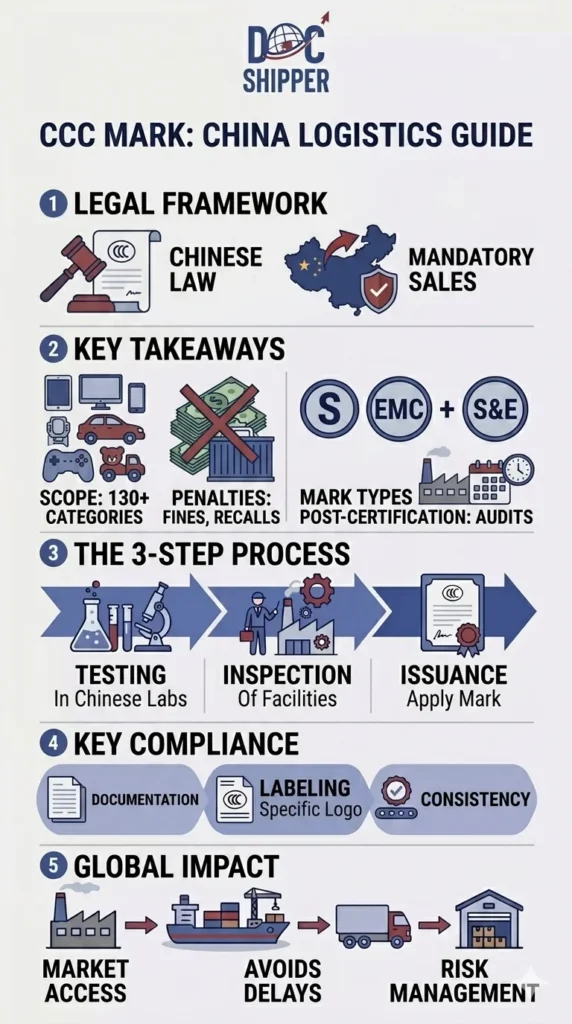
The certification process follows five distinct phases:
Application submission requires manufacturers to engage a CNCA-designated certification body. Applicants must provide business licenses, product specifications, technical drawings, and quality management documentation. Foreign manufacturers typically work through Chinese agents or subsidiaries.
Product testing occurs exclusively in CNCA-approved laboratories located in China. Samples undergo rigorous evaluation against GB (Guobiao) national standards. Testing duration varies from 4 to 12 weeks depending on product complexity. At DocShipper, we coordinate sample shipment and liaise with testing facilities to expedite this critical phase.
Factory inspection verifies manufacturing capabilities and quality control systems. Auditors assess production equipment, testing instruments, and quality procedures. Factories must demonstrate consistent production capacity and traceability systems. This inspection typically occurs within 90 days of application.
Certificate issuance follows successful testing and factory approval. Certificates remain valid for five years but require annual surveillance audits. The certification body maintains authority to suspend or revoke certificates for non-compliance.
Mark application involves affixing the standardized CCC logo to products and packaging. The mark must meet specific size requirements relative to product dimensions. Permanent marking methods include molding, etching, or screen printing, while adhesive labels are permitted for certain categories.
According to the CNCA official portal, the 17 regulated categories encompass electrical equipment, automotive components, safety glass, agricultural machinery, telecommunications equipment, and children’s products. Each category references specific GB standards that define technical requirements.
Exemption procedures exist for limited circumstances including scientific research samples, temporary imports under carnet systems, and diplomatic goods. However, commercial shipments rarely qualify for exemptions regardless of quantity.
Non-compliance consequences include customs detention, administrative fines reaching 30% of product value, criminal liability for serious violations, and blacklisting from Chinese market access. These penalties apply equally to importers and manufacturers.
Practical Cases & Compliance Data
Understanding CCC requirements through real-world scenarios helps exporters navigate certification complexities and avoid common pitfalls.
Case Study: Electronics Manufacturer
A European laptop adapter manufacturer planned Chinese market entry. Their product fell under CCC category 0807 (Information Technology Equipment Power Supplies). The certification process required:
| Phase | Duration | Cost (USD) |
|---|---|---|
| Application & Documentation | 2-3 weeks | $500-800 |
| Laboratory Testing (GB 4943.1) | 6-8 weeks | $3,500-5,000 |
| Factory Inspection | 1 week | $2,000-3,000 |
| Certificate Processing | 2-3 weeks | $1,000-1,500 |
| Total Timeline & Investment | 11-15 weeks | $7,000-10,300 |
This manufacturer successfully obtained certification but discovered that design modifications required re-testing. DocShipper advises clients to freeze product specifications before initiating CCC applications to avoid duplicate costs.
Comparative Analysis: CCC vs. International Certifications
| Certification | Market | Factory Audit | Validity Period |
|---|---|---|---|
| CCC Mark | China | Mandatory + Annual | 5 years |
| CE Marking | European Union | Not required (self-declaration possible) | Indefinite |
| UL Certification | United States | Quarterly surveillance | Ongoing |
| PSE Mark | Japan | Not required | Indefinite |
Unlike CE marking’s self-declaration option, CCC certification requires third-party verification and cannot be self-assessed. This fundamental difference increases compliance complexity for foreign manufacturers.
Key Compliance Statistics:
- Average certification timeline: 3-4 months from application to certificate issuance
- First-attempt failure rate: 35-40% of initial factory inspections require corrective actions
- Testing failure rate: 20-25% of products fail initial laboratory testing
- Annual surveillance cost: $1,500-2,500 for maintaining certification validity
- Customs detention rate: Products without CCC face 95%+ detention at Chinese ports
These figures underscore the importance of proper preparation and expert guidance. At DocShipper, we conduct pre-assessment reviews to identify potential compliance gaps before formal application, reducing failure rates significantly.
Conclusion
The CCC Mark represents a non-negotiable requirement for accessing China’s vast consumer market. Successful certification demands thorough understanding of technical standards, meticulous documentation, and ongoing compliance management. Early preparation and expert support transform this regulatory challenge into a manageable pathway for market entry.
Need assistance navigating CCC certification requirements for your products? Contact DocShipper for comprehensive support from application through annual audits.
📚 Quiz
Test Your Knowledge: CCC Mark
Q1 — What does the CCC Mark (China Compulsory Certificate) primarily represent?
Q2 — A foreign manufacturer already holds a CE marking for their electrical product. Can they use this to self-declare compliance and skip CCC certification for the Chinese market?
Q3 — A European toy manufacturer obtains CCC certification for their factory in Germany. They later open a second production facility in Vietnam to manufacture the same certified product. Which statement is correct?
🎯 Your Result
📞 Free Quote in 24hFAQ | CCC Mark: Definition, Requirements & Practical Examples
CCC applies to 17 categories including electrical cables, household appliances, audio/video equipment, IT products, lighting fixtures, automotive parts, safety glass, agricultural machinery, telecommunications equipment, medical devices, fire safety products, security equipment, decorative materials, children's products, and wireless devices. Each category has specific sub-classifications.
No. Products within regulated categories cannot legally enter Chinese commerce without valid CCC certification. Customs will detain non-compliant shipments regardless of quantity. Attempting market entry without certification results in administrative penalties, forced re-exportation, and potential criminal liability for serious violations.
CCC certificates remain valid for five years from issuance date. However, maintaining validity requires passing annual surveillance audits conducted by the certification body. Failure to complete annual audits results in certificate suspension. Certificate holders must also report significant design changes that may necessitate re-testing.
Failed products require design modifications and re-testing. The certification body provides detailed failure reports identifying non-compliant aspects. After implementing corrections, manufacturers submit revised samples for additional testing. This process incurs extra costs and extends certification timelines by 6-12 weeks depending on modification complexity.
Foreign manufacturers must work through Chinese representatives. Options include establishing a Chinese subsidiary, partnering with Chinese importers, or engaging authorized agents. The Chinese entity becomes the certificate holder and assumes legal responsibility for compliance. This requirement ensures Chinese authorities have local enforcement jurisdiction.
Required documentation includes business license, product specifications, technical drawings, circuit diagrams, component lists, user manuals, quality management system documentation, production process descriptions, testing equipment lists, and previous certification reports. Foreign documents require official Chinese translation by certified translators.
Total costs range from $7,000 to $15,000 depending on product complexity and testing requirements. Major expenses include laboratory testing ($3,000-8,000), factory inspection ($2,000-3,000), certification body fees ($1,000-2,000), and agent services ($1,000-2,000). Annual surveillance audits add $1,500-2,500 yearly to maintain certification.
No. CCC certificates specify exact manufacturing locations. Companies producing identical products at multiple facilities require separate certifications for each location. Factory inspections verify production capabilities at specific sites. Relocating production necessitates new factory inspections and certificate amendments before shipping from new locations.
The CCC mark must appear on product bodies and outer packaging. Mark diameter must equal at least 5mm or 1/40 of product's minimum dimension, whichever is larger. Permanent marking methods include molding, etching, or screen printing. Adhesive labels are permitted for certain product categories. Placement must ensure visibility during normal use.
Partial acceptance is possible through CB scheme recognition. China participates in the IECEE CB system, allowing some test results from accredited foreign laboratories to supplement CCC testing. However, complete exemption is rare. Most products still require testing in CNCA-approved Chinese laboratories, though CB reports may reduce testing scope and costs.
Certificates face suspension for failing annual surveillance audits, unauthorized design changes, quality complaints exceeding thresholds, or refusing follow-up inspections. Revocation occurs for serious safety violations, fraudulent applications, persistent non-compliance, or manufacturing products significantly different from certified samples. Revocation prohibits using the CCC mark and requires new certification.
Limited exemptions exist for non-commercial purposes including scientific research, testing, and exhibition samples. Applicants must provide documentation proving non-commercial intent and commit to re-exportation or destruction. Commercial samples distributed to potential customers require full certification. Customs authorities strictly scrutinize exemption claims to prevent commercial circumvention.
Need Help with
Logistics or Sourcing ?
First, we secure the right products from the right suppliers at the right price by managing the sourcing process from start to finish. Then, we simplify your shipping experience - from pickup to final delivery - ensuring any product, anywhere, is delivered at highly competitive prices.


Fill the Form
Prefer email? Send us your inquiry, and we’ll get back to you as soon as possible.
Contact us




