


In short ⚡
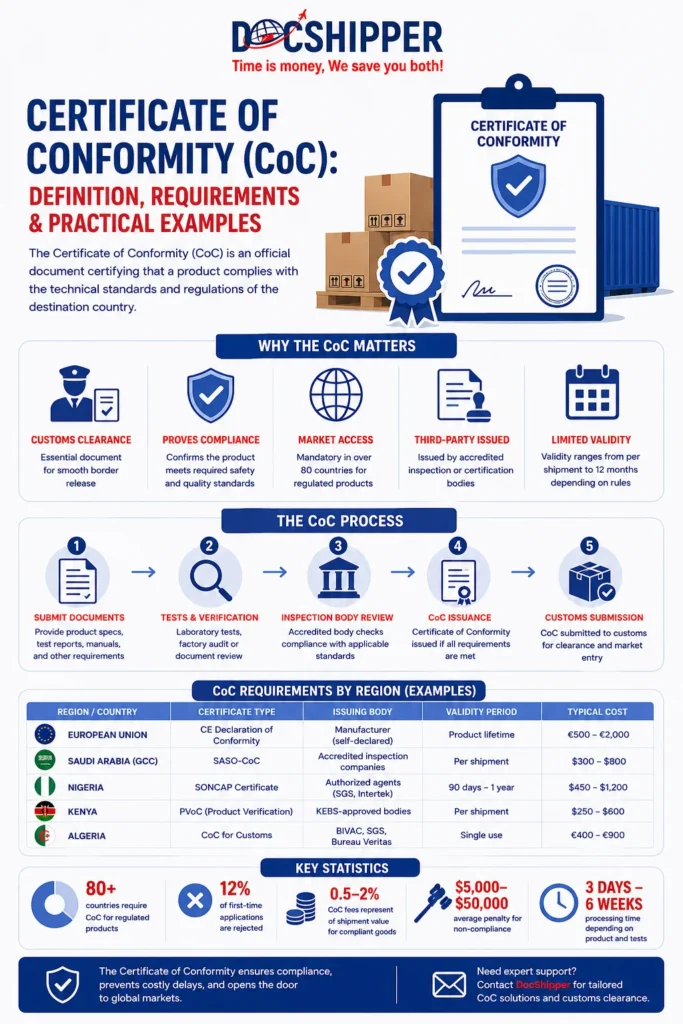
The Certificate of Conformity (CoC) is an official document issued by a manufacturer or authorized third party certifying that a product complies with specific technical standards, regulations, or safety requirements of the destination country. It serves as proof of compliance during customs clearance and market entry.
Introduction
Many importers face costly delays when their shipments arrive at customs without proper conformity documentation. The Certificate of Conformity eliminates this risk by demonstrating regulatory compliance before goods cross borders.
In international trade, the CoC acts as a quality passport. It confirms that products meet destination-country standards for safety, environmental impact, and technical specifications. Without it, shipments may be rejected, quarantined, or destroyed.
Key characteristics of the Certificate of Conformity:
- Mandatory verification: Required by over 80 countries for regulated product categories
- Third-party issuance: Often issued by accredited inspection bodies like SGS, Bureau Veritas, or Intertek
- Product-specific standards: References exact technical norms (ISO, CE, SONCAP, etc.)
- Customs prerequisite: Necessary for clearance in markets like EU, GCC, and African nations
- Validity period: Typically ranges from single shipment to 12 months depending on regulations
Technical Requirements & Regulatory Framework
The Certificate of Conformity operates within a complex regulatory ecosystem. Understanding its technical foundation prevents compliance failures and accelerates market access.
Issuing authorities vary by destination. The EU accepts manufacturer self-declarations for CE marking, while Saudi Arabia requires SASO-CoC from accredited bodies. Nigeria mandates SONCAP certificates through pre-shipment inspection. Each regime follows distinct protocols.
Testing procedures form the certificate’s backbone. Products undergo laboratory analysis, factory audits, or document reviews. Electrical goods face EMC and safety tests. Textiles require flammability and chemical composition verification. Food items need microbiological screening and ingredient validation.
Standard references must appear explicitly on the CoC. ISO 9001 for quality management, EN standards for European markets, or ASTM specifications for US-bound goods. The certificate links the product to these benchmarks through test reports and batch numbers.
Legal implications extend beyond customs. A CoC transfers liability from importer to manufacturer regarding product safety. It becomes evidence in legal disputes and insurance claims. Falsifying a certificate constitutes fraud under international trade law.
Digital transformation is reshaping CoC issuance. Blockchain-verified certificates reduce fraud. Electronic submissions via national single windows accelerate processing. At DocShipper, we systematically verify CoC authenticity through direct liaison with issuing bodies, preventing counterfeit documentation that causes shipment detention.
For authoritative guidance, consult the European Commission’s CE Marking Guidelines or the ISO Conformity Assessment Standards.
Practical Examples & Real-World Applications
Real-world scenarios illustrate how the Certificate of Conformity functions across different industries and regulatory environments.
Comparative Analysis: CoC Requirements by Region
| Region/Country | Certificate Type | Issuing Body | Validity Period | Typical Cost |
|---|---|---|---|---|
| European Union | CE Declaration of Conformity | Manufacturer (self-declared) | Product lifetime | €500-€2,000 (testing) |
| Saudi Arabia (GCC) | SASO-CoC | Accredited inspection companies | Per shipment | $300-$800 |
| Nigeria | SONCAP Certificate | Authorized agents (SGS, Intertek) | 90 days – 1 year | $450-$1,200 |
| Kenya | PVoC (Product Verification) | KEBS-approved bodies | Per shipment | $250-$600 |
| Algeria | CoC for Customs | BIVAC, SGS, Bureau Veritas | Single use | €400-€900 |
Use Case: Electronics Import to Saudi Arabia
Scenario: A French company ships 500 LED lighting units (HS Code 9405.40) to Riyadh.
CoC Process:
- Step 1: Submit technical documentation (test reports, user manuals, product photos) to SGS Gulf
- Step 2: SGS verifies compliance with IEC 62560 and Saudi energy efficiency standards
- Step 3: Factory inspection in France confirms manufacturing consistency
- Step 4: SASO-CoC issued within 5-7 business days, valid for this shipment only
- Step 5: Certificate submitted electronically via Saudi Customs’ FASAH platform
Outcome: Clearance completed in 48 hours. Without the CoC, the shipment would face minimum 14-day detention plus re-export costs exceeding €3,000.
Key Data Points
- Processing time: Ranges from 3 days (document review) to 6 weeks (full product testing)
- Rejection rate: 12% of first-time applications fail due to incomplete documentation
- Cost impact: CoC fees represent 0.5-2% of shipment value for compliant goods
- Penalty exposure: Non-compliance fines average $5,000-$50,000 depending on jurisdiction
- Market coverage: Over 60 countries mandate pre-shipment CoC for controlled products
At DocShipper, we manage the entire CoC application process, coordinating with inspection bodies and ensuring documentation meets destination-country requirements before shipment departure.
Conclusion
The Certificate of Conformity transforms regulatory compliance from a barrier into a competitive advantage. Proper certification ensures smooth customs clearance, reduces detention risks, and builds buyer confidence in international markets.
Need expert guidance on CoC requirements for your specific products and destinations? Contact DocShipper for tailored compliance solutions that keep your supply chain moving.
📚 Quiz
Test Your Knowledge: Certificate of Conformity (CoC)
Q1 — What is the primary purpose of a Certificate of Conformity (CoC) in international trade?
Q2 — A manufacturer wants to export LED lighting units to Saudi Arabia. Can they issue their own Certificate of Conformity (SASO-CoC) without third-party involvement?
Q3 — A shipment of electronics arrives at customs without a Certificate of Conformity. What is the most likely outcome?
🎯 Your Result
📞 Free Quote in 24hFAQ | Certificate of Conformity (CoC): Definition, Requirements & Practical Examples
While often used interchangeably, a Certificate of Conformity specifically verifies adherence to technical standards, whereas a Certificate of Compliance may cover broader regulatory requirements including environmental or ethical certifications.
This depends on the issuing country's regulations. EU CE declarations remain valid indefinitely, while Saudi SASO-CoC applies to single shipments. Some programs like Nigeria's SONCAP offer annual licenses for regular importers.
Typically the importer pays for CoC issuance unless otherwise specified in the sales contract. Incoterms like DDP may shift this responsibility to the exporter.
Timeline varies from 3-5 business days for document verification to 4-6 weeks for products requiring laboratory testing and factory inspections.
Customs will detain the goods, requiring retrospective certification, re-export, or destruction. Detention fees typically start at $50-$200 per day plus storage costs.
No. High-risk items like electronics, chemicals, and food face stricter scrutiny than low-risk goods like textiles or stationery. Each HS code may have unique certification pathways.
Only in self-declaration regimes like EU CE marking. Most countries require third-party verification from accredited inspection bodies to prevent conflicts of interest.
Essential elements include product description, HS code, applicable standards, test report references, manufacturer details, batch/serial numbers, and issuing body's accreditation number.
Yes, if modifications affect safety, performance, or compliance with referenced standards. Minor cosmetic changes typically don't require re-certification, but always consult the issuing body.
Check the issuing body's website using the certificate number. Legitimate CoCs include security features like holograms, QR codes, or unique serial numbers. Contact the inspection company directly if in doubt.
Increasingly yes. Many countries now accept electronic certificates through single-window systems, though some still require original hard copies with stamps and signatures.
Penalties include shipment confiscation, fines up to 200% of goods value, criminal prosecution for fraud, and permanent blacklisting from import privileges in the destination country.
Need Help with
Logistics or Sourcing ?
First, we secure the right products from the right suppliers at the right price by managing the sourcing process from start to finish. Then, we simplify your shipping experience - from pickup to final delivery - ensuring any product, anywhere, is delivered at highly competitive prices.


Fill the Form
Prefer email? Send us your inquiry, and we’ll get back to you as soon as possible.
Contact us




