


In short ⚡
Dispatching is the operational process of assigning, coordinating, and directing transportation resources—vehicles, drivers, and cargo—to execute deliveries efficiently. It ensures optimal route planning, real-time tracking, and timely coordination between warehouses, carriers, and final destinations in supply chain management.Introduction
Many importers struggle with delivery delays caused by poor coordination between warehouse release and final-mile carriers. The gap between “goods ready” and “goods delivered” often stems from ineffective dispatching—a critical yet underestimated function in international logistics.
Dispatching acts as the central nervous system of freight operations. It connects inventory availability, carrier capacity, and customer expectations into a synchronized workflow. Without proper dispatching, even the most efficient supply chains face bottlenecks, missed delivery windows, and increased operational costs.
Key characteristics of professional dispatching include:
- Real-time resource allocation based on cargo priority and route optimization
- Dynamic rerouting in response to traffic, weather, or customs delays
- Multi-modal coordination across sea, air, road, and rail transport
- Compliance monitoring for driver hours, vehicle capacity, and regulatory constraints
- Performance analytics tracking on-time delivery rates and cost per shipment
Operational Mechanisms & Expertise
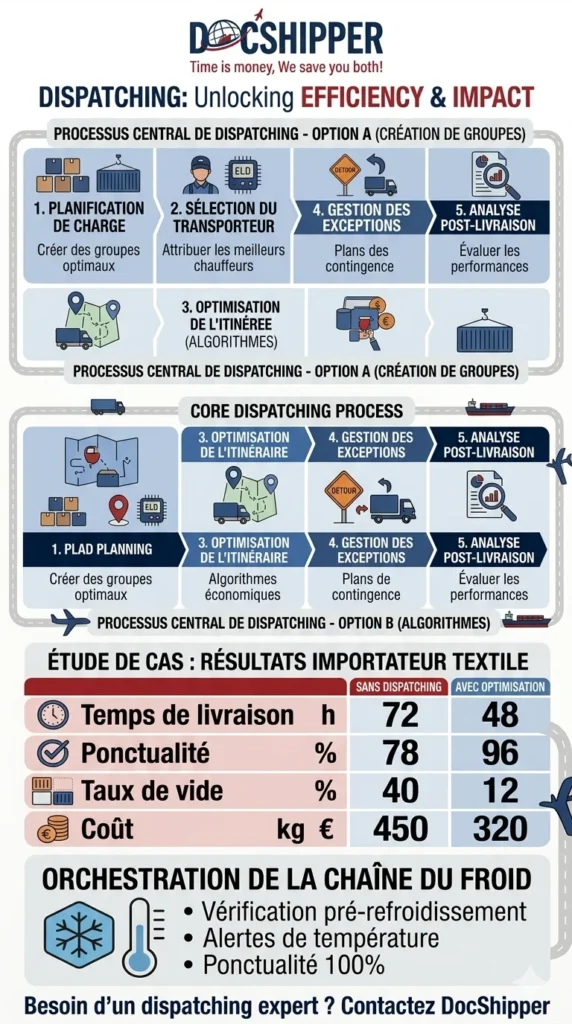
Dispatching operates through layered decision-making protocols that balance urgency, cost, and capacity. The process begins with load planning, where dispatchers analyze shipment volumes, destinations, and delivery deadlines to create optimal cargo groupings. This prevents underutilized vehicles and reduces empty mile ratios.
The second phase involves carrier selection and assignment. Dispatchers evaluate available drivers based on proximity to pickup points, legal driving hours remaining, vehicle type compatibility, and historical performance metrics. Advanced systems integrate GPS data with electronic logging devices (ELDs) to ensure regulatory compliance with frameworks like the EU’s Regulation (EC) No 561/2006 on driving time and rest periods.
Route optimization algorithms form the technical backbone of modern dispatching. These systems process variables including road conditions, toll costs, fuel efficiency, and delivery time windows to generate the most economical paths. At DocShipper, we integrate these algorithms with customs clearance schedules to prevent trucks from arriving at ports before documentation is finalized—a common cause of demurrage charges.
The fourth critical component is exception management. When disruptions occur—vehicle breakdowns, border delays, or rejected deliveries—dispatchers must execute contingency protocols. This requires maintaining relationships with backup carriers, understanding alternative routing options, and communicating transparently with all stakeholders. According to the European Commission’s Transport Directorate, proactive exception handling reduces average delivery delays by 34%.
Finally, post-delivery analytics close the operational loop. Dispatchers review proof-of-delivery documents, analyze variance between planned and actual routes, and identify patterns in delays or cost overruns. This data feeds continuous improvement cycles, refining future dispatching decisions and carrier partnerships.
Concrete Examples & Data
Consider a textile importer receiving 15 containers weekly at Rotterdam port destined for distribution centers across Germany, France, and Belgium. Without centralized dispatching, each container would be assigned randomly to available carriers, resulting in fragmented routes and 40% empty backhaul trips.
With optimized dispatching, the operation transforms:
| Metric | Without Dispatching | With Dispatching |
|---|---|---|
| Average Delivery Time | 72 hours | 48 hours |
| Cost per Container | €450 | €320 |
| On-Time Delivery Rate | 78% | 96% |
| Empty Miles Ratio | 40% | 12% |
| Carbon Emissions (kg CO₂/container) | 185 | 112 |
A second use case involves time-critical pharmaceutical dispatching. A biotech company ships temperature-sensitive vaccines from Belgium to 12 hospitals across Poland within a 36-hour window. The dispatcher coordinates:
- Pre-cooling verification of refrigerated trucks 4 hours before loading
- Priority lane booking at border crossings to avoid 6+ hour queues
- Backup vehicle staging at 200km intervals in case of mechanical failure
- Real-time temperature monitoring with automated alerts at ±2°C deviation
- Customs pre-clearance coordination to eliminate inspection delays
This level of orchestration achieved 100% on-time delivery across 48 shipments in Q1 2024, compared to an industry average of 87% for cold-chain logistics. The cost premium was 18%, but avoided spoilage losses that would have exceeded 200% of transport costs.
Conclusion
Effective dispatching transforms logistics from reactive firefighting into proactive orchestration. It directly impacts delivery reliability, cost efficiency, and customer satisfaction across international supply chains.
Need expert dispatching coordination for your shipments? Contact DocShipper for tailored freight management solutions.
📚 Quiz
Test Your Knowledge: Dispatching
Q1 — What best defines dispatching in logistics?
Q2 — A common misconception is that dispatching and freight forwarding are the same thing. What is the correct distinction?
Q3 — A biotech company needs to ship temperature-sensitive vaccines from Belgium to 12 hospitals in Poland within 36 hours. Which dispatching action is most critical to ensure on-time, compliant delivery?
🎯 Your Result
📞 Free Quote in 24hFAQ | Dispatching: Definition, Process & Real-World Examples
Dispatching focuses on operational execution—assigning vehicles and coordinating movements. Freight forwarding encompasses broader services including documentation, customs clearance, and carrier contracting. Dispatching is a subset of forwarding operations.
Automated systems use algorithms to match shipments with available carriers based on location, capacity, cost, and delivery windows. They integrate GPS tracking, traffic data, and regulatory constraints to generate optimized routes in real-time.
Effective dispatchers require knowledge of transport regulations, route geography, carrier management software, and crisis resolution. Many hold certifications in logistics management or supply chain operations, with 3+ years of field experience.
Yes. Optimized routing reduces empty miles and fuel consumption. Consolidated shipments decrease the number of trips. Advanced dispatching can cut transport-related emissions by 20-35% compared to uncoordinated operations.
Dispatchers activate backup protocols, reassigning the load to alternative carriers. They analyze rejection reasons—unrealistic deadlines, route safety concerns, or equipment mismatches—to prevent future issues. Persistent rejections trigger carrier performance reviews.
Cross-border dispatching requires coordination with customs brokers, monitoring of document readiness, and selection of drivers with proper certifications. Dispatchers schedule arrivals to match clearance windows and manage bonded transit requirements.
Outsourced dispatching typically costs 8-15% of total freight spend, or $150-$400 per shipment for dedicated services. Costs vary based on shipment complexity, frequency, and geographic coverage. Volume discounts apply for regular users.
Modern dispatching platforms connect via APIs to WMS, pulling real-time data on inventory availability, order priorities, and loading dock schedules. This synchronization prevents premature truck arrivals and optimizes warehouse labor allocation.
Key performance indicators include on-time pickup rate (target: >95%), on-time delivery rate (target: >92%), cost per mile, empty mile percentage (<15%), and first-call resolution for exceptions. Customer satisfaction scores also measure service quality.
Absolutely. Even businesses shipping 10-20 loads monthly gain value through reduced delays, lower transport costs, and improved customer reliability. Many third-party logistics providers offer scalable dispatching services without requiring dedicated staff.
Multi-modal dispatching coordinates transitions between sea, rail, and road transport. Dispatchers synchronize container releases from ports with rail schedules and final-mile truck availability, ensuring seamless handoffs and minimizing dwell times at intermodal terminals.
AI enhances dispatching through predictive analytics for demand forecasting, machine learning algorithms for route optimization, and natural language processing for automated communication with drivers. AI reduces manual workload by 40-60% while improving decision accuracy.
Need Help with
Logistics or Sourcing ?
First, we secure the right products from the right suppliers at the right price by managing the sourcing process from start to finish. Then, we simplify your shipping experience - from pickup to final delivery - ensuring any product, anywhere, is delivered at highly competitive prices.


Fill the Form
Prefer email? Send us your inquiry, and we’ll get back to you as soon as possible.
Contact us




