


In short ⚡
Change Management is a structured approach to transitioning individuals, teams, and organizations from a current state to a desired future state. It encompasses methodologies, processes, and tools designed to minimize resistance, maximize engagement, and ensure successful adoption of new systems, processes, or organizational structures in international logistics operations.Introduction
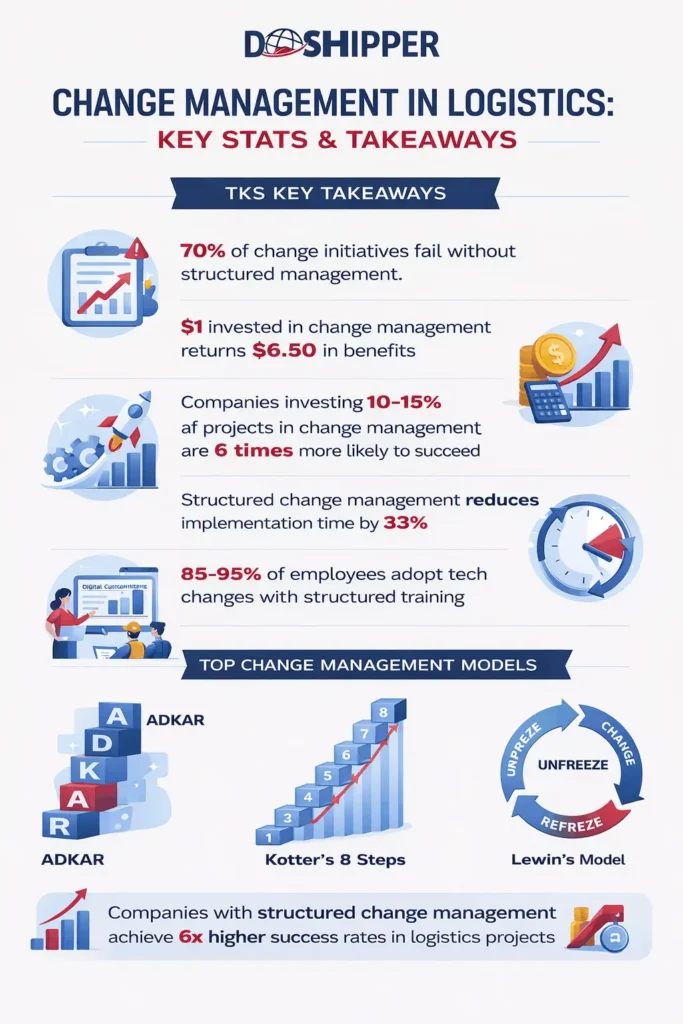
Why do 70% of organizational change initiatives fail? The answer lies in inadequate change management. In international logistics, where digital transformation, regulatory shifts, and operational restructuring occur constantly, managing change effectively determines competitive survival.
For freight forwarders, customs brokers, and supply chain operators, implementing new customs platforms, warehouse management systems, or compliance protocols without proper change management creates costly disruptions. Shipment delays, documentation errors, and employee resistance multiply when transitions lack structure.
Effective change management in logistics addresses:
- Technology adoption – Transitioning from manual to automated customs clearance systems
- Regulatory compliance – Adapting to new trade agreements or customs regulations
- Process optimization – Implementing lean methodologies in warehouse operations
- Organizational restructuring – Merging logistics departments post-acquisition
- Stakeholder alignment – Ensuring clients, partners, and teams embrace operational changes
Change Management Framework & Expertise
Successful change management in logistics follows proven methodologies adapted to supply chain complexities. The most widely applied frameworks include ADKAR (Awareness, Desire, Knowledge, Ability, Reinforcement), Kotter’s 8-Step Process, and Lewin’s Change Model (Unfreeze-Change-Refreeze).
The ADKAR model proves particularly effective for logistics transformations. It focuses on individual change as the foundation for organizational success. Each element addresses specific barriers:
Awareness establishes why change is necessary. For example, explaining how new EU customs regulations require updated declaration systems prevents confusion and resistance.
Desire creates personal motivation. When warehouse staff understand that automation reduces repetitive tasks and allows focus on value-added activities, adoption accelerates.
Knowledge provides training and information. Implementing a new transportation management system requires comprehensive tutorials, not just technical manuals.
Ability ensures practical application through hands-on practice. Simulated customs clearance scenarios prepare teams for real-world implementation.
Reinforcement sustains change through recognition and continuous support. Regular feedback loops identify persistent challenges and celebrate successes.
From a legal and operational perspective, change management intersects with ISO 9001 quality management standards and AEO (Authorized Economic Operator) compliance requirements. The European Commission emphasizes that organizational change processes must maintain traceability and documentation standards, as outlined in EU AEO guidelines.
At DocShipper, we integrate change management protocols into every system implementation and process optimization project. When migrating clients to digital customs platforms, we deploy structured communication plans, phased training programs, and dedicated support channels to ensure seamless transitions without operational disruptions.
Concrete Examples & Data-Driven Insights
Real-world logistics transformations demonstrate the quantifiable impact of structured change management. Consider three scenarios that illustrate different approaches and outcomes:
Use Case 1: Customs Platform Migration
A European freight forwarder with 200 employees transitioned from paper-based customs declarations to a fully digital platform. Without change management, initial adoption rates remained below 40% after three months. After implementing a structured approach including weekly training sessions, dedicated change champions, and phased rollout, adoption reached 95% within eight weeks. Error rates in customs declarations dropped from 12% to 2.3%, reducing clearance delays by 67%.
Use Case 2: Warehouse Automation Implementation
An Asian logistics provider introduced robotic picking systems across five distribution centers. The first facility, lacking change management protocols, experienced 23% employee turnover and 18-day implementation delays. Subsequent facilities benefited from lessons learned: pre-implementation surveys identified concerns, job redesign workshops addressed displacement fears, and skills retraining programs created new career paths. Turnover dropped to 4%, and implementation completed 12 days ahead of schedule.
Comparative Analysis: Change Management Investment vs. Outcomes
| Metric | Without Change Management | With Structured Change Management |
|---|---|---|
| Implementation Timeline | 6-9 months (delays common) | 4-6 months (on schedule) |
| User Adoption Rate (6 months) | 45-60% | 85-95% |
| Employee Resistance | High (30-40% active resistance) | Low (5-10% resistance) |
| Operational Disruption | Significant (15-25% productivity loss) | Minimal (3-7% productivity loss) |
| ROI Achievement Timeline | 18-24 months | 9-12 months |
Industry data from McKinsey & Company reveals that organizations investing 10-15% of project budgets in change management activities achieve success rates 6 times higher than those neglecting this dimension. In logistics specifically, where operational continuity directly impacts client satisfaction and revenue, this investment proves critical.
Five key success factors emerge from high-performing logistics transformations:
- Executive sponsorship – Visible leadership commitment accelerates buy-in at all levels
- Communication frequency – Weekly updates outperform monthly communications by 3:1 in engagement metrics
- Training customization – Role-specific training increases competency 40% faster than generic programs
- Feedback mechanisms – Bi-directional communication channels identify resistance points early
- Quick wins – Early successes build momentum and credibility for larger transformations
Conclusion
Change management transforms logistics operations from reactive disruption management to proactive transformation leadership. In an industry facing constant regulatory evolution, technological advancement, and competitive pressure, structured change approaches determine organizational resilience and market position.
Need support implementing operational changes in your logistics operations? Contact DocShipper for customized change management solutions that ensure smooth transitions and sustained results.
📚 Quizz
Test Your Knowledge: Change Management
Q1 — What is the primary definition of Change Management in a logistics context?
Q2 — A common misconception about Change Management is that it only applies to large-scale enterprise transformations. According to the article, which statement is correct?
Q3 — A European freight forwarder is migrating 200 employees to a new digital customs platform. Based on the article's case study, which approach leads to a 95% adoption rate within 8 weeks?
🎯 Your Result
📞 Free Quote in 24hFAQ | Change Management: Definition, Framework & Concrete Examples
The primary goal is to minimize operational disruption while maximizing adoption of new systems, processes, or structures. It ensures continuity of service during transitions, reduces employee resistance, and accelerates return on investment for transformation initiatives.
Duration varies by scope. Small process changes require 6-12 weeks, while enterprise-wide system implementations span 4-9 months. Effective change management actually shortens overall timelines by reducing resistance-related delays and rework.
Fear of job displacement, lack of technical confidence, perceived increased workload, insufficient training, and unclear communication about benefits. Addressing these proactively through transparent communication and comprehensive support reduces resistance by 60-70%.
ADKAR proves highly effective for regulatory changes because it focuses on individual understanding and capability building. Customs compliance requires precise knowledge transfer and procedural mastery, which ADKAR's structured progression addresses systematically.
Key metrics include adoption rate, time-to-competency, error reduction, productivity maintenance, employee satisfaction scores, and ROI timeline. Successful programs achieve 85%+ adoption within 6 months and maintain operational performance above 90% during transitions.
Executive sponsorship increases success probability by 5-6 times. Leaders provide resources, remove obstacles, model desired behaviors, and communicate strategic importance. Visible leadership commitment accelerates middle management and frontline buy-in.
Yes. While adding 10-15% to project budgets, structured change management reduces total cost of ownership by 25-40% through faster adoption, fewer errors, reduced rework, lower turnover, and accelerated ROI achievement.
Engage them as change champions. Experienced staff possess valuable institutional knowledge and peer credibility. Involving them in solution design, pilot testing, and peer training transforms potential resistors into powerful advocates.
Weekly updates during active implementation phases, with daily touchpoints during critical transition periods. Over-communication proves less risky than under-communication. Multiple channels (email, meetings, dashboards) ensure message penetration across diverse teams.
Even minor changes benefit from basic change management principles. A simple communication plan and brief training session prevent confusion and errors. The investment scales with change magnitude but always delivers positive returns.
Cultural dimensions significantly affect communication styles, authority acceptance, and change pace preferences. Successful global implementations adapt messaging, training methods, and timelines to regional cultural norms while maintaining core process consistency.
Neglecting change management typically results in 50-70% failure rates, characterized by low adoption, persistent workarounds, employee turnover, client dissatisfaction, extended timelines, budget overruns, and failure to achieve projected benefits. Recovery costs often exceed initial project investments.
Need Help with
Logistics or Sourcing ?
First, we secure the right products from the right suppliers at the right price by managing the sourcing process from start to finish. Then, we simplify your shipping experience - from pickup to final delivery - ensuring any product, anywhere, is delivered at highly competitive prices.


Fill the Form
Prefer email? Send us your inquiry, and we’ll get back to you as soon as possible.
Contact us




